The Slow Part
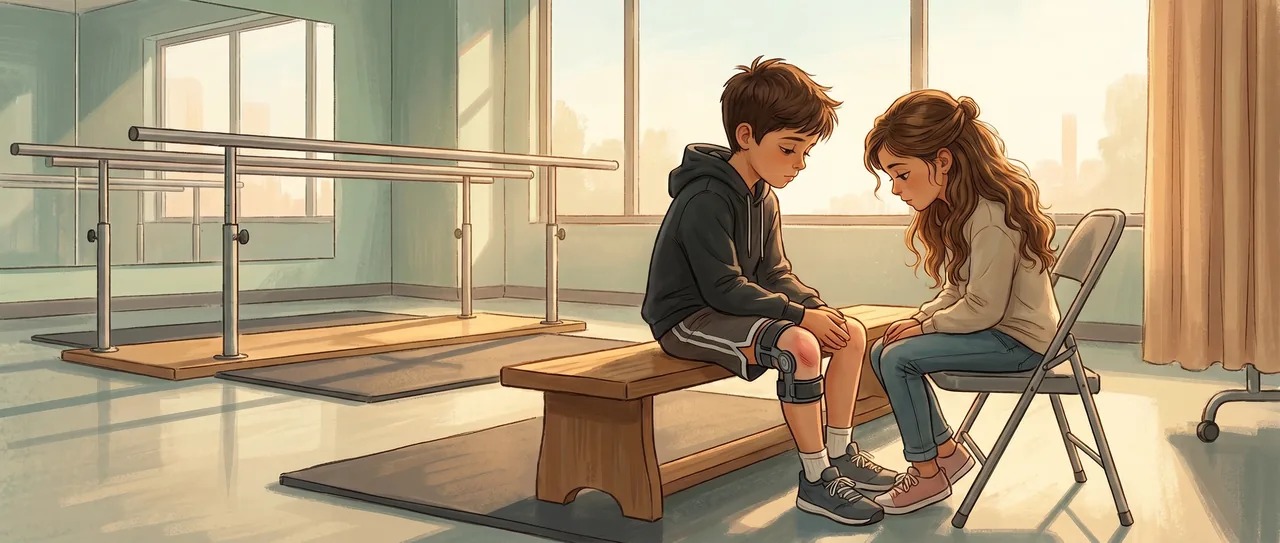
The physical therapy gym smelled like rubber mats and something antiseptic underneath that. Maya sat on a folding chair next to the parallel bars and watched Soren do his slow walk. Heel, toe, heel, toe. The therapist, a tall woman named Deb with a long braid and a clipboard full of other patients, had shown him the motion once and gone to check on someone else across the room.
Soren was being careful. That was the thing about Soren. He had fallen off his bike three weeks ago, done something to his left knee that the doctor called a partial cartilage tear, and now he walked like he was defusing something.
Maya waited until he reached the far end of the bars and turned around.
"Does it hurt?" she asked.
"Only when I stop thinking about it," he said.
She had googled his injury the same night he'd called to tell her about it, because that was what she did. She had not expected to fall down a strange hole for two hours.
"Can I tell you something weird about your knee?" she said.
"Yes," he said, without hesitation, which was one of the things she liked about him.
"There are no blood vessels in it."
He stopped. He looked down at his knee, then back at her.
"In the cartilage," she said. "The part you tore. No blood supply. None."
"That can't be right," he said, but the way he said it was not dismissal. It was the beginning of thinking about it.
"That's what heals things," Maya said. "Blood. White cells, nutrients, all of it. It goes to a cut and closes it. But cartilage doesn't have that. It just sits there, getting fed by the fluid around it."
Soren took the last few steps to the end of the bars and stood there, holding the rail loosely with both hands.
"So it soaks it up," he said.
"Like a sponge. Except really slowly."
"How slowly?"
"Months. Sometimes it doesn't really heal. Not all the way."
He was quiet for a moment. She could see him doing the thing he did, which was to take an idea and walk around it from different sides.
"So the rest of my knee has blood vessels," he said. "All the muscle, the bone. Just not that part."
"Just not that part."
"Why?"
Maya opened her mouth and closed it again. She had spent two hours reading and she did not have a satisfying answer. "Something about how it works. It has to be smooth and slippery and if there were vessels running through it they'd get compressed every time you bent your knee."
"Okay," Soren said slowly. "That makes sense. But then," and he paused, "it chose to be bad at healing."
Maya sat up straighter.
"It chose to be good at something else," she said.
"Right. And the price of that is this." He gestured at his knee, at the slow walk, at Deb's clipboard somewhere across the room.
Deb came back then, glanced at Soren standing at the end of the bars instead of walking, and said, "Two more lengths, please," without breaking stride, already moving on to write something down.
Soren started back. Heel, toe, heel, toe.
"The doctor told my mom," he said, talking to her while he walked, which he was apparently allowed to do, "that I have to be careful with this knee for the rest of my life. That if I damage it again when I'm older it might not recover at all."
"I read that too," Maya said. "People hurt their knee cartilage young and then when they're forty or fifty it's just," she searched for the word, "worn."
"Because it never fully fixed itself."
"Because it can't. Not like other things."
Soren reached her end of the bars again. He did not turn around right away.
"So there's this part of me," he said, and he was looking at his knee again, "that has been quietly broken since three weeks ago. And my body can't really see it. Can't send anything to it."
"It's trying," Maya said. "The fluid. It's just slow."
"It doesn't know it's slow," he said. "It's doing the only thing it knows how to do."
Maya looked at his knee too, at the slight swelling still visible above the brace. She thought about the cartilage under there, smooth and white and dense, no vessels running through it, waiting for molecules to drift through the synovial fluid, carrying small amounts of oxygen and nutrients one slow migration at a time. Doing the work without any of the infrastructure that the rest of the body took for granted.
"You know what's strange," she said.
"What."
"It's in every knee. Every person who ever lived. This incredibly complicated joint that can bend and pivot and absorb your whole weight, and in the middle of it there's this part that works completely differently from everything around it. And we've had knees for millions of years and it's always been this way."
Soren turned around and started his second length.
"Something that good at one thing," he said, "and that bad at the other."
"Yeah."
"I want to know why it ended up that way. Like, what happened."
"I don't think anyone completely knows," Maya said.
He walked the whole second length without either of them speaking. At the far end he turned around and came back, slower now, his knee doing its careful work.
Deb crossed the room, checked something on her clipboard, and said, "Good," meaning he was done.
Soren unclipped the brace from his leg and sat down on the bench beside Maya. He put his hand on his knee. Not rubbing it. Just resting it there.
He sat like that, hand on the quiet place, while the gym carried on around them.
Read the interactive version, listen to the narration, and earn a gold star →
A science-verified short story for curious kids · Curiosity Land