The Lake That Forgot What It Was
The water was the wrong color.
Maya noticed it the way she noticed most things, which was before she could explain it. She was standing at the end of the dock, the morning still cold enough that her breath showed, and the lake was greenish where it should have been dark. Not everywhere. Just near the shallows by the old boat ramp.
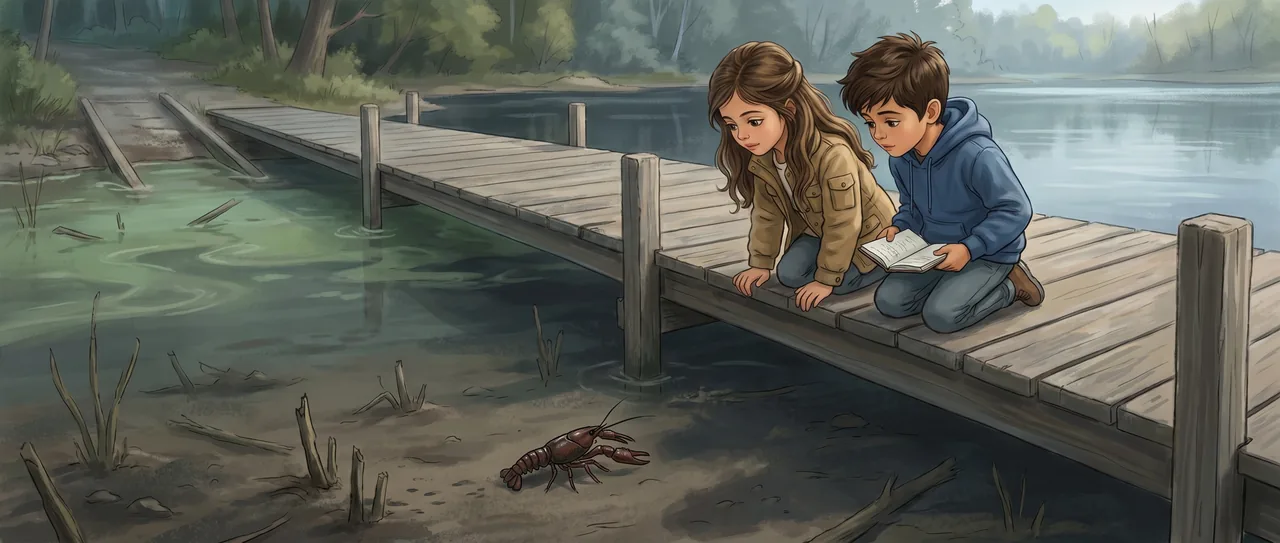
Soren was already on his knees at the edge of the dock, peering down. He had been watching a crayfish for eleven minutes. Maya knew because she had counted, waiting for him to finish.
"There's something wrong with the shallow end," she said.
He looked up, then over at the boat ramp. He didn't say anything. He put a small mark in his notebook and walked with her toward it.
The shallows were almost empty. That was the thing. A glacial lake in July should have been crowded with life in the shallows: water plants, small perch, the darting shapes of juvenile fish using the weed cover to hide from bigger fish. Maya had read the baseline survey that Dr. Vance had left in the equipment shed. This lake had seventeen native aquatic plant species three years ago. She had been counting since they arrived yesterday. She was at four.
"Where are the plants," she said. It wasn't really a question.
Soren crouched and put his hand in the water. He pulled it out almost immediately and rubbed his fingers together. "Silty," he said. "Way silty. The bottom feels soft. Like it's been disturbed."
"Churned," Maya said.
"Repeatedly."
They looked at each other.
Soren went back for the dip nets. Maya walked the perimeter of the shallows, staying on the bank, watching the bottom where the water was clear enough to see. She found two rusty crayfish in the first ten meters. Then five more. Then she stopped counting and started looking for the ones she wasn't seeing, which were native crayfish, and there weren't any.
Dr. Vance arrived at half past nine, late, distracted, already on her phone. She was a real field ecologist, which in practice meant she was always dealing with something that wasn't the thing in front of her. She waved at them and went directly to the water quality sensors.
"Dr. Vance," Soren said. "We found something in the shallows."
"Write it in the log," she said, not looking up.
"We think the rusty crayfish population is very large," Maya said. "We think they've eaten most of the aquatic plants."
Dr. Vance looked up then. "Show me what you've got."
They showed her the count. Fourteen rusty crayfish in forty minutes of observation along sixty meters of shoreline. No native crayfish. Four plant species where the baseline said seventeen.
Dr. Vance was quiet for a moment. Not the quiet of a person who is about to explain something. The quiet of a person doing arithmetic that isn't coming out right.
"The last survey was eight months ago," she said. "There were some rusty crayfish, but the native population was holding."
"What changed in eight months," Maya said.
"That's the question."
But that wasn't actually the question Maya was holding. The question Maya was holding was stranger than that. She went back to the dock and sat with it.
Rusty crayfish were from the Ohio River basin. They had ended up in Minnesota in the nineteen sixties, most likely dropped as fishing bait by someone who didn't know or didn't think it mattered. They ate aquatic plants. Native crayfish ate aquatic plants too, but within a system that had worked out a balance over thousands of years. The plants had chemical defenses that native crayfish respected, mostly, enough. The fish knew how to eat the native crayfish at the right rate. Everything had friction against everything else.
The rusty crayfish had none of that friction. The plants' defenses did nothing to them. The fish didn't recognize them as prey in the same way, not at first, maybe not ever, because the fish had never needed to learn it. The whole lake was a room full of locks and the rusty crayfish was a key that opened all of them, and the locks had never needed to be stronger because nothing like this key had ever existed here before.
Soren sat down next to her. He had his notebook open. He had been writing things down and then crossing them out.
"It's not that they're tougher," he said.
"No."
"It's that everything here evolved against something else."
"Against each other," Maya said. "For thousands of years. Against each other specifically. And then something shows up that wasn't part of that."
Soren looked at his crossed-out notes. "So the defenses aren't weak. They're just aimed wrong."
The greenish color of the water near the boat ramp made sense now. Without the plants filtering it, the sediment was drifting free. Without the plants, the juvenile fish had no cover. Without the juvenile fish, the adults would move. Without the adults, the insects would bloom. The whole thing was a set of arrangements that had taken an unimaginable amount of time to reach, and it was coming undone not because anything had gotten worse at its job, but because something new was here that the arrangements had never accounted for.
Maya thought about the baseline survey. Seventeen plant species. She thought about what the lake had been doing for the last ten thousand years since the glacier left, building that number, species by patient species.
She thought: what else is there, in other places, that has no friction against what's coming for it? Not because it's weak. Because it evolved in a world where what's coming didn't exist yet.
She didn't say this out loud. Some thoughts were too large to say out loud immediately. She needed to carry them a while.
Dr. Vance called from the equipment shed that she needed help pulling the additional survey traps. Soren got up and went. Maya stayed one more moment.
Below the dock, in the shadow, a rusty crayfish moved across the bare sediment where a plant bed had been. It moved without hesitation, without looking up, through a place that had never learned to stop it.
Maya watched it until it disappeared under the dock.
Read the interactive version, listen to the narration, and earn a gold star →
A science-verified short story for curious kids · Curiosity Land