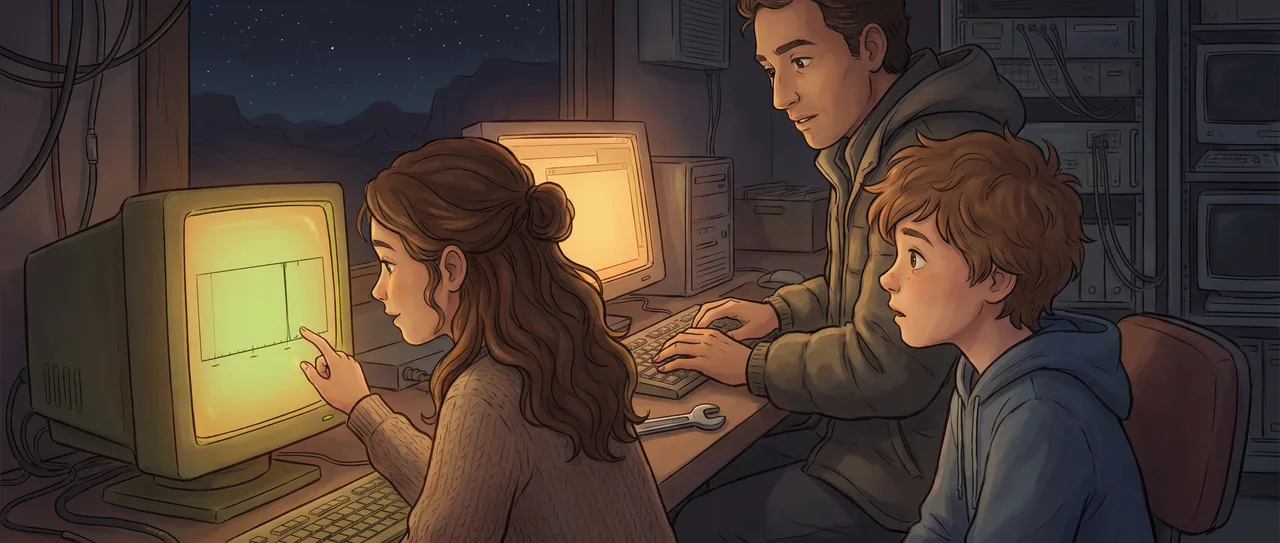
The First Fire
The astronomer had been gone for forty minutes.
Soren didn't mind. The data room was warm and smelled like old carpet and electronics, and Dr. Reyes had left her spectral analysis software open on the second monitor before she ran out with her wrench and her flashlight and her very specific frustration with the cooling pump. Soren was not supposed to touch the second monitor. He was definitely not touching it. He was sitting approximately four inches from it, reading everything on the screen.
Maya was pacing.
She had been pacing since minute three. The observatory sat at nine thousand feet and the windows showed nothing but stars and the faint orange glow of a city two hundred miles away, and something about all that darkness was making her walk in short rectangles between the door and the equipment rack.
"Stop looking at her computer," Maya said.
"I'm not touching it," Soren said.
"You're memorizing it."
"I'm reading a spectrum." He pointed without touching. "That jagged line. That's what a star looks like from the inside. Every element absorbs a different wavelength of light, so when the light comes through, there are gaps. Little dark lines. Each one is an element. Iron. Calcium. Carbon."
Maya stopped pacing. She looked at the screen.
"Those marks are what the star is made of?"
"The dark ones. Where the light went missing."
She was quiet for a moment. Then: "So a star with no marks would be -- "
"Just hydrogen. Maybe helium." Soren looked at her. "Which basically doesn't exist anymore. Every star we can see has been polluted."
"Polluted."
"By older stars. By everything that exploded before them." He turned back to the screen. "The sun has iron in it. Carbon. Oxygen. None of that was in the universe when it started. Somebody made it."
Maya pulled a chair over and sat down.
Soren had read about Population III stars three weeks ago in a paper he wasn't entirely sure he was old enough to understand. He understood the shape of it. The universe had started with almost nothing: hydrogen, helium, a little lithium. No carbon. No oxygen. No iron. No calcium. The stuff that made planets and oceans and bones hadn't been invented yet. Then the first stars formed from those bare ingredients, and they had no trace elements to slow their collapse, so they grew enormous, a hundred times the mass of the sun, and they burned so fast, so catastrophically fast, that they were gone in a million years. Which sounds like a long time. The sun has been burning for four billion years. A million years is nothing. A million years is a Wednesday.
And when they died, they exploded, and the explosion made everything heavier. Carbon. Oxygen. Nitrogen. Iron. All of it flung into space. The second generation of stars formed in that debris and they were different. Smaller. Longer-lived. They could make planets. The elements were there now.
Every atom of carbon in every living thing on Earth had been cooked in a star that no longer existed, from a star before that which had never been anything but hydrogen, burning itself to nothing in a million years so that eventually, billions of years later, there would be enough material for a planet and a ocean and something that could wonder about it.
Soren had not said any of this out loud yet. He was still deciding how.
"So no one has ever seen one," Maya said. She had followed his thinking without him finishing it, which she did sometimes and which he had mostly stopped being surprised by. "A first star. A clean one."
"They're all gone. They died before the sun was born. Before Earth was born. Before there was anything to be born on." He paused. "Some telescopes might be seeing the light from them. Light that left before any of this existed. But we haven't confirmed one yet."
"But we will."
"Probably. The Webb telescope is looking."
Maya was quiet in a different way now. Not restless. Absorbed.
"They never had planets," she said.
"Couldn't. No iron. No silicon. No rock. Just gas."
"So they burned for a million years and there was nothing watching."
Soren had not thought of it that way. He sat with it.
"Nothing could watch," he said. "The stuff that makes eyes hadn't been made yet."
"They made it, though. Those stars." Maya leaned closer to the spectrum on the screen, the dark lines that meant something was present, something had absorbed the light. "All this," she said, and she wasn't pointing at the screen anymore, she was gesturing at herself, at the room, at the window and the dark beyond it. "All this is left over from something that burned out a billion years before the sun turned on. And it never got to know that it did this."
Soren looked at her.
He thought about the spectrum. Every dark line a gap where something had swallowed the light. Every gap a record of what was there. The sun's light carried the signature of all the deaths that had made it.
"We know," he said.
Maya turned and looked at him directly.
Neither of them said anything else for a while.
The door opened and Dr. Reyes came back in, smelling like cold air and machine oil, still holding the wrench. She looked at them both sitting in front of her monitor and opened her mouth to say something sharp.
"The spectrum," Maya said, before she could. "The dark lines. Can you show us one with fewer of them? The oldest star you have?"
Dr. Reyes looked at Maya, then at Soren, then at the screen. Whatever she had been about to say, she set it down.
She pulled up a chair, sat between them, and started typing.
The spectrum that appeared was nearly clean. A few thin marks. Almost nothing missing. Almost nothing there.
Maya pressed one finger to the glass of the monitor, not touching the lines, just close, the way you might hold your hand near a flame to feel whether it was real.
Read the interactive version, listen to the narration, and earn a gold star →
A science-verified short story for curious kids · Curiosity Land