The Element That Eats Everything
The card on the display case said: Henri Moissan, 1886, Nobel Prize.
Soren read it twice. The case held a small glass tube, sealed at both ends, mounted on velvet like a jewel. Nothing inside it that he could see. Just a tube.
"Why is an empty tube in a museum?" he asked.
Maya was already at the next case. "It's not empty," she said, not looking up. "Come see this."
The next case held a photograph. A man in a laboratory, the kind from old pictures, standing at a bench covered in equipment Soren didn't recognize. The man's hands were wrapped in bandages up to the elbows.
The card beneath it said: George Gore, 1869. Attempted isolation. Laboratory explosion.
"Attempted isolation of what?" Soren said.
"Fluorine," said Maya.
Soren looked at the photograph again. Then at the next case, which held more photographs, more bandaged hands, more cards with dates and the word attempted. Paulin Louyet, 1869. Jerome Nickles, 1869. Humphry Davy. The cards were careful not to say what had happened to some of them.
"They all tried to get it out of its compounds," Maya said. "Separate it. Pure. And it kept..."
She didn't finish. The photographs finished it.
Soren pulled out his notebook, then thought better of it. The room felt wrong for taking notes. He put it back.
The museum was nearly empty. A school group had come through an hour earlier, herded fast past the more interesting cases by a teacher who kept saying, "keep moving, keep moving." Now it was just Soren and Maya and a security guard by the door who was reading something on his phone.
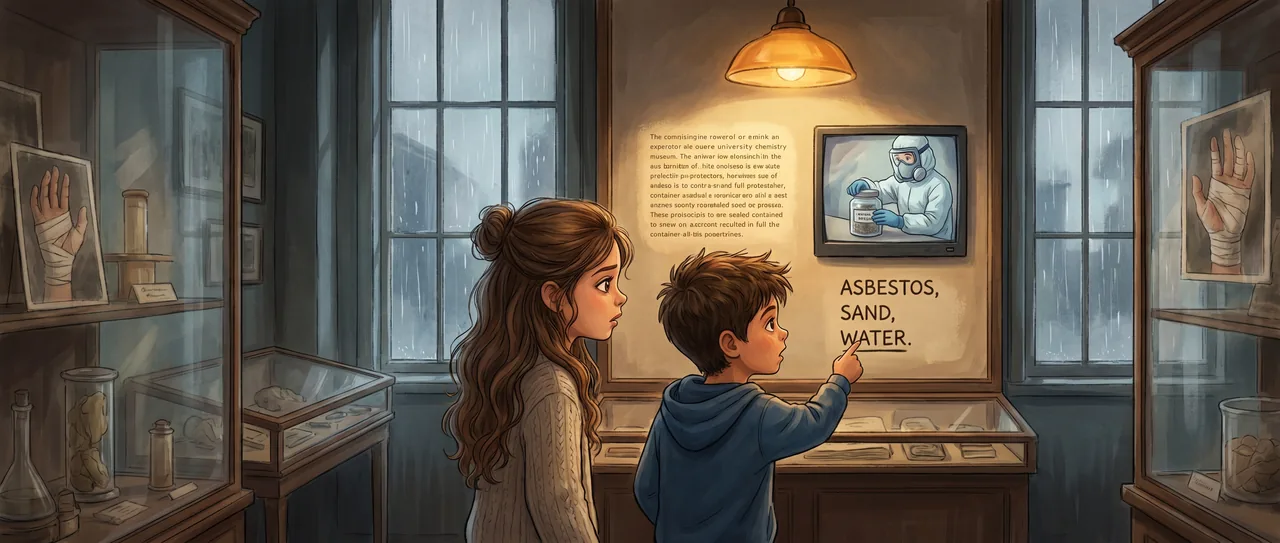
Maya stopped at a case near the back wall. This one had actual text, a full paragraph under glass, and Soren came to stand beside her.
The paragraph explained that fluorine was the most reactive element on the periodic table. That it wanted electrons the way nothing else wanted anything. That when early chemists finally isolated it and let it touch the open air, it attacked the air itself. That it would ignite materials that burned in nothing else.
The list was what stopped Soren.
Asbestos. Fireproof.
Sand. A rock.
Water.
"That's wrong," he said.
"Which part?"
"Water. Water doesn't burn. Water is what you use to stop burning. That's the definition of what water does."
"The card says fluorine ignites it," Maya said.
"The card is wrong."
Maya tilted her head and looked at him the way she looked at things that didn't fit yet. Not arguing. Waiting.
"Water is two hydrogens and an oxygen," Soren said slowly. "Fluorine reacts with the hydrogen. Pulls it away. And when it does that, heat comes out. Enough heat to..."
He stopped.
"To make the oxygen," Maya said, "available."
They both looked at the case.
What Soren had understood in his chest was this: water was not a thing. Water was a temporary arrangement. Two atoms that happened to be holding onto each other, and if something came along that wanted one of them badly enough, the arrangement was over, and what was left was just oxygen, loose, and heat already happening, and that was fire. Water burning was not magic. It was just a stronger want.
He did not say any of this aloud.
"Sand too," Maya said. Her voice was quiet. "Sand is silicon and oxygen. So fluorine takes the silicon and the oxygen goes free and --"
"Everything we call fireproof," Soren said, "is only fireproof against things weaker than fluorine."
The case at the back had a short film playing on a small screen, a loop, no sound. It showed a laboratory experiment from what looked like the nineteen-eighties. A researcher in full protective gear was handling a sealed container. The gear was not like anything Soren had seen in a school lab. It covered everything, and whoever was wearing it moved slowly, deliberately, the way you moved when you understood that a mistake was not recoverable.
Maya watched the film run through twice. "All those early people," she said. "They didn't know what they were working with."
"They knew it was dangerous," Soren said. "The injuries told them that."
"But they didn't know why. So they couldn't know how to be safe. They were just trying to see it. Just trying to find out if it was real."
The man in the film set down the container. His hands in the heavy gloves were steady.
Soren thought about the empty-looking tube in the first case. Moissan, 1886, Nobel Prize. A man who spent years solving a problem that had blinded and burned and killed people before him, who solved it by learning what the thing actually was instead of guessing, who built the handling method out of the understanding. The tube didn't look like a prize. It looked like the end of something very long and very hard.
"The card on that first case," Maya said. "The empty tube. What do you think is actually in it?"
"Fluorine compounds, probably. Something stable," Soren said. "You can make it stable if you know what you're doing."
"So it's not that it's impossible to handle. It's that it took people getting hurt before anyone understood it well enough."
"A lot of people," Soren said.
Maya looked at the film again, at the researcher moving slowly inside all that protective gear, and then back at the photographs of bandaged hands.
"Do you think there's something like that now?" she said. "Something people are working on, getting hurt by, that no one understands yet?"
Soren didn't answer right away. He thought about it the way he thought about things he wanted to get right.
"Yes," he said.
Maya nodded once, and then she walked back to the first display case and stood in front of the empty-looking tube for a long time, her breath making the faintest fog against the glass.
Read the interactive version, listen to the narration, and earn a gold star →
A science-verified short story for curious kids · Curiosity Land