The Cell That Said If
The bacteria were supposed to glow green.
That was the whole point. Dr. Osei had explained it three times on the drive over, her eyes on her phone the entire time, one earbud in, one earbud dangling. The cells had been engineered with a genetic circuit, she said. Two signals go in, one response comes out. Like a switch, but made of DNA. If the right chemicals were both present, the circuit would switch on and the cells would fluoresce. Green. Bright, obvious green.
"They've been doing it reliably for six weeks," she said, swiping at something on her screen. "You can watch the plates under UV while I finish this grant section. Don't touch the centrifuge."
She disappeared behind a wall of monitors.
Maya looked at the plates.
The plates looked back.
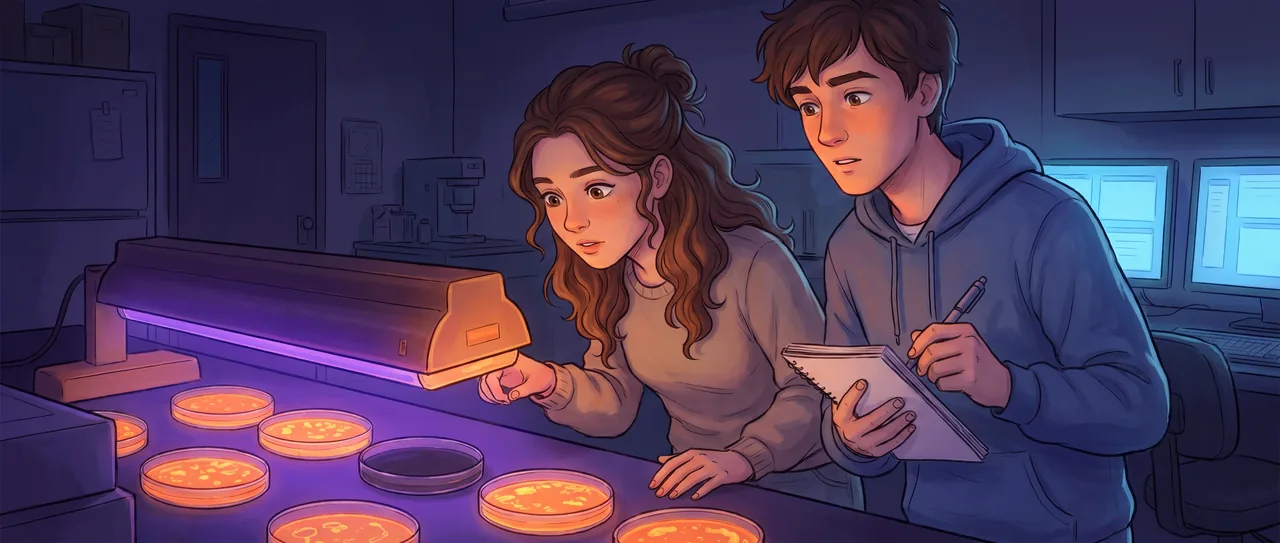
They were glowing, but not green.
Orange.
"Soren," she said.
He was already looking.
The plates sat in a row under the UV lamp, each one a thin layer of gel containing millions of bacterial cells too small to see individually. Plate one: orange. Plate two: orange. Plate three: faint orange, almost yellow. Plate four: nothing. Plate five: orange again.
Soren pulled out his notebook, uncapped his pen, and wrote down the colors in order. He did this before he said anything, because he had learned that if he didn't write things down immediately, he started arguing with his own memory.
"She said green," he said.
"She said green," Maya agreed.
"These are not green."
"No."
Maya leaned closer to plate three. The orange was fainter there. Not orange-orange. More like something that couldn't quite decide. She moved to plate four, which showed nothing, and back to plate five, which was the brightest of all.
"What's different about four," she said. Not a question. The beginning of a thought.
Soren looked at his list. Looked at the plates. Then at the small handwritten labels on each dish. He had to tilt his head to read Dr. Osei's script.
"Four got both signals," he said. "The other ones only got one."
"She said both signals was the thing that turned it on."
"She did say that. But four is dark and the others are lit."
Maya stood very still. This was something Soren had noticed about her: she went quiet when something didn't fit, like she was holding the wrong piece of a puzzle and turning it over to find the edge that matched.
"So the circuit is working," she said slowly. "It's just working backwards from what she expected."
"Or," Soren said, and then stopped.
"Or."
"Or it's not backwards. Or it's a different circuit."
Maya looked at him. "What do you mean."
"She said it was like a switch made of DNA. But you can make different kinds of switches. There are AND gates and OR gates." He wrote both terms down, then looked up. "She described an AND gate. Both signals in, response out. But what if this is."
"A NOT gate," Maya said.
Soren blinked. "I was going to say OR."
"No, look. Four is dark. Four has both signals. The ones that are lit only have one signal or the other, not both. It's glowing when it shouldn't be and dark when it should be lit." She pointed at plate four without touching the glass. "It's like the two signals together are telling it to stop."
Soren wrote: AND but inverted? NAND? He stared at what he'd written. He had read about logic gates once, in a book about computers. The idea that the same set of rules could run on silicon or on cells had seemed like a cool coincidence at the time. Sitting here now, it didn't feel like a coincidence at all. It felt like a law. A deep one.
"If that's true," he said, "then something in the circuit changed. Flipped. A promoter, or a repressor, or something in the sequence that tells the gene when to turn on."
"Or it was always this way and no one noticed."
"She said it's been green for six weeks."
"She said it's been glowing for six weeks. She said green. But what if she assumed green because that's what it was designed to do." Maya paused. "What color is a green fluorescent protein gene when you put it next to an orange one?"
Soren stared at her. "I don't know."
"Neither do I. That's the thing."
He wrote that down too. Not because he needed to remember it. Because it deserved to be written somewhere.
They stood there for a while, not talking. The UV lamp hummed. Somewhere behind the monitors, Dr. Osei's keyboard clicked in long focused bursts.
Maya said, "The cells didn't make a mistake."
"No," Soren agreed. "They did exactly what their circuit told them."
"So somewhere between the design and the result, something is different from what anyone expected. And the cells just. Faithfully. Did the computation. Whatever the computation actually was."
Soren thought about that. A cell no bigger than a speck of dust, running logic. Not thinking. Not choosing. Just executing a program written in the language of molecules, a program that had been running since before anything in this room existed, since before computers existed, since before anyone knew what a circuit was.
And somewhere in these plates, a circuit had been built by human hands inside living cells, and the cells were running it now, faithfully, doing something no one had planned.
"We should tell her," Soren said.
"Yeah."
Neither of them moved immediately.
Maya was staring at plate four, the dark one, the one where both signals had arrived and the cell had computed its answer and produced silence. She was thinking about the list in her head, the running list of things that didn't make sense yet. This would go on it. Even after they told Dr. Osei. Even if Dr. Osei explained everything perfectly and it all made complete sense by the time they drove home.
Because there was still something under the explanation. Something about the fact that a living thing could be built to think in logic. And the logic could surprise you. And the cell would never know.
She reached out and touched the edge of the UV lamp's housing with one finger, not the plate, just the warm plastic frame, while plate four sat dark in the light and plate five burned orange beside it.
Read the interactive version, listen to the narration, and earn a gold star →
A science-verified short story for curious kids · Curiosity Land