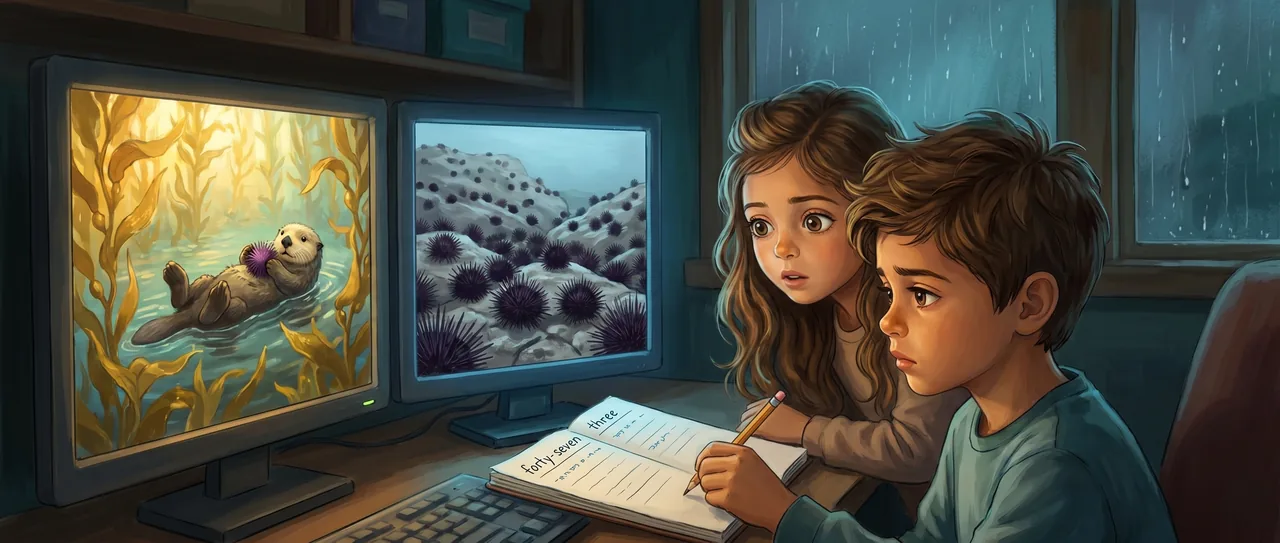
The Urchin Barrens
The argument started over a sea urchin.
Not a real one. A purple smudge on Monitor Four, timestamped three days ago, filmed by a remote camera anchored to the seafloor somewhere off Amchitka Island. Soren had been cataloging the footage frame by frame since Tuesday, marking every organism he could identify. Maya had been doing the same thing on Monitor Two, which showed a different stretch of ocean floor six kilometers away.
Soren's screen looked like a parking lot. Gray rock. More gray rock. A carpet of purple-black sea urchins covering every surface, their spines shifting like a slow ugly crowd. No kelp. No fish. Nothing tall enough to cast a shadow.
"Yours is dead," Maya said, not looking up from her own screen.
"It's not dead. There are thousands of urchins."
"That's what I mean."
Her screen was different. Her screen was a forest. Giant kelp rose in golden-brown columns from the rocks, swaying with the current, their fronds so thick that the sunlight above filtered through them like stained glass. Between the stalks: rockfish, lingcod, snails trailing silver paths, a sea star the color of a bruised peach. She had counted forty-seven species so far and she was only eleven minutes into the footage.
Soren looked at his own screen again. Urchins. Rock. Urchins.
"I've counted three species total," he said.
Dr. Vasquez came through with a mug of coffee and a phone pressed between her shoulder and her ear, talking to someone about a grant deadline. She glanced at their monitors without stopping. "Six kilometers apart," she said to them, hand over the phone. "Same depth. Same water temperature. Same ocean." Then she was gone down the hall.
Same ocean.
Soren wrote it down. He underlined it twice, which he almost never did.
"What's different then," Maya said. It wasn't a question. It was the thing she was about to figure out.
Soren scrubbed backward through his footage. Four hours of urchin barrens. Nothing changed. The urchins ate and moved and ate. He could see the marks their mouths left on the rock, tiny white scrapes where they had chewed away every trace of anything that had tried to grow.
"Go back further on yours," he said.
Maya scrolled. Her kelp forest swayed. A harbor seal twisted through the canopy like a corkscrew, hunting something. And then, at timestamp seven minutes forty-two seconds, a shape drifted into frame that made her sit up straighter.
A sea otter. On its back, turning something in its paws. It dove, disappeared, and came back with a sea urchin. It cracked the urchin against a rock balanced on its chest. Ate. Dove again.
"Soren."
"I see it."
"Do you have any?"
He already knew the answer. He had watched four hours of footage from his site. Not one otter.
Maya pulled up the station's species log on the shared computer. The historical surveys went back decades. She scrolled to Soren's site. Sea otters had been recorded there until nineteen-ninety-one. After that, nothing. The population had crashed.
"Look at this," Soren said. He had opened the kelp coverage data. At his site, kelp had declined steadily starting in nineteen-ninety-two. By two thousand and three, it was gone. And with it: the rockfish, the lingcod, the harbor seals, the bald eagles that fed on fish near the surface. The whole list just stopped.
"One animal," Maya said.
"One animal."
She pulled her chair over to his monitor. They sat together in front of the urchin barrens.
"It's like dominoes," Soren said, then shook his head. "No. Dominoes is the wrong word. Dominoes fall in a line. This fell in every direction at once."
"The otters ate the urchins," Maya said, talking the way she did when she was fitting pieces together, each sentence short and sure. "The urchins couldn't eat the kelp. So the kelp grew. And the kelp was the whole world."
"For everything."
"For everything. And then the otters disappeared and the urchins ate the world."
Soren was quiet for a long time. He rewound his footage to the beginning and watched the urchins crawl across bare rock. He thought about how many animals weren't in the frame. Not missing the way a missing sock is missing. Missing the way a language goes missing. The whole structure of the place had been unmade.
"Dr. Vasquez said same ocean," he said.
"She did."
"Six kilometers. That's nothing. That's how far I bike to school."
Maya nodded slowly.
"So your site has otters and it's a forest. My site lost its otters and it's a parking lot. Same water. Same rocks. Same everything else. Except one species."
He opened his notebook and drew two columns. In one he wrote every species Maya had counted. Forty-seven and climbing. In the other he wrote his own count. Three.
Forty-seven to three. Because of one animal.
Maya was already pulling up something else on the shared computer. Maps. Other sites around the Aleutians. Some had otters. Some had lost them. She toggled between the kelp coverage layers and the otter survey layers, and the match was so exact it looked like the same map drawn twice.
"Every single time," she said.
"Every single time."
Soren stared at the two columns in his notebook. He thought about what it meant for one species to hold hundreds of others in place. Not by being the biggest or the strongest. The sea otter was not particularly big. It just happened to eat the thing that ate everything else. Remove it and the whole structure came apart, not slowly, not gracefully, but completely, like pulling one card from the bottom of a house of cards.
Except this wasn't cards. This was real ocean floor that he was looking at right now.
"What else is like this," Maya said, turning to him. Her voice had changed. It was quieter, and wider somehow, as if the question had gotten bigger while she was asking it. "What else is like this that we don't know about yet? What if there are species like that everywhere, in every ecosystem, and we don't know which ones they are until they're gone?"
Soren did not answer, because he did not have an answer, and Maya did not need one. She was already looking past him, past the monitors, past the rain on the station windows, at something he could feel too. The size of the question.
He turned back to his screen. The urchins moved across the bare rock in their slow, grinding thousands, and the water above them was empty all the way to the light.
Read the interactive version, listen to the narration, and earn a gold star →
A science-verified short story for curious kids · Curiosity Land