The Tilt
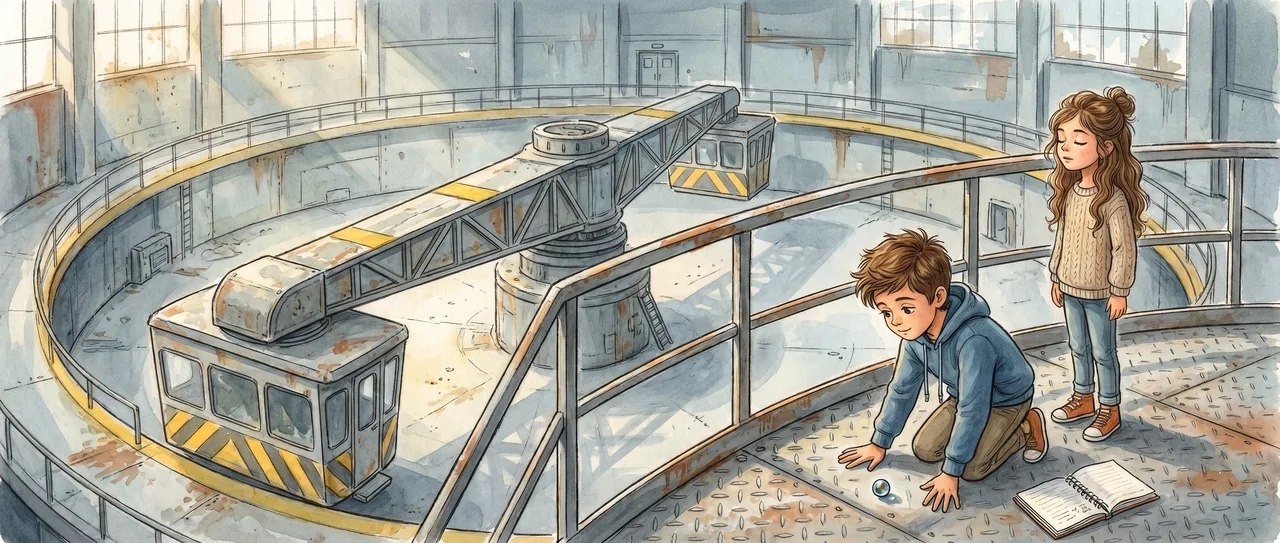
The centrifuge hadn't spun in eleven years, but Soren could feel it.
Not the machine. Something else. He was standing perfectly still on the observation platform above the circular track, and the floor was not moving, and he knew it was not moving, but something in his head insisted otherwise.
"Maya."
She was across the room, reading the placards on the wall. Old ones, yellowed, from when astronaut candidates actually trained here.
"Maya, come stand right here."
She walked over, her sneakers squeaking on the polished floor. She stood where he pointed.
"Feel anything?" he asked.
"Like what?"
"Like tilting."
Maya was quiet for three seconds. Then four. "The floor is level."
"I know."
"But yes," she said.
Dr. Keane, their program leader, was downstairs arguing with someone on her phone about a budget line. They could hear her voice bouncing off the curved walls, sharp and irritated. She had spent exactly four minutes showing them the centrifuge room before her phone buzzed and she waved them off with a distracted "look around, don't touch the gondola."
Soren opened his notebook. He wrote: Platform 2, northwest quadrant. Sensation of tilt, leftward. Duration, ongoing. He looked at Maya. "Which direction?"
"Left," she said immediately.
Same direction. He wrote that down too.
"Move three steps to your right," he said.
Maya moved.
"Still?"
"Gone." She stepped back. "There again."
Soren pulled a marble from his pocket. He carried marbles the way some kids carry gum. He set it on the metal floor. It didn't roll.
"Floor's flat," he confirmed.
"So it's us," Maya said.
Soren crouched and looked at the platform surface. Smooth steel with a diamond-plate pattern. Below them, the centrifuge arm stretched out like the spoke of an enormous wheel, ending in the gondola where trainees once sat while the machine spun them at forces strong enough to press their organs backward.
Maya was already moving. She walked the perimeter of the platform, stopping every few steps. "Here," she said near the east side. "Tilt again. But forward this time."
Soren followed her. She was right. A slight, insistent pull forward, as if the floor were angled two or three degrees. Except it wasn't. The marble proved it twice.
"There's a placard over here about the inner ear," Maya said, pointing at the wall she'd been reading before.
They walked over together. The diagram showed a cross-section of the human ear, but deeper than Soren expected. Past the eardrum, past the cochlea, there were three tiny loops, like half-finished roller coasters, and two small chambers beneath them.
The text read: THE VESTIBULAR SYSTEM. Three semicircular canals detect rotation in three planes. The utricle and saccule detect linear acceleration and head position relative to gravity using tiny calcium carbonate crystals called otoliths resting on hair cells. This system is sensitive enough to detect accelerations as small as one tenth of standard gravity.
One tenth of gravity. Soren read it again.
"That's incredibly small," he said. "That's like, the acceleration of a slow elevator."
"Slower," Maya said. "Way slower."
Soren looked back at the spot on the platform where they'd both felt the tilt. "What if there's something under the floor? Something with mass?"
Maya shook her head. "Gravity doesn't work that way. You'd need a mountain underneath us to feel anything, and even then our inner ear wouldn't detect that separately from regular gravity."
She was right. He crossed it out.
"But our vestibular system thought something was happening," he said. "Both of ours. Same direction."
Maya walked back to the spot. She stood there, eyes closed. Soren watched her face.
"There's a vibration," she said.
"I don't feel a vibration."
"Not in your feet. In the floor. Put your hand on it."
Soren knelt and pressed his palm flat against the diamond plate. She was right. The faintest tremor, so slight his fingers almost couldn't find it. But his palm could.
"The building's HVAC," Maya said. "Or some machine running somewhere below. It's putting a vibration through the platform. Low frequency. Really low."
Soren stood up and walked to the spot where the sensation vanished. Knelt again. His palm felt nothing.
"The vibration's only in certain spots," he said. "Resonance nodes. The platform is a big metal sheet. It vibrates in patterns."
"And the vibration is asymmetric," Maya said, her voice getting faster. "Not straight up and down. It has a lateral component. Sideways. Just a tiny push, over and over."
"And our otoliths feel it," Soren said.
He stared at the diagram on the wall. Tiny crystals, sitting on hair cells, in a chamber no bigger than a pea, deep inside his skull. Those crystals were picking up a vibration so faint his hands could barely feel it. They were detecting an acceleration that was some fraction of a tenth of gravity, and sending that signal to his brain, and his brain was interpreting it as tilt.
Not wrongly. That was the thing. His brain was not wrong. There was a real lateral acceleration, a real sideways force, happening right where they stood. His brain had detected an invisible, mechanical heartbeat running through the building, translated it into a sensation of falling, and reported it faithfully.
"We're not broken," Maya said. "We're too precise."
Soren walked slowly around the platform again, stopping, kneeling, pressing his palm down, standing, checking his own inner ear against the floor. In some spots the two agreed. In others, his vestibular system reported motion his hands could not confirm.
Maya was doing the same thing on the far side, mapping her own skull's opinion of the floor.
"It's everywhere," she called across the room. "Once you know what to feel for, it's everywhere. The whole building is doing something and we just never had a reason to notice."
Dr. Keane's voice drifted up from below, still on the phone, still talking about budget numbers.
Soren pressed his hand to the floor one more time. The tremor was there, patient and tiny, smaller than anything he should have been able to feel. But the crystals in his skull were older than language, older than thought, and they had been counting every motion since before he was born.
Maya stood at the far edge of the platform, her head tilted slightly to one side, her eyes closed, her feet planted on steel that was perfectly level and quietly, invisibly, singing.
Read the interactive version, listen to the narration, and earn a gold star →
A science-verified short story for curious kids · Curiosity Land