The Puddle That Ate Itself
The stain was bothering Soren before anything else about the day went wrong.
His mother had signed them both up for the library rooftop volunteer day, which meant carrying boxes of supplies up four flights of stairs because the elevator was broken. She was downstairs now, talking to the project coordinator about drainage angles, which was the kind of conversation that could last forty minutes.
Soren set down his box and looked at the stain again.
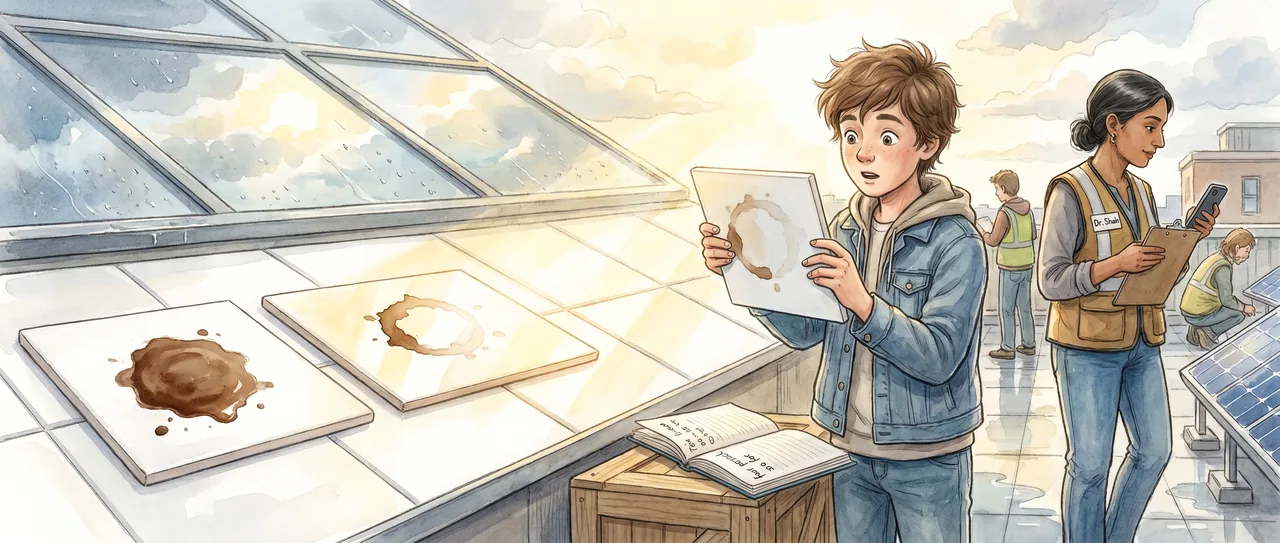
Someone had spilled coffee across one of the sample tiles laid out on the folding table. Two tiles, side by side. Same white surface. Same coffee puddle, splashed across both. But the left tile was still brown and sticky. The right tile was almost clean, just a faint ghost where the coffee had been, fading even as he watched.
He touched the right tile. Dry. He touched the left tile. Still wet and brown.
Soren pulled out his notebook and wrote: Two tiles. Same coffee. One cleaning itself. WHY.
He picked up both tiles and turned them over. The left one had a sticker on the back: CONTROL. The right one said: TiO2 COATED.
TiO2. He knew that formula. Titanium dioxide. It was in sunscreen. It was in white paint. It was in the white filling of Oreos, or at least it used to be. He wrote that down too, then crossed out the Oreo part because he wasn't sure anymore.
But titanium dioxide didn't eat coffee. It just sat there being white.
He held the coated tile up to the light. The sun was out, which in Portland in March felt like a minor miracle. The tile looked exactly like the other one. Same glaze. Same weight. Whatever the coating was, it was invisible.
Soren set both tiles on the table in full sun and watched.
The coffee on the coated tile was definitely fading faster now. Not dripping off, not evaporating. The brown color was just going away, like someone was slowly turning down the saturation on a photograph. The control tile stayed brown and disgusting.
He moved the coated tile into the shadow of the stairwell housing. Watched for two minutes. Nothing changed. Moved it back into sunlight. The fading resumed.
Light was doing it. The coating plus light.
A woman came up the stairs carrying a clipboard and a bag of zip ties. She had a name tag that said DR. PRIYA SHAH, MATERIALS ENGINEERING, and she was already talking into her phone about a delivery that was late.
Soren waited. She finished her call and started sorting zip ties by size, which seemed unnecessary.
"Excuse me," he said. "What does the TiO2 coating actually do to the coffee?"
Dr. Shah looked at the tiles, then at Soren, then at the tiles again. "It's a photocatalyst. Are you with the volunteer group?"
"Yes. What does photocatalyst mean, exactly?"
"It means the surface uses light energy to accelerate a chemical reaction without being consumed itself. The titanium dioxide absorbs UV photons, generates reactive oxygen species on its surface, and those species oxidize organic molecules. Break them apart." She said this the way someone might read a grocery list, already reaching for more zip ties. "The coffee is organic matter. It gets decomposed into carbon dioxide and water. Basically nothing."
Soren wrote fast. "The surface doesn't get used up?"
"That's what a catalyst is. It enables the reaction but doesn't participate permanently. As long as there's UV light, the surface keeps working. Indefinitely, in principle."
She went back to her zip ties. Soren went back to the tiles.
He poured water from his bottle onto the coated tile. In sunlight, the water sheeted flat across the surface instead of beading up the way it did on the control tile. He wrote that down. The coating made the surface love water. Hydrophilic. Which meant rain would wash it clean in thin sheets, carrying away whatever the UV had already broken down.
A surface that destroyed dirt and then washed itself.
But that wasn't the part that made him stop writing.
He'd read something once about splitting water. Electrolysis, where you ran current through water and got hydrogen and oxygen. Hydrogen was fuel. Real fuel, the kind that burned clean.
He walked back to Dr. Shah, who was now on the phone again. He waited. She hung up.
"Can titanium dioxide split water?" he asked.
"Under UV irradiation, yes. It was discovered in nineteen seventy-two. The Honda-Fujishima effect. TiO2 electrode, UV light, water breaks into hydrogen and oxygen." She paused. "It's not efficient enough yet for commercial fuel production. The bandgap only captures UV, which is about four percent of sunlight. People are working on shifting it to absorb visible light. Doping with nitrogen, coupling with other semiconductors. It's a whole field."
"So the same surface that cleans a window could make fuel."
"Same basic mechanism. Photon comes in, electron gets excited, chemistry happens at the surface. What chemistry depends on what's sitting on the surface." She looked at him for the first time like she was actually seeing him. "Why?"
Soren didn't answer right away. He was staring at the tile in the sun.
The coating was invisible. Thin as nothing. And it turned light into chemistry. Not heat, not electricity. Chemistry. It reached into molecules and broke them apart or rearranged them, powered by photons that were going to hit the surface anyway, whether anyone used them or not.
Every rooftop. Every window. Every road surface baking in the sun. All that light, landing on all those surfaces, doing nothing.
Unless the surfaces were listening.
He thought about four percent. Four percent of sunlight was UV. But if you could shift the response into visible light, then every surface in every city on every sunny day was a chemical reactor that didn't know it yet.
Dr. Shah's phone rang again. She walked away, already talking about the late delivery.
Soren sat on the rooftop edge and looked out across Portland. The rain had stopped an hour ago. The buildings were wet and shining. Thousands of windows caught the afternoon light and threw it back, wasted, into the sky.
He opened his notebook to the page where he'd written Two tiles. Same coffee. Below everything else, he added a single line: four percent so far.
Then he closed the notebook and watched the sun hit every window he could see.
Read the interactive version, listen to the narration, and earn a gold star →
A science-verified short story for curious kids · Curiosity Land