The Other Half
Soren had already broken two bananas.
Not on purpose. The first one he squeezed too hard while peeling it. The second one slid off the table when he reached for the ziplock bag. Both times, the college student running the station just handed him another banana without looking up from her phone.
The sign on the table read: EXTRACT REAL DNA WITH YOUR OWN HANDS. Underneath, in smaller letters: Suitable for ages 8 and up.
Soren was eleven. He did not need the smaller letters.
He mashed the third banana inside the bag, the way the laminated instructions said. Added a squirt of dish soap, a pinch of salt, warm water. Kneaded the bag until the mixture went pale and frothy. Then he strained it through cheesecloth into a plastic cup, and the liquid that dripped through was thin and yellow and did not look like it contained the instructions for building a banana.
The college student glanced over. "Now the fun part," she said. "Pour the rubbing alcohol down the side of the cup. Slowly. You want it to float on top."
Soren poured. He poured so slowly that his arm started to ache. The alcohol sat on the banana liquid like a clear lens.
"Now watch the line where they meet," she said.
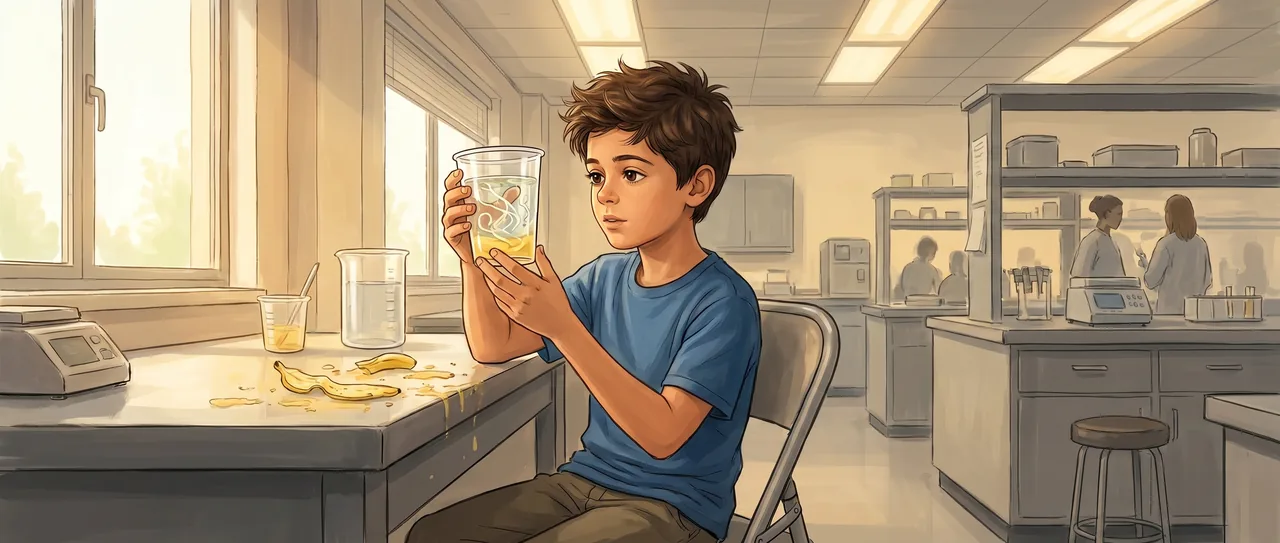
He watched. At first, nothing. Then something that looked like a white thread appeared at the boundary between the two layers. Then another. Then a clump of them, rising, drifting upward into the alcohol like slow ghosts.
"That's banana DNA," the college student said. "The real thing. You can spool it on a toothpick if you want."
Soren picked up a toothpick and twisted it into the clump. The strands wound around it, sticky and pale. He held it up and stared at it.
It looked like snot.
He wrote that down.
The college student laughed, but not in a mean way. "Everyone says that. It's actually millions of DNA strands tangled together. Each one is way too thin to see alone."
"How thin?" Soren asked.
"About two nanometers wide. You could lay fifty thousand of them side by side across a human hair."
He wrote that down too.
At the next station, a poster showed a diagram of the human genome beside a diagram of the banana genome. A big yellow fifty percent was stamped between them. A man with a beard and a lanyard stood behind the table, talking to a family of four. He was gesturing a lot.
"We share roughly half our DNA with this humble fruit," the man was saying. He held up a banana like it was a trophy. "Makes you think twice about your morning smoothie."
The family laughed. Soren didn't.
He stood to the side and read the poster while the family moved on. The poster said the shared genes were mostly for basic cell functions. Copying DNA. Building proteins. Producing energy. Repairing damage. The machinery that keeps a cell alive.
The bearded man noticed him. "Pretty wild, right? Fifty percent banana."
"But what does the fifty percent actually mean?" Soren said.
"Well, about half the genes in a banana have recognizable counterparts in humans. The sequences are similar enough that we can match them up."
"Similar how?"
The man paused. "Similar enough that they do the same jobs. The gene that tells a banana cell how to copy its DNA looks a lot like the gene that tells your cells how to copy your DNA. Because they both inherited it from the same ancestor."
Soren looked at the banana on the man's table. Then he looked at his own hand. "When?"
"When what?"
"When was the ancestor?"
The man set the banana down. "About one point five billion years ago. Give or take. Some single-celled organism in the ocean that eventually led to both plants and animals. It already had the basic toolkit. The genes for staying alive at the cellular level. Those genes worked so well that evolution kept them in almost everything that came after."
Soren opened his notebook and started writing, then stopped.
One point five billion years.
He looked at the toothpick he was still holding, the one with the banana DNA wound around it. The snot-like strands had started to dry. They looked like thin white thread now.
He thought about his own cells. Right now, inside him, his DNA was being copied. Proteins were being assembled. Energy was being made. All of it running on instructions that were one and a half billion years old. The same instructions, more or less, that were running inside the banana.
Not similar instructions. Not instructions that happened to look alike. The same ones, passed down and passed down and passed down, from one cell dividing into two, over and over, for longer than there had been anything on land. Longer than there had been eyes or bones or leaves or anything a person would recognize as alive.
The bearded man had turned to greet another family.
Soren sat down on the metal folding chair behind the extraction station. The college student had gone somewhere. The table was covered in banana residue and crumpled cheesecloth and cups of yellowish liquid with white strands floating in them, all abandoned by kids who had already moved on to the robotics table.
He picked up one of the cups. Held it at eye level. The white threads drifted in the alcohol, suspended, going nowhere.
Half of this was him. Or half of him was this. The words didn't work right in either direction, because it wasn't about the banana and it wasn't about him. It was about the thing before both of them. The thing that had figured out how to copy itself in an ocean that didn't have a name, on a planet that didn't have continents yet, under a sun that was dimmer than the one outside the window right now.
That thing was still going.
It was going inside the banana. It was going inside him. It was going inside the college student wherever she had wandered off to, and inside the bearded man, and inside the grass in the parking lot and the bacteria on the table and the yeast in the bread someone was eating in the hallway.
All of it still running the same old code.
Soren held the cup steady. The white threads turned slowly in the light
Read the interactive version, listen to the narration, and earn a gold star →
A science-verified short story for curious kids · Curiosity Land