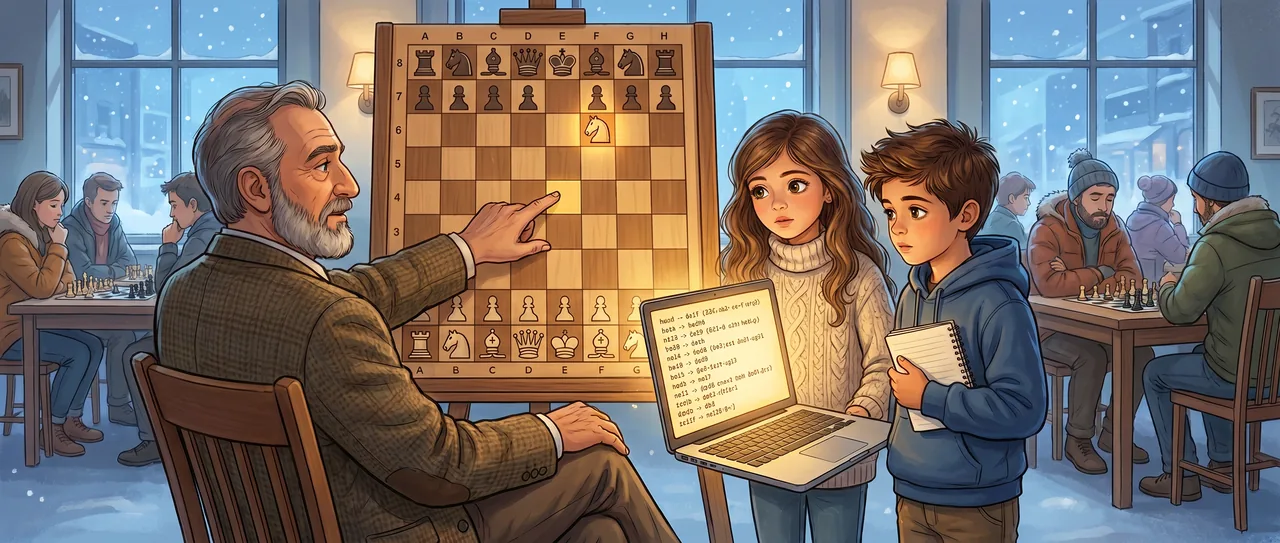
The Moves Nobody Taught
The program lost its fourteenth game in a row on a Tuesday.
Soren stared at the screen. The cursor blinked next to the output: e4 e5 Nf3 Nc6 Bb5 a6 Ba4 b5 Bb3 Na5. Then it played Qh5, which was terrible. Then it played Ke2, which was worse. Then it resigned by outputting a string of nonsense characters.
"It doesn't know what chess is," Soren said.
Maya, sitting cross-legged on the floor of Soren's room with a physical board between her knees, moved the pieces to match what the program had played. She tilted her head at the position.
"It doesn't know what anything is," she said. "It's a text predictor. You fed it text. What did you expect?"
"I expected it to find the patterns."
"In three days?"
"The paper said it could work."
Maya picked up the white king from where the program had marched it to e2 for no reason. "How much notation did you give it?"
"Ten million games. Just the moves. No commentary, no evaluations, no rules. Just the algebraic notation, one game per line."
"So it has never seen the word checkmate."
"It's seen the symbol for it. The hash mark. But no, it doesn't know what it means. It doesn't know what any of it means. It just knows which tokens tend to follow which tokens."
Maya set the king back down. "Keep training it."
Soren kept training it.
By Thursday it stopped playing illegal moves. By Friday it stopped blundering its queen. By Saturday morning, when Soren woke up and played it from his phone while still in bed, it beat him in twenty-three moves with a rook sacrifice he didn't see coming.
He called Maya.
"It sacked the rook on f7," he said. "Then it brought the knight to g5 and I couldn't stop the mate. I went back and looked. The sacrifice was correct. Like, engine-verified correct."
Maya was quiet for four seconds. Soren counted.
"Soren. It doesn't know what a rook is."
"I know."
"It doesn't know the rook moves in straight lines. It doesn't know the board is eight by eight. It doesn't know there's a board."
"I know."
"So how does it know to sacrifice something it has never seen on a square it has never been to?"
That was the question. That was the whole question.
They brought it to the community center tournament on Sunday. Not to compete officially. Mrs. Azevedo, who ran the tournament and also ran the center's after-school program, let them set up a laptop at the demo table in the back. She thought they were showing off a chess engine.
"It's not an engine," Soren told her. "Engines search through millions of possible positions. This doesn't search at all. It just predicts the next move the way your phone predicts the next word in a text message."
Mrs. Azevedo looked at him over her glasses. "And that works?"
"We don't know yet," Maya said.
The first challenger was a boy named Derek who was rated twelve hundred. The program, which Maya had named Parrot because it was just repeating patterns, beat Derek in nineteen moves. Derek asked to play again. Parrot beat him in sixteen.
A girl named Yolanda, rated fifteen hundred, sat down next. Parrot won in a long endgame, converting a one-pawn advantage with mechanical precision, trading pieces in exactly the right order.
"It plays like a book," Yolanda said.
Maya glanced at Soren. He was writing in his notebook, not the result but a question: HOW DOES PATTERN PREDICTION LEARN STRATEGY?
By the afternoon, Parrot had beaten seven players. Then Mr. Khoury sat down.
Mr. Khoury was a former national master. He volunteered at the center on weekends. He had a rating of twenty-two hundred and played with the quiet confidence of someone who had seen everything on a chessboard at least twice.
He played the Sicilian Defense. Parrot responded with the Open Sicilian, mainline theory, every move landing in the center of known practice. On move fourteen, Mr. Khoury deviated with a rare knight maneuver.
Parrot thought for one point three seconds, which was how long the text generation took, and played a move Soren had never seen in any database.
Mr. Khoury leaned back.
"That's a very good move," he said slowly.
"You sound surprised," Maya said.
"I am surprised. That move requires understanding pawn structure three moves deep. Where did this engine learn that?"
"It's not an engine," Soren said. "It never looked at pawn structures. It never looked at anything. It read ten million games written as text and learned to predict what letter comes next."
Mr. Khoury looked at Soren, then at Maya, then at the screen.
"That isn't possible," he said.
"It's beating you," Maya said.
It was. Parrot won on move forty-one, and Mr. Khoury sat very still for a moment, then reset the pieces on the demonstration board and played the game again from memory, stopping at move fourteen.
"This move," he said, tapping the square. "This move understands something. But you're telling me nothing behind that move understands anything."
Maya looked at Soren.
"The patterns are so deep," Soren said, "that when you predict them well enough, you get something that looks exactly like understanding. Even though there's nothing inside that has a picture of a board. Nothing inside that knows what winning means."
"Or," Maya said, and she paused, and Soren could tell she was chasing something, "or the patterns are the understanding. And we just don't know what understanding is well enough to tell the difference."
Mr. Khoury stared at the board. His finger was still on the square where Parrot had played its impossible, correct, beautiful move.
"Those are not the same thing," he said.
"No," Maya agreed. "They're really not."
They packed up the laptop at five. The center was emptying out. Soren closed his notebook and zipped his bag. Maya was still looking at the demonstration board, where Mr. Khoury had left the position from move fourteen set up. She hadn't touched it.
"Soren," she said. "If the pattern is deep enough, and the prediction is good enough, and nobody can tell the difference from the outside, what's the test? How do you check?"
He stopped zipping his bag.
"I don't think there is one yet."
Maya picked up the knight from f7 and held it in her closed fist, feeling the weight of the small carved horse, the thing that did not know it was a horse.
Read the interactive version, listen to the narration, and earn a gold star →
A science-verified short story for curious kids · Curiosity Land