The Identical Strangers
Maya had already lost.
Their project, a soil conductivity sensor made from pencil graphite and a nine-volt battery, sat on the table looking exactly like what it was: a thing built in a garage. The booth to their left had a robotic arm that sorted recycling. The booth to their right had a neural network that identified birdsong. Four hundred and twelve students filled the convention center, and Maya was pretty sure every single one of them had a better project.
"We're going to lose," she said.
"We already lost," Soren said. He was reading the program booklet. He did not seem upset. "Judging started twenty minutes ago. Whatever's going to happen is already happening. Worrying about it now is like worrying about whether it rained yesterday."
"That's not comforting."
"It's not supposed to be comforting. It's supposed to be accurate."
Maya leaned back in her folding chair and stared at the ceiling, which was the kind of institutional ceiling made of rectangular tiles that invited counting. She didn't count them. Instead she watched the students moving below it, hundreds of them in matching lanyards, and she started doing the thing she always did when she was bored and surrounded by people. She started looking for duplicates.
Two girls in identical green sneakers. A pair of boys with the same haircut. Three students carrying the same brand of water bottle.
"Soren. How many people are in this room?"
He checked the booklet. "Four hundred twelve students. Plus maybe fifty adults. Judges, organizers, parents."
"So at least four hundred sixty-two people."
"At least."
"I guarantee you that at least two people in this room share a birthday."
Soren looked up from the booklet. "That's probably true, but you can't guarantee it."
"I can. I absolutely can."
Soren put the booklet down. This was the voice Maya used when she had found something, and it was a voice that had never once been wrong about having found something, even when the something turned out to be different from what she thought.
"Explain," he said.
"How many possible birthdays are there?"
"Three hundred sixty-five. Well, three hundred sixty-six if you count February twenty-ninth."
"Fine, three hundred sixty-six. And how many people are in this room?"
"At least four hundred sixty-two."
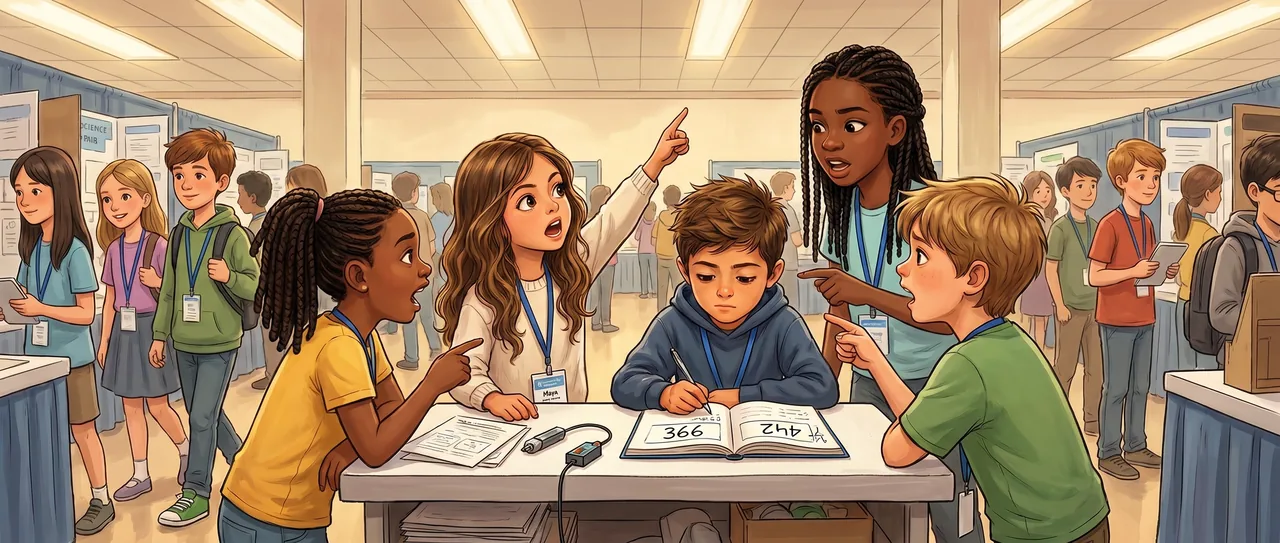
Soren stopped. His pen was already in his hand. He wrote the two numbers next to each other in his notebook: 366 and 462.
"Oh," he said.
Maya waited.
"Even if you tried to spread them out," Soren said slowly. "Even if you deliberately assigned one person to every possible birthday. January first gets someone. January second gets someone. All the way through December thirty-first, leap day, you've placed three hundred sixty-six people. But there are still ninety-six people left."
"And they have to go somewhere," Maya said.
"They have to go somewhere." Soren stared at his notebook. "It's not statistics. It's not probably. It's just. It's structure. There aren't enough days."
"It's like chairs," Maya said. "If there are ten chairs and eleven people, someone is standing. You don't need to know which person. You don't need to know which chair. You just know."
Soren wrote that down. Then he looked up at the moving crowd with an expression Maya recognized. It was the expression he got when a small door had opened onto a room much larger than the door.
"How many people do you actually need," he asked, "before a shared birthday is guaranteed?"
"Three hundred sixty-seven. One more than the number of possible days."
"Three hundred sixty-seven." Soren tapped his pen against the notebook. "But wait. What else does this work for?"
This was the moment Maya had been waiting for, because she had gotten this far and then run into the same wall of expanding implications that she could feel Soren accelerating toward.
"Try it," she said.
Soren wrote quickly. "Okay. Hair. Human heads have between eighty thousand and one hundred twenty thousand hairs. So if you had one hundred twenty thousand and one people, at least two of them would have exactly the same number of hairs on their head. But there are millions of people in any city. Which means right now, in this city, thousands of people have exactly the same hair count." He paused. "That's actually guaranteed?"
"Not probably. Guaranteed."
"That is extremely strange."
A student from a neighboring booth, a tall girl with box braids and a project about mycelium networks, leaned over. "What are you two arguing about?"
"We're not arguing," Maya said. "We're freaking out."
"About what?"
"How many students are at this fair?" Soren asked.
"Four hundred twelve. It's in the booklet."
"That means at least two students here were born on the same day of the year. Not probably. It's certain. It has to be true."
The girl, whose badge read Adaeze, frowned. Then her frown shifted into something else. "Wait. Because there are more people than days."
"There are always more people than days," Soren said.
"So in any school of four hundred kids, this is always true."
"In any group of three hundred sixty-seven people anywhere on Earth, ever," Maya said. "Three hundred sixty-seven strangers on a bus, in a stadium, in a photograph from a hundred years ago. Always at least one match."
Adaeze pulled a chair over from her booth and sat down. "What else?"
"We're making a list," Soren said. And he was. The notebook page was filling up. Hairs on heads. Letters in last names. Steps taken in a day. Every time the count of people exceeded the count of possibilities, certainty clicked shut like a lock.
The judges came by at some point. Maya and Soren answered questions about soil conductivity. Adaeze went back to her mycelium. But during the lunch break, Adaeze returned, and she had brought two other students with her, a boy who was skeptical and a girl who wanted to try it with phone numbers.
Soren's notebook was open on the table. Around it, five students leaned in, arguing about how many possible middle initials existed and what that meant for a room this size.
The results were posted at three o'clock. Their soil sensor took no prize.
Maya didn't notice for almost an hour, because Adaeze had just asked what happens when you apply the same logic to grains of sand, and Soren was writing so fast that the tip of his pen was getting hot.
Read the interactive version, listen to the narration, and earn a gold star →
A science-verified short story for curious kids · Curiosity Land