The Gray Advance
Maya's grandmother had not cried once during the packing, which was how Maya knew it was bad.
The house sat on a low rise a quarter mile from the Albemarle Sound. Three generations of the family had lived here, and now the boxes were stacked in the hallway and the moving truck was coming Tuesday. Maya's mother was inside wrapping dishes in newspaper, and her grandmother was on the back porch, looking out at what used to be woods.
Maya stood at the tree line.
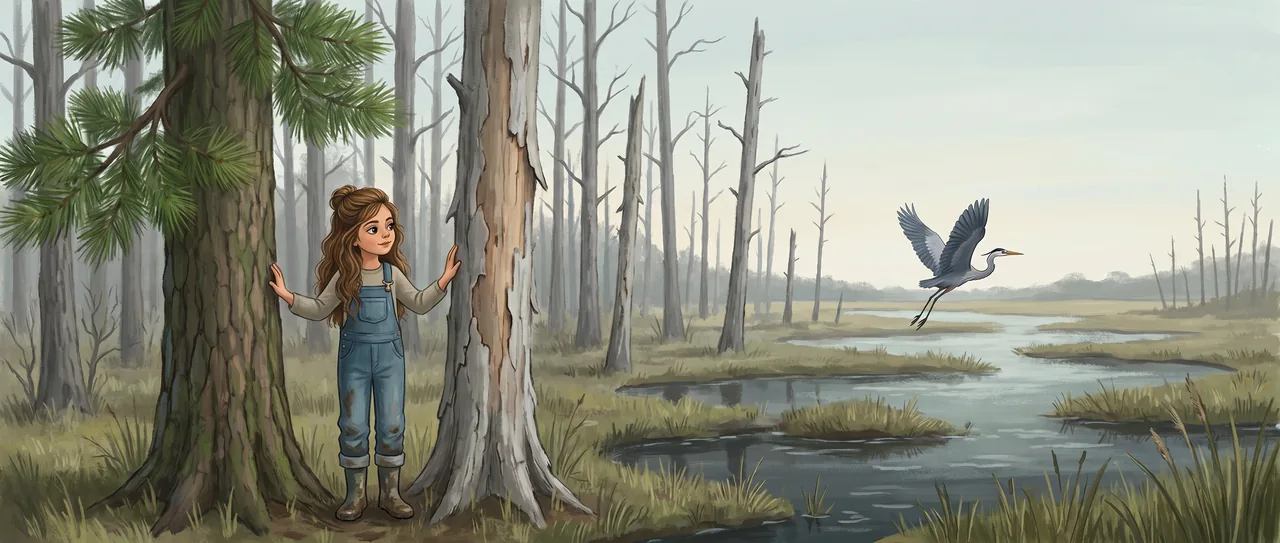
She had been here two summers ago, and the trees had been green. Loblolly pines, thick and sweet-smelling, running all the way down to the marsh. Now the first hundred yards of forest looked like something had reached up from underground and drained the color out. Gray trunks stood bare against the sky, their bark peeling in long strips. No needles. No green. Just poles of dead wood, still standing, like the forest's skeleton had been left behind after everything alive walked away.
Behind the dead trees, the living ones were still green. But the border between alive and dead was sharp, almost a line, and Maya could see that the line was closer to the house than it had been.
Her grandmother came down the porch steps slowly. Mabel Harris was seventy-three and had opinions about everything, including Maya's haircut, the governor, and whether corn needed sugar in the water when you boiled it. She did not have opinions about the trees. She just looked at them.
"Gran, what happened to them?"
"Salt," her grandmother said. "Water table's going salty. Has been for years. Kills them standing up."
"But they're still here."
"Wood doesn't fall down just because it's dead. Takes a hurricane for that. So they stand there." Her grandmother adjusted her glasses. "Your grandfather called it the gray army. Said it was marching."
Maya walked into the dead zone.
The ground was different. Wetter. Not flooded, but soft, and the grass that grew between the dead trunks was not the same grass that grew in the yard. It was coarser. Marsh grass. Spartina, maybe. She crouched and touched it. The soil smelled like the sound, like salt and mud and something organic breaking down.
She looked back at the house. From here, she could see the line more clearly. The living pines came right up to a boundary, and then they stopped, and everything past that boundary was gray and bare. Like someone had drawn a border on a map and the trees on one side had to die.
But it was not a map. It was the water under her feet. Saltwater, creeping inland through the ground as the sea rose, reaching the roots of trees that had never tasted salt in their lives.
She pulled out her phone and opened the satellite app she used for school projects. She zoomed in on their location. The image was from four months ago, and even from space, she could see it. A gray band running along the coast, widening in some places, narrowing in others. Standing dead wood. Thousands and thousands of trees, visible from orbit, forming a border between the ocean's future territory and the land that still held.
She scrolled to an older image. Two years ago. The gray band was thinner.
She scrolled further. Five years ago. Thinner still.
The gray was growing. Not fast enough to see if you stood here every day. But fast enough to see from space, and fast enough that her grandmother's house, which had once been surrounded by living forest, was now a quarter mile from an advancing edge of dead trees.
Maya walked deeper in. The dead pines gave way to something unexpected. In the gaps where the biggest trees had finally fallen, she found open pools of brackish water, and in those pools, the marsh was already building itself. Cordgrass pushed up through the shallow water. A great blue heron stood motionless in one of the pools, hunting. Fiddler crabs worked the edges.
This was not nothing. This was something becoming something else.
She heard her grandmother behind her, picking her way carefully over a fallen trunk.
"Gran, look at this."
"I see it."
"It's turning into marsh. The dead part, where the trees fell, it's already marsh."
Her grandmother looked at the pool, the heron, the crabs. "Your grandfather said that too. Said the forest was leaving and the marsh was coming in behind it. Said it was like watching one tenant move out and another move in, except nobody asked him about it."
"Did he study it?"
"He paid attention to it. That's not the same thing, but it's not nothing either."
Maya looked at the satellite image on her phone again. The gray band was not just death. It was a border zone, a place where one ecosystem was becoming another. The forest was retreating inland. The marsh was following the salt. And the ghost trees stood in between, marking the years like rings in a trunk, except these rings were made of whole dead forests and you could count them from space.
She thought about how scientists must track this. You would not need to walk through every coastal forest. You could watch the gray bands widen on satellite images, year by year, and measure how fast the salt was winning. The dead trees were the signal. They were the data, standing up, refusing to fall, marking exactly where the boundary had been and where it was going.
"Gran."
"Hmm."
"How far inland is the new house?"
Her grandmother looked at her. "Twelve miles. Higher ground."
"How fast is the salt moving?"
"I don't know the number. I know it reached the Dawson place three years ago and they left two years before we did."
Maya looked at the line of living green pines, still healthy, still growing, a quarter mile from the house. She tried to calculate how many years before the salt reached where she was standing now. She did not have enough data. But the satellite images existed, going back decades, and the gray bands were measurable, and the question was answerable.
The heron lifted off from the pool with slow heavy wingbeats, banking over the dead trees toward the sound.
Her grandmother turned back toward the house. Maya stayed.
She held up her phone and took a photograph of the exact spot where the last living pine met the first dead one. She marked the GPS coordinates. She would come back. Not next year. Every year. She would stand in this spot and measure whether the line had moved, and by how much, and she would compare it to what the satellites showed.
She put one hand on the bark of the last living pine and one hand on the bark of the first dead one, and she stood there in the border, feeling the rough wood under both palms.
Read the interactive version, listen to the narration, and earn a gold star →
A science-verified short story for curious kids · Curiosity Land