The Fracture That Wasn't
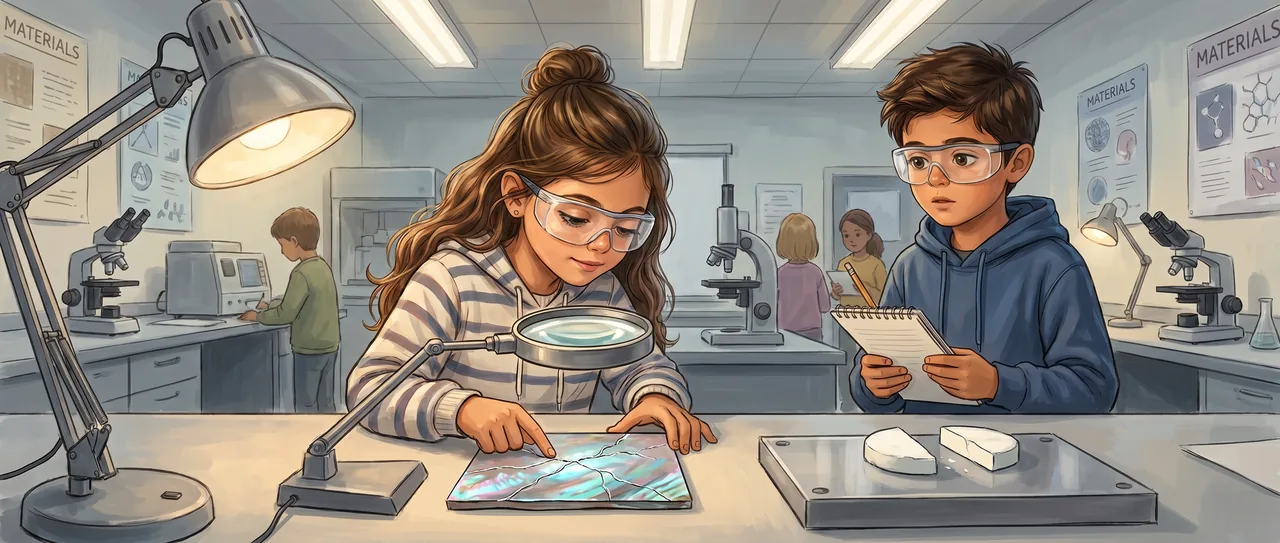
The hydraulic press came down on the first sample and Maya flinched at the sound. A clean, sharp crack, and the block of chalk split into two pale halves that slid apart on the steel plate like the covers of an opened book.
"Pure calcium carbonate," said Dr. Vasquez, already turning to adjust something on her laptop. She was running four experiments at once today, and Maya and Soren were only one of them. "Write down the force reading. Next sample when you're ready."
She walked away to check on something across the lab.
Soren wrote the number in his notebook. "Forty-seven newtons. That's not much."
"It's chalk," Maya said. She picked up one of the broken halves and rubbed her thumb across the fracture surface. Smooth. The break had gone straight through, like the material hadn't even tried to stop it.
She set the broken chalk down and picked up the second sample. A rectangle of abalone shell, cut and polished so that its cross-section showed. Even under the flat lab lights it had a glow to it, like something lit from inside.
"Same stuff," Soren said.
"What?"
"Same chemical. Calcium carbonate. Both of them." He tapped the chalk fragment, then the shell. "Dr. Vasquez said the abalone makes its shell out of the same mineral as the chalk. So this should break at about the same force."
Maya turned the shell sample in her hand. "It won't."
"I know it won't. I read the sheet. But I want to know why I know, and I don't yet."
Maya liked that about Soren. He didn't pretend to understand things he hadn't actually understood yet.
She placed the shell sample on the plate. They both put on their safety glasses. Soren hit the button.
The press came down. The force reading climbed. It passed forty-seven newtons, which was where the chalk had given up. It kept climbing. One hundred. Two hundred. Maya watched the number and waited for the crack.
Five hundred. Seven hundred.
The shell sample was still there. Not even a chip.
At nine hundred and sixty newtons, something happened. A tiny white line appeared on the surface, a hairline fracture. But the number kept climbing. One thousand. Twelve hundred. The fracture didn't grow. More thin lines appeared, fanning out from the first one, then stopping. Starting. Stopping. As if every crack ran into a wall and had to find a new direction.
At sixteen hundred newtons, the press was at its limit for small samples. Soren released the button.
The shell sat on the plate, cracked but whole. A web of white lines covered its surface, but not one of them had made it all the way through.
"That's thirty-four times the force," Soren said, writing. "And it still didn't break."
"Look at the cracks," Maya said.
She picked up the shell and held it under the desk magnifier. The fractures weren't straight. They zigzagged. They turned sharp corners, ran sideways, doubled back. Under the magnifier, Maya could see why. The shell wasn't solid. It was built in layers, thin as the pages of a book, and each layer was made of tiny flat tiles. The cracks couldn't go through the tiles. They had to go around them.
"It's a maze," Maya said.
"Let me see." Soren looked through the magnifier for a long time, moving the shell slowly. "The tiles aren't lined up. Each layer is offset from the one below it. Like bricks in a wall."
"So every time a crack hits the edge of a tile, it has to turn."
"And every turn uses energy."
They looked at each other.
"The animal doesn't just make a wall," Soren said. "It makes a wall that's specifically designed to be difficult to break. But it's using the weakest possible material to do it."
"How does it know?" she said. "How does a snail know to lay the tiles down in offset layers?"
Soren looked up at the ceiling, which was his way of thinking hard. "It's in the proteins, I think. Dr. Vasquez said the animal secretes proteins that control where the crystals grow. Like a mold. The proteins decide the size and the shape and the direction."
"So the animal doesn't know. Its body knows. Its body is a factory that builds a material that human engineers are still trying to copy."
Dr. Vasquez came back, glanced at their force readings, and nodded once. "Good data. You can pack up."
"Dr. Vasquez," Soren said. "Can anyone make this artificially yet? The nacre structure?"
"We're trying. Everyone's trying. We can get close in small samples. But the abalone does it at ocean temperature, in seawater, with no furnace and no pressure chamber." She almost smiled. "It does it better than we can, and it does it while also being a snail. Humbling, honestly." She picked up her laptop and walked to the next station.
Maya held the cracked shell up to the light. The fracture lines caught the glow and turned silver. Every zigzag was a place where the crack had tried to destroy the shell and the shell had said: not here. Go around. Try again. Not here either.
The same atoms as chalk. Arranged by an animal that had no idea what it was doing, and was doing it better than any laboratory on Earth.
"Soren."
"Yeah."
"We build things by choosing strong materials. The abalone builds things by choosing the right arrangement. It starts with something weak and makes it incredible."
Soren set down his pen and looked at the shell in her hand, at the web of cracks that had been stopped, turned, and exhausted by something a creature had grown in the dark water of the Pacific.
Maya set the shell back on the steel plate, next to the two halves of the broken chalk. Same substance. One had shattered in an instant. The other had fought the press to a standstill.
She ran her finger along the longest crack, the one that turned seven times before it stopped.
Read the interactive version, listen to the narration, and earn a gold star →
A science-verified short story for curious kids · Curiosity Land