The Coldest Thing in the Universe
The lab was disappointing.
Maya had expected something that looked like the future. Instead it looked like a plumber's nightmare: pipes and tubes and silver canisters connected by wires that someone had zip-tied into bundles. A computer monitor showed a graph that wasn't doing anything.
Dr. Vasquez was already talking.
"So the outreach coordinator said you two won the district science fair," she said, not really asking, already adjusting a dial. "Congratulations. Don't touch the vacuum chamber. It took us nine months to get the seal right and I will actually cry."
Soren wrote that down. Maya watched the graph.
"What are we going to see?" Maya asked.
"Hopefully?" Dr. Vasquez said. "The coldest thing in the universe. Colder than outer space. Colder than anything that exists naturally anywhere, as far as we know. We take rubidium atoms. We use lasers to slow them down. Then we use magnetic fields to trap them and cool them further. We get them to within a few billionths of a degree above absolute zero."
"What happens then?" Soren asked.
"Something that shouldn't make sense," Dr. Vasquez said. She checked a readout and frowned at it. "Give me twenty minutes. The magnetic trap is being temperamental." She walked away, muttering.
Maya looked at Soren. "She didn't answer you."
"I noticed."
They stood in front of the vacuum chamber. It was a metal cylinder the size of a coffee thermos, surrounded by electromagnetic coils, connected to a system that pumped out every molecule of air so the rubidium atoms inside had nothing to bump into. Nothing to warm them up.
Soren flipped back through his notebook. He'd prepared. "So absolute zero is the temperature where atoms stop moving."
"Almost stop," Maya said. "You can't actually reach it."
"Right. But they get close. Billionths of a degree away." He looked at the chamber. "There's like a million atoms in there."
"And they're each doing their own thing," Maya said. "Bouncing around. Being separate."
"Until they aren't," Soren said quietly.
Maya turned to him. "What do you mean?"
Soren tapped a page in his notebook. He'd printed out a diagram. "I looked it up last night. When they get cold enough, the atoms stop being separate. Their quantum wave functions overlap. They all fall into the same quantum state. A million atoms, and they become one thing."
"One atom?"
"One quantum object. Like, they lose their individuality. Every atom becomes indistinguishable from every other atom. They're all in exactly the same state, doing exactly the same thing, in the same place."
Maya stared at the chamber. "That's not disappointing."
"No."
"That's terrifying."
Dr. Vasquez came back, still frowning. "Okay. Magnetic trap is behaving. We're starting the evaporative cooling sequence. This is the last stage, where we let the hottest atoms escape so the remaining ones get colder. Like blowing on soup, if your soup was already colder than interstellar space."
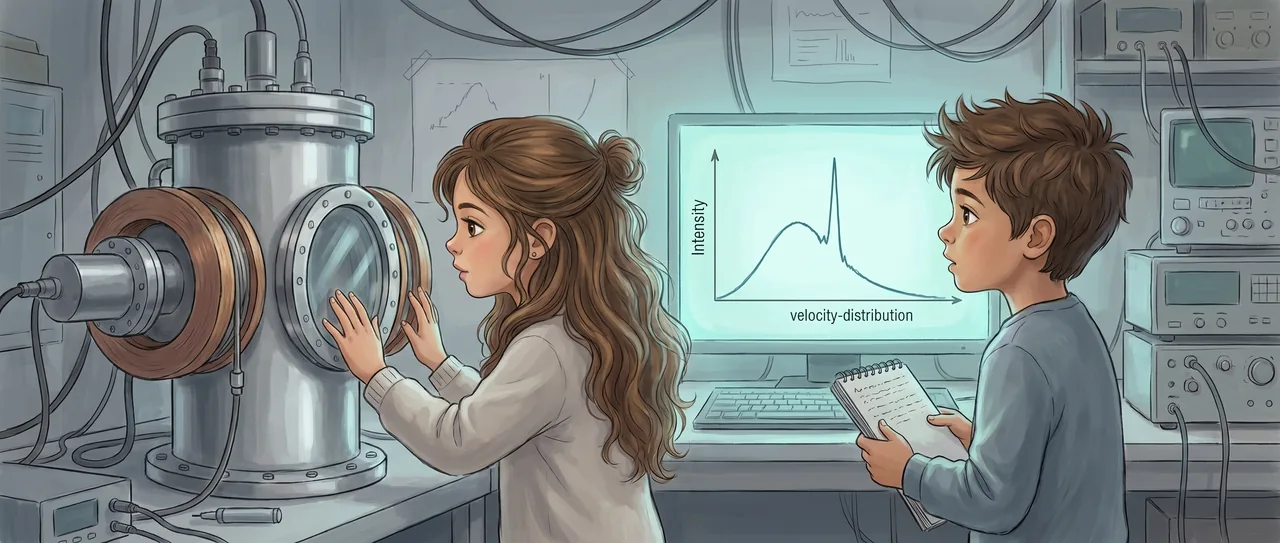
The graph on the monitor began to change. A broad hump of data points, showing the distribution of atom velocities.
"Watch the graph," Dr. Vasquez said, and then her phone buzzed and she stepped into the hallway.
Maya and Soren watched.
The hump narrowed. The atoms were slowing down, their speeds converging. The peak grew taller and thinner as the spread of velocities shrank.
Then something happened.
The hump didn't just narrow. It changed shape. A sharp spike shot up from the center of the distribution, sudden and clean, like a mountain rising out of foothills. The broad thermal cloud was still there around its base, but the spike was something else entirely.
"Soren," Maya said.
"I see it."
The spike meant that a huge number of atoms had stopped having different velocities. They weren't approximately the same. They were exactly the same. They had dropped into one shared quantum state, together, all at once.
"That's them," Soren said. "That's the condensate."
Maya couldn't stop looking at the spike. In the rest of the graph, you could see individual atoms doing individual things, a smear of different speeds and positions. Normal. In the spike, there was no smear. There was one state, and every atom was in it.
"Quantum effects," she said slowly. "Those are supposed to be tiny. Subatomic. You need special equipment to detect them, usually."
"Usually," Soren said.
"But this is a million atoms. That's not subatomic. That's a thing. That's a thing you could almost see."
"If you shone a light on it, you could see it," Soren said. "They've taken pictures. It looks like a little bright dot."
Maya pressed her fingertips to the glass window of the vacuum chamber. Cold metal frame, room temperature, but inside, billionths of a degree from the coldest anything could possibly be.
"So all those atoms in there right now," she said. "They aren't atoms anymore. Not really. They're one thing pretending to be a million things. Or a million things that became one thing. Which is it?"
"I don't know," Soren said. "Both, maybe."
Dr. Vasquez came back in. She looked at the monitor and her frown broke into a grin. "Oh, beautiful. Look at that peak. Clean condensate. Nice." She checked the numbers. "Four hundred nanokelvin. Give or take."
"Is that the coldest thing in the universe right now?" Soren asked.
Dr. Vasquez laughed. "Probably in the top five. Why, does that matter?"
"The coldest thing in the universe is in this room," Maya said.
Dr. Vasquez had already turned back to her instruments, adjusting something, logging data. She wasn't listening.
But Soren was. He was looking at the spike on the graph, and Maya could see him counting the implications. If atoms could forget they were separate. If quantum effects, the rules that govern the smallest things that exist, could climb up into the world you could see and touch just because something got quiet enough, cold enough, still enough.
Then the boundary between the tiny and the enormous was not a wall. It was a temperature.
Maya took her hand off the glass. Soren turned to a blank page.
On the monitor, the spike held steady, a million atoms being one thing, in the coldest room-temperature building in an ordinary university town, under an ordinary Tuesday sky.
Read the interactive version, listen to the narration, and earn a gold star →
A science-verified short story for curious kids · Curiosity Land