The Billion-Year Second
The demonstration was supposed to fizz.
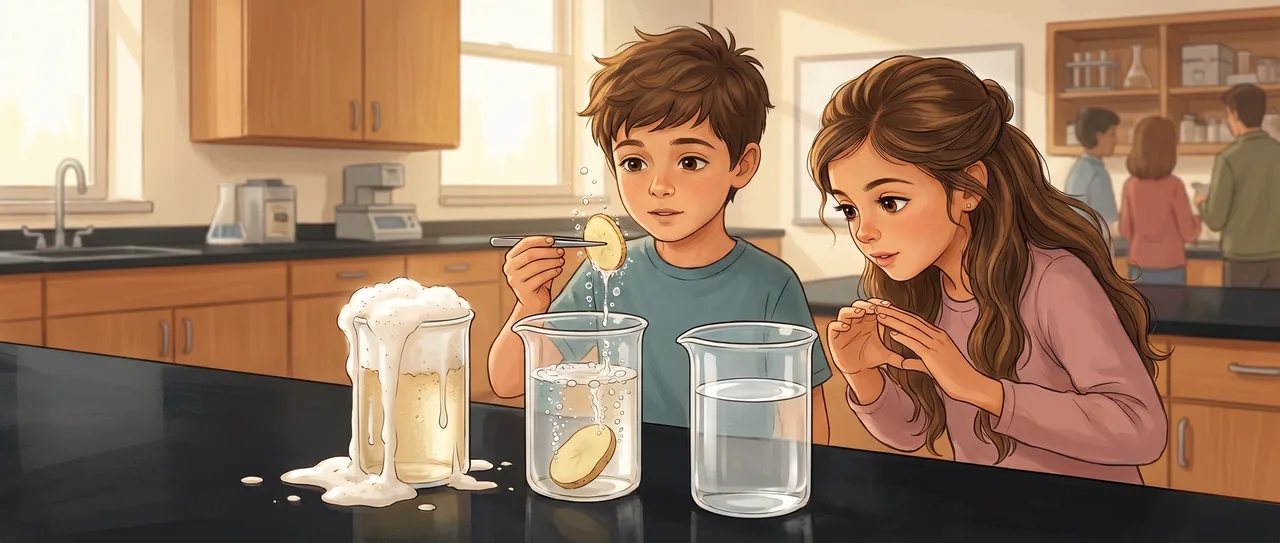
Maya's cousin Priya had set out three beakers on the long black lab bench, each one filled with hydrogen peroxide. Clear liquid, perfectly still. Priya had been on the phone for eleven minutes, pacing near the hallway, explaining to someone that the grant application had the wrong date and no she could not fix it from here and yes she understood that Monday was a deadline.
The open house visitors would arrive in twenty minutes.
"She said to add the catalyst," Maya said, reading from the index card Priya had scrawled instructions on. "Beaker one gets manganese dioxide. Beaker two gets a piece of raw potato. Beaker three is the control, nothing added."
Soren picked up the small jar labeled MnO2. "This is the one that's supposed to be dramatic?"
"That's what the card says. It decomposes the peroxide. Should bubble."
Soren tapped a small scoop of the dark powder into beaker one. Immediately, a rush of white foam climbed the glass, hissing and warm. Bubbles of oxygen racing out so fast the surface churned.
"Okay," Soren said. "That works."
Maya dropped a thin slice of raw potato into beaker two.
For a moment, nothing. Then tiny bubbles began streaming off the potato's surface, delicate and steady, like the potato was breathing underwater.
"Both catalysts," Maya said. "Both speed up the same reaction. Hydrogen peroxide breaks down into water and oxygen."
"But the powder is way faster."
"Is it though?" Maya leaned closer to beaker two. The bubbles were increasing. Not as violent as beaker one, but persistent. "The potato's catching up."
Soren looked at the control beaker. Perfectly still. "That one's supposed to just sit there?"
"The peroxide breaks down on its own eventually. Just really, really slowly."
Soren wrote the time on his notebook page. Then he wrote: how slowly?
Priya came back, phone still in hand, looking frazzled. "Did you start without me? Good. Great. Is the catalase demonstration working?"
"The potato one? Yeah. What's catalase?" Maya asked.
"It's the enzyme in the potato. In all living cells, actually. It breaks down hydrogen peroxide, which is toxic. Your body makes hydrogen peroxide as a byproduct of metabolism and then immediately destroys it. Catalase is one of the fastest enzymes known." Priya glanced at her phone again. "One molecule of catalase can break down millions of peroxide molecules per second."
"Millions per second," Soren repeated.
"Per second. Each molecule. Look, I need to send one email. Two minutes." She was already walking away.
Maya stared at the potato slice. Millions per second, from a slice of potato sitting in a beaker. She picked up the index card and flipped it over. Priya had written some notes for her own reference on the back:
Uncatalyzed half-life of H2O2 decomposition in absence of catalyst: very slow. Some reactions enzymes catalyze would take billions of years uncatalyzed. Acceleration factor for some enzymes: 10^17.
"Soren."
"Yeah."
"What's ten to the seventeenth?"
Soren stared at the ceiling, calculating. "A hundred quadrillion."
"She wrote that some enzymes speed up reactions by a factor of a hundred quadrillion."
Soren put his pencil down.
They both looked at the control beaker. The one with no catalyst. The perfectly still, perfectly clear liquid, doing almost nothing.
"So that reaction," Soren said slowly, "the one that's happening in the potato in milliseconds. Without the enzyme, it would take..."
"Billions of years," Maya said. "That's what the card says. Some of these reactions, without the enzyme, would take longer than the Earth has existed."
The control beaker sat there, patient and still, on a timescale that made no human sense.
Soren picked up the potato slice with the tweezers and held it at eye level, watching the tiny oxygen bubbles still streaming off its surface. "Every cell in this potato has been doing this. Every cell in us is doing this. Right now."
"Thousands of different enzymes," Maya said. "Each one only grabs its one specific molecule. Catalase only breaks down peroxide. It ignores everything else floating around it."
"How?"
"Shape. I think." Maya cupped one hand and pressed a fist into it. "The enzyme has a pocket that only fits one molecule. Like a lock and key, but the lock also does the breaking."
Soren set the potato down and looked at his own hands. He turned them over. "So right now, inside us, there are thousands of different enzymes, each one finding the one molecule it's shaped to fit, and each one making a reaction happen that otherwise wouldn't happen before the sun burns out."
"Not wouldn't happen. Would happen. Just so slowly it might as well not."
"That's the part that gets me," Soren said. "The reaction wants to happen. The chemistry is there. It's just waiting. And the enzyme is the thing that says now."
Maya picked up the jar of manganese dioxide. "This stuff speeds it up too. But it's not picky. It's just a surface for the reaction to happen on. The enzyme is picky. The enzyme chooses."
"Not chooses."
"Finds. Recognizes. Whatever the word is for a molecule shaped so precisely that out of all the thousands of molecules bumping around in a cell, it only grabs the right one."
Soren looked at the three beakers in a row. Beaker one, spent, foam dripping down the sides. Beaker two, still quietly bubbling, the potato patient and relentless. Beaker three, still as glass.
Three versions of the same reaction. One forced. One guided. One waiting.
Priya came back. "Okay. Email sent. How's the setup?"
"Priya," Maya said. "How many different enzymes are working inside one of my cells right now?"
"Thousands. Maybe four thousand distinct types, give or take. Why?"
"Each one with its own shape. Each one matched to one molecule."
"More or less. It's what makes you not be soup." Priya laughed at her own joke and started arranging pamphlets.
Maya didn't laugh. She was counting on her fingers, not reaching any number, just moving through the idea of four thousand locks finding four thousand keys in the dark, every second, in every cell, in every living thing on the table and beyond it.
Soren was writing. Not words. He was drawing a pocket shape on his notebook page, open like a cupped hand, and beside it a small circle that almost fit inside.
Read the interactive version, listen to the narration, and earn a gold star →
A science-verified short story for curious kids · Curiosity Land