Three Bodies
The planetarium simulator was supposed to be for little kids.
That was what the sign said, anyway. GRAVITY GARDEN: AGES 5 AND UP. You placed glowing dots on the touch table and the projector threw them onto the dome overhead, and they pulled on each other and swung around and around, and the five-year-olds loved it because the dots left colored trails like finger paint across the ceiling.
Maya was eleven. She had been here for two hours.
The woman running the exhibit, Dr. Aguilar, had stopped checking on her after the first hour. She was across the room now, recalibrating something, occasionally glancing over with an expression Maya recognized. It was the expression adults wore when they could not decide if you were having fun or having a problem.
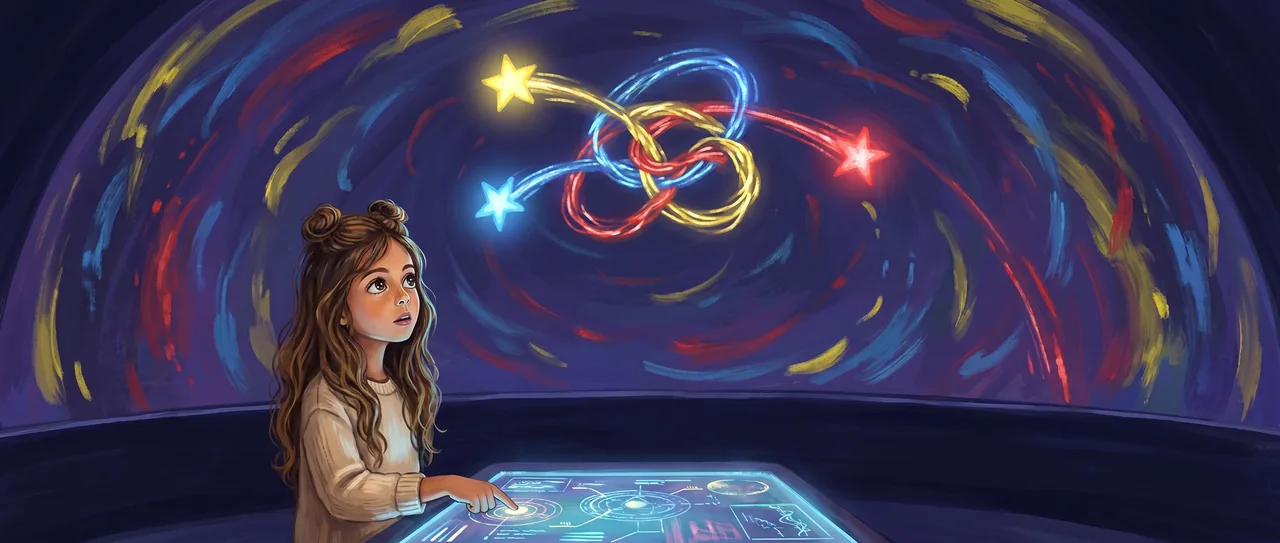
Maya placed two stars on the table. One yellow, one blue. The projector flung them onto the dome and they began their dance. Yellow swung around blue. Blue swung around yellow. They traced a figure eight, then settled into a steady elliptical orbit, the trails weaving a neat pattern like thread on a loom.
Two bodies. Predictable. She had done this forty times now, varying the masses, the distances, the velocities. Two bodies always found a rhythm. Always.
She placed a third star. Red.
The red dot joined the projection overhead, and for a moment the three stars seemed fine. Yellow and blue adjusted their paths, pulling wider, accommodating the newcomer. Then red swung close to yellow, and yellow lurched sideways, and blue, suddenly free of yellow's grip, shot outward in a long arc, and red chased after it while yellow spun alone, and then blue came screaming back and all three tangled together in a knot of light and scattered.
The trails on the dome looked like someone had sneezed paint.
Maya touched the reset. Placed the same three stars in the same positions. She was careful. She used the grid lines on the table. Same masses. Same spots.
The three stars launched. Yellow and blue began the same way. Red swung in. And then everything was different. Blue went left instead of right. Yellow spiraled inward. Red got flung off the dome entirely.
She stared at the ceiling.
She reset. Same three stars. Same grid squares. Same masses. This time red and yellow locked together briefly while blue sailed away in a wide peaceful arc, and then red broke free and chased blue down like it had a grudge.
Three completely different outcomes. Same starting positions. Or what looked like the same starting positions.
"The touch sensor," Maya said, not really to anyone. "It's not precise enough."
Dr. Aguilar looked up from across the room. "Sorry?"
"Each time I place them, my finger is a tiny bit different. Maybe a pixel. Maybe less. And that tiny difference is enough to change everything."
Dr. Aguilar walked over. She had a soldering iron in one hand, which she seemed to have forgotten about. "That's the simulator being honest, actually. The real three-body problem does the same thing. Two bodies, you can write an equation and solve it forever. Three bodies, there is no general solution. Not because we haven't found it yet. Because mathematically it cannot exist."
Maya looked at the dome. Three fading trails going in three different directions from the same beginning. "So with two, you can predict where they'll be in a million years."
"Yes."
"And with three, you can't predict where they'll be in ten minutes."
"Roughly."
"Because of a pixel."
Dr. Aguilar set the soldering iron down on the table edge, realized what she'd done, picked it up again, and gestured vaguely at the ceiling with it. "The real universe has more than three objects in it."
Then her phone buzzed and she walked away, already talking to someone about a projector bulb order.
Maya stood alone under the dome.
She placed two stars and watched them orbit, clean and eternal. She thought about every physics poster she had ever seen, all those neat ellipses, planets going around suns in tidy loops, everything where it should be. That was the two-body version. That was the simple one.
She added a third star.
Chaos. Beautiful, unrepeatable chaos. The trails tangled and scattered and looked like nothing she could name.
She did it again. Different chaos. She did it again. Different again. Each time the same three dots, the same grid squares, her finger a fraction of a fraction off, and the universe on the dome overhead was unrecognizable from the one before.
There was something in this that she could not quite hold. Not the unpredictability. She understood that part. It was something else.
She placed two stars. Watched them orbit. Predictable. Solvable. Safe.
She held her finger over the table, ready to place the third.
One dot. That was all it took. One more object with mass and gravity and a position in space, and the whole system stopped being something you could solve with an equation and became something you could only watch unfold. Not because it was random. The simulator ran on math. Every frame was calculated. It was all determined. It just could not be predicted. The universe knew where everything would go. It simply would not tell you in advance.
She pressed down. The third star appeared.
On the dome, the three lights pulled at each other in paths no equation could shortcut. Two of them spiraled close, their trails braiding together, while the third swung wide and lonely and then, slowly, began falling back toward the other two.
Maya watched the trails. She had seen hundreds of them now, and not one had repeated. Not one. Every arrangement was the first and only time that arrangement would ever exist.
She thought about Earth. One body. The Sun. Two bodies. Jupiter. Three.
She thought about every star in the galaxy pulling on every other star, and every galaxy pulling on every other galaxy, and the whole universe being a three-body problem multiplied by a number she did not have a word for, every single object tugging on every other object, the whole thing unsolvable, cascading, determined but unpredictable, and somehow, somehow, here she was standing inside of it.
A five-year-old ran up to the table next to her and slapped both hands down, placing a dozen stars at once. On the dome, twelve lights exploded outward in every direction, trails scattering like fireworks.
The kid laughed.
Maya placed one more star among them and watched it fall toward the others, its path already changing everything.
Read the interactive version, listen to the narration, and earn a gold star →
A science-verified short story for curious kids · Curiosity Land