The Space Where the Frog Should Be
The argument started over breakfast.
Maya said the recording from Array Six sounded wrong. Soren said it sounded exactly the same as the recording from Array Five. They were both right, which was the problem.
Dr. Vargas had given them access to the station's sound library as a reward for two weeks of careful work cataloging leaf samples. Thousands of hours of rainforest recordings, captured by thirty-two microphone arrays scattered across eight square kilometers of lowland forest. Each array recorded everything, all the time, every night chorus and dawn explosion and the long green hum of afternoon. The AI system, called BioListen, tagged every call it recognized. There were four hundred and twelve species in its library.
Maya had been listening to night recordings from March, jumping between arrays, when she stopped chewing her rice and beans and pulled one earbud out.
"Something's not there," she said.
Soren took the other earbud. He listened for forty seconds. "Sounds like forest."
"Exactly. It sounds like forest. But listen to Array Five from the same night."
He listened. He looked at her. "Those sound the same."
"They do. But pull up Array Six from February."
Soren did. And this time, even on first listen, he heard it. February's Array Six had a pulse in it. A short, rising note repeated every eight seconds or so, threaded underneath the insect drone and the other frog calls. It was in the lower frequencies. Easy to miss under the rest.
"Something was calling in February that stopped calling in March," he said.
"At Array Six specifically. Arrays Four, Five, and Seven still have it in March. I checked."
Soren pulled up the BioListen interface and filtered Array Six's March recordings by species. The AI had already found the gap. It was flagged in a neat orange bar on the timeline: Craugastor fitzingeri, absence detected, March first onward.
"Fitzinger's rain frog," Soren read. "Common species. BioListen says it's present at every other array in March. Just missing from Six."
"So why did it leave one spot?"
"Could be anything. A tree fell. Water shifted. Maybe a predator moved in."
"Okay," Maya said. "But here's the weird part. Pull up April."
Soren pulled up April. Array Six. The orange absence bar stopped on April ninth. Fitzinger's rain frog was back.
"It came back," he said.
"It came back. So it wasn't that the habitat was destroyed. It wasn't a permanent change. Something made them leave for five weeks and then come back."
Dr. Vargas came through the dining hall carrying a broken antenna mount and a cup of coffee, already late for something. Maya asked her about it.
"Craugastor fitzingeri? Sure, they move around. Microhabitat shifts. Moisture, temperature, leaf litter depth. Could be seasonal."
"But the other arrays didn't lose them," Maya said.
"Could be localized. A single light gap, a small drainage change." Dr. Vargas was already edging toward the door. "The AI flags hundreds of absences a month. Most of them are just animals being animals. The ones that matter are the ones that don't come back." She smiled. "Good catch, though. Flag it in the notes if you want."
She left. Soren wrote down: Absence March 1 to April 9. Array 6 only. Species returned.
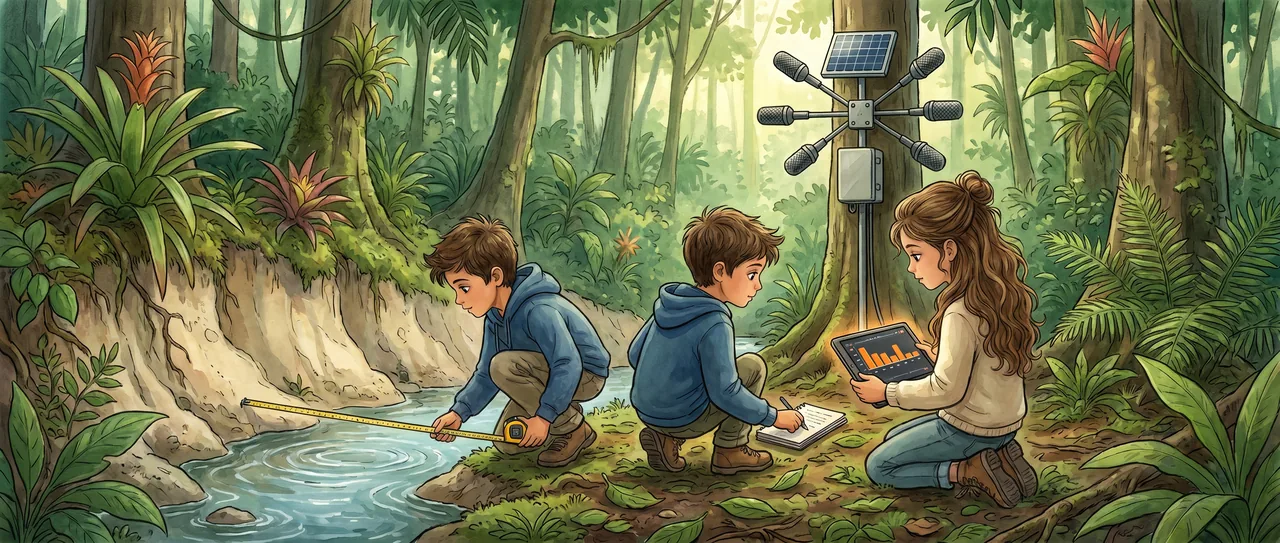
They went to Array Six after breakfast. It was a forty-minute hike through secondary growth that opened into older forest, dense and dripping. The array was bolted to a tree at head height, four microphones in a cross pattern, a solar panel, a weatherproof box with a transmitter. Nothing special to look at.
Soren crouched and looked at the ground around the tree. Leaf litter. Fungus. A beetle the color of wet copper.
Maya walked in slow circles, wider and wider. On her third loop she stopped.
"There's a creek here," she called. "Small one. Barely moving."
Soren came over. The creek was maybe a hand-width across, trickling over clay and roots. But the bank on one side was different from the bank on the other. One side had thick leaf litter, deep and spongy. The other side was thinner, more exposed, with pale clay visible underneath.
"The water moved," he said.
"What?"
"Look at the clay. That side was underwater more recently. The creek shifted. Maybe in the February rains." He knelt and measured the distance from the water's edge to where the litter thinned out. About thirty centimeters. "If the creek widened during heavy rain and stayed wide for a few weeks, this patch would have been too wet. Saturated ground. No leaf litter for the frogs to hide in during the day."
"And then the water pulled back in April and the litter built up again."
"And the frogs came back."
Maya sat on a root. "But BioListen knew before anyone walked out here. It knew on March first. No human would have noticed one frog species going quiet at one microphone for five weeks."
"Dr. Vargas said the ones that matter are the ones that don't come back."
"But how do you know which ones won't come back unless you pay attention to the ones that do?"
Soren opened his notebook to the page where he had written the absence dates. Below them he wrote: What if a five-week absence becomes six weeks next year? What if the creek doesn't shrink back?
Maya pulled up BioListen on the station tablet and started a new query. Not just Fitzinger's rain frog. All species. All arrays. Every temporary absence over the past three years.
The list populated slowly. It was long. Hundreds of entries. Orange bars scattered across timelines like missing teeth.
"Most of these come back," she said.
"Most."
"But some of them are getting longer. Look. Array Twelve. Hyalinobatrachium valerioi. Glass frog. Absent for three weeks in the first year. Five weeks the second year. Nine weeks this year."
Soren looked at the pattern. Three, five, nine.
"The forest is still loud," Maya said. "You could stand at Array Twelve right now and it would sound completely full."
"Because everything else fills in the space."
"So by the time it sounds empty, it's too late. The only way to hear what's leaving is to listen for what's not there."
Soren wrote: glass frog, 3, 5, 9 and drew a small question mark after the nine.
They sat together on the root in the wet green noise of the forest, everything calling, everything answering, while Maya scrolled through the silences that only the machine had heard, looking for the next absence that was growing longer, one screen at a time.
Read the interactive version, listen to the narration, and earn a gold star →
A science-verified short story for curious kids · Curiosity Land