The Shape of Maybe
The AI said no.
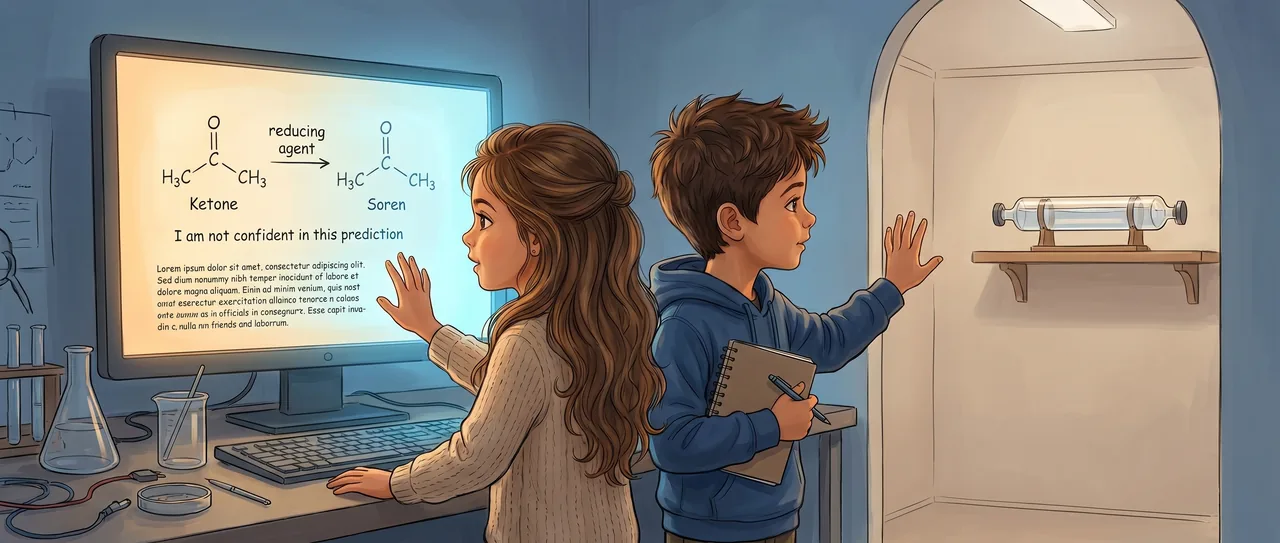
Not no exactly. It said: I am not confident in this prediction.
Maya read the words on the screen three times. In seven months of using ChemLoop for their weekend projects at the Garfield Makerspace, the program had never once said that. It had predicted the products of every reaction they had fed it. Vinegar and baking soda, obvious. Iron and oxygen, easy. Last month it had handled a tricky substitution reaction involving bromobutane without hesitating. Maya had started to think of it the way she thought of a calculator. You press the buttons, you get the answer.
But today she had drawn two molecules on the screen, a prochiral ketone and a borohydride reducing agent, and asked ChemLoop what would happen, and ChemLoop had blinked.
"It's broken," Soren said. He was already writing in his notebook, copying down the exact molecules they had entered.
"It's not broken. Read what it says."
Soren leaned closer. Below the uncertainty warning, ChemLoop had generated a paragraph of explanation. It did that sometimes when they asked about safety. It had never done it for a prediction before.
The explanation said: This reaction's products depend on the three-dimensional arrangement of atoms at the reaction site. Specifically, the reducing agent can approach the carbonyl group from two different faces, producing two different mirror-image products. Which product dominates depends on steric and electronic factors that are underrepresented in my training data. I cannot reliably predict the ratio of products for this class of reactions.
"Mirror-image products," Maya said.
"It's saying the same atoms connect in the same order, but the shape is different."
"I know what mirror images are, Soren."
"I know you know. I'm saying it out loud because it's weird." He held up his left hand, then his right. "Same fingers. Same order. But you can't rotate one to match the other."
Maya held up her own hands and tried. She already knew you couldn't, but she tried anyway, because sometimes knowing a thing and feeling a thing were different.
"So the AI can predict what atoms end up bonded to what," she said slowly. "But it can't predict which side of the molecule the new bond forms on."
"Because the training data doesn't have enough examples of this kind of reaction."
"But why not?"
That was the question that made Soren stop writing. He looked at the screen again. ChemLoop was waiting, cursor blinking, perfectly patient with them in the way that software is patient, which is not patience at all.
"Ask it," he said.
Maya typed: Why is this underrepresented in your training data?
ChemLoop answered: Stereochemical outcomes are more difficult and expensive to characterize experimentally than connectivity outcomes. Many published reaction datasets record what atoms are bonded but not the three-dimensional arrangement. When I learn from those datasets, I learn connectivity well but geometry poorly.
Soren wrote that down too. Maya watched his pen moving and felt something she could not quite name. Not disappointment. Something sharper.
"It knows it doesn't know," she said.
"That's actually pretty good."
"No, listen. It knows exactly why it doesn't know. It can describe the gap. It just can't fill it."
Dr. Reeves walked past their bench carrying a tray of beakers for the afternoon session. She was always carrying something. She paused long enough to glance at their screen and say, "You two breaking my software?"
"Your software broke itself," Maya said.
"Doubt it. Show me later. I'm behind on prep." She was already walking away.
Maya turned back to the screen. She had a list in her head, and something had just been added to it. She could feel it settling into place between "why does hot water sometimes freeze faster than cold" and "what happens to information inside a black hole." The list of things that did not make sense yet.
But this one was different. This one had a shape she could see.
"Soren. The AI learned from millions of reactions."
"Probably."
"And it got good at predicting what bonds form. Really good. We've tested it."
"Forty-three times," he confirmed, checking his notebook.
"But the shape of the product, the three-dimensional, left-hand-right-hand shape, that's harder to measure in a real lab. So the data just doesn't exist in the same quantity. And without the data, the AI hits a wall."
"A very specific wall."
"A wall shaped like a mirror."
Soren almost smiled. "That's not how walls work."
"You know what I mean."
He did. He was quiet for a moment, and then he said something that surprised her. "The AI is honest about it, though. It could have just guessed. Given us a product and not mentioned that it was basically flipping a coin. But it told us."
"Because someone programmed it to flag low confidence."
"Right, but think about that. Someone already knew this was the boundary. Someone already mapped where the knowledge runs out. And they built the warning on purpose, so that the next person who hit the edge would know they'd hit it."
Maya looked at the blinking cursor. She thought about the person who had written that warning. Sitting at their own screen, probably late at night, deciding that an AI that admitted uncertainty was more useful than an AI that pretended certainty.
"We could measure it," she said.
"Measure what?"
"The ratio. The actual products. We could run the reaction. Use the polarimeter Dr. Reeves has in the back room. If one mirror-image product rotates light one way and the other rotates it the other way, we could see which one the reaction actually makes more of."
"And then that's one more data point."
"One more data point at the edge of the wall."
Soren closed his notebook. Not because he was done. Because he was ready to do something other than write.
"Dr. Reeves is going to say we have to do safety review first," he said.
"So we do safety review first."
"And she's going to say it'll take three sessions."
"So it takes three sessions."
He stood up. Maya stood up. On the screen behind them, ChemLoop waited with its honest, blinking admission of what it did not know.
Maya was already walking toward the back room where the polarimeter sat on its shelf, a tube of glass and light that could tell left hands from right hands, one molecule at a time.
Read the interactive version, listen to the narration, and earn a gold star →
A science-verified short story for curious kids · Curiosity Land