The Room That Spoke Perfect Korean
Maya was already inside the booth when Soren arrived, surrounded by laminated cards.
"You're late," she said. "Mrs. Pak needs us running in ten minutes."
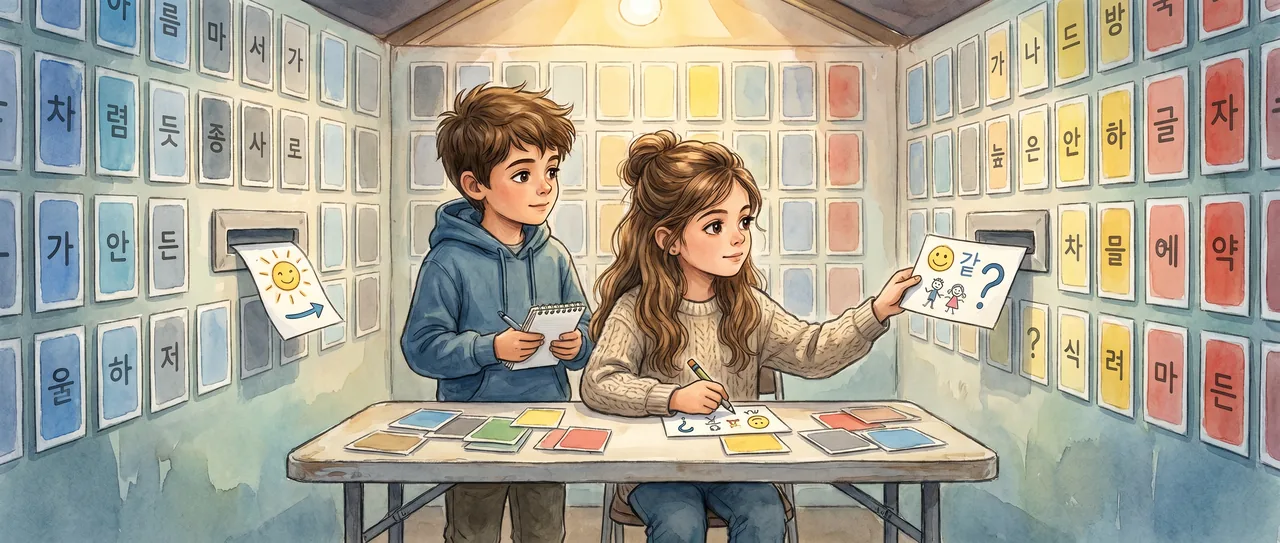
The booth was simple. A slot in the left wall. A slot in the right wall. Between them, a folding table covered in hundreds of color-coded cards, each one printed with a Korean character on the front and an English instruction on the back.
The language festival had twelve booths like this, each one a different language, each one staffed by volunteers who did not speak that language. That was the point. Mrs. Pak had designed the whole thing as a demonstration. The cards were the system. The volunteers were just hands.
"Okay," Soren said, reading the instruction sheet taped to the wall. "Someone outside passes a card with Korean writing through the left slot. We look at the shapes. We match them to these cards. The back of each card tells us which response card to send out the right slot."
"We don't need to read Korean," Maya said.
"We don't need to know a single word."
A slip of paper came through the left slot. Three Korean characters, handwritten in blue ink.
Maya held it up. Soren flipped through the laminated cards until he found matching shapes. The back of the card read: Send response card 7-B through right slot.
He found 7-B. It had Korean writing on both sides. He pushed it through.
From outside, they heard laughter. Then clapping.
"Did we just say something funny?" Maya asked.
"No idea."
Another slip came through. Then another. They got faster. Maya matched the shapes while Soren pulled response cards. Within twenty minutes they had a rhythm. Slips came in, answers went out, and the people on the other side of the wall kept reacting. Laughing. Gasping once. A long pause, then a murmur of voices that sounded impressed.
Soren stopped. He was holding response card 14-A.
"Maya."
"Yeah."
"What are we saying to them?"
"Whatever the cards say."
"But what are the cards saying?"
She looked at him. They both looked at the walls of the booth, the hundreds of laminated cards, the slips of paper piling up. They had been having a conversation in Korean for twenty minutes. The people outside thought so, anyway.
"We could be saying anything," Soren said. "We could be telling someone about our childhood. We could be giving medical advice. We could be writing poetry."
"We could be telling someone we love them," Maya said quietly.
They stared at each other.
A new slip came through. Maya matched it automatically, her hands finding the right card in seconds. Response card 22-D. Soren pushed it out. More voices outside. Someone said something in Korean that sounded like a question, earnest and searching.
"Soren. We are really good at this."
"We're fast, yeah."
"No. I mean the people out there think we're good. They think we understand them. Listen to how they're talking to us."
He listened. The voice on the other side of the wall was speaking slowly now, carefully, the way you talk to someone when you're saying something that matters.
Soren pulled out his notebook and wrote: We produce perfect Korean. We understand zero Korean. Where does the understanding live?
"Maybe it's in the cards," Maya said, reading over his shoulder. "Mrs. Pak wrote them. She speaks Korean. She understood everything when she built the system."
"But she's not here. She's running the festival. The system works without her."
"So the system understands Korean."
"Does it though?" Soren tapped the table. "I'm part of the system. I definitely don't understand Korean. You're part of the system. You don't either. The cards are laminated paper. They don't understand anything. So where in this booth does the understanding happen?"
Maya sat down on the folding chair. "Maybe nowhere."
The voice outside the wall said something else. It sounded gentle. Patient. Waiting for a reply.
Maya matched the shapes. Found the card. Her hands did not hesitate. Response 31-F went through the slot.
The person outside the wall said one quiet word, almost a whisper, and then walked away.
"What did we just say to them?" Maya asked.
"I don't know. But they believed it."
During their break, they found Mrs. Pak by the water fountain. She was organizing schedules and only half paying attention.
"Mrs. Pak, what are people saying to us? In the booth?"
Mrs. Pak glanced up. "Oh, all sorts of things. Some people test you with jokes. Some ask directions. One woman told me she was going to ask the booth for advice about her sister." She looked back down at her clipboard. "The cards handle most common conversations. I spent four months writing them."
"But we don't understand any of it," Soren said.
"That's the demonstration," Mrs. Pak said brightly, already walking away. "You don't have to."
They went back to the booth. Soren closed the door.
"A computer," Maya said.
"What?"
"That's what we are in here. A computer is just a room that follows rules. It takes input, matches patterns, sends output. Fast. Perfectly. And everyone outside thinks it understands."
"Every chatbot. Every translation app. Every program that talks to you," Soren said.
"And the question is whether the room understands, or just performs understanding so perfectly that it doesn't matter."
"It matters to us," Soren said. "We're in the room. We know we don't understand."
"Does the room know?"
Neither of them answered.
A new slip came through the left slot. The handwriting was different this time. Smaller. Careful. A child's handwriting, the characters drawn with visible effort, some of them slightly wrong.
Maya picked it up. The shapes didn't quite match any card perfectly. Close to card 9, but not exact. Close to card 16, but not that either.
"The system doesn't have a response for this," Soren said.
"Because a kid wrote it. And kids make mistakes that don't fit the rules."
They looked at the slip. They looked at the hundreds of cards. They looked at each other.
Maya took a blank response card from the spare pile. She picked up a pen.
She drew a small picture. A smiley face. Two stick figures waving. And then she carefully, slowly, copied the child's own characters back onto the card, mistakes and all, with a question mark beside them.
She pushed it through the right slot.
From outside the wall came a sound. High-pitched. Delighted.
The child pushed another slip through, and this time there was a drawing on it too. A sun with a face. An arrow pointing at the booth.
Soren looked at the drawing, then at the hundreds of perfect laminated cards, then at the slot where something no rule had predicted kept coming through.
Outside, the child knocked on the wall three times, fast, like a heartbeat.
Read the interactive version, listen to the narration, and earn a gold star →
A science-verified short story for curious kids · Curiosity Land