The Other Side of Still
The argument started on the third night.
Maya said the Moon was moving. Soren said it wasn't. They were both right, which was the problem.
"Look at the edge," Maya said, tapping the printout from Tuesday's observation. "Crater Grimaldi. It was right on the limb two nights ago. Now it's further in. The Moon turned."
Soren held up his own printout, Wednesday's, and overlaid it on hers against the light of the mess hall window. The craters did shift. Slightly. He could see it.
"It wobbles," he said. "That's not the same as turning."
"Wobbling is turning. Just not all the way."
"Wobbling is wobbling. Turning would mean we'd eventually see the whole far side, and we never do."
They had been assigned to measure the Moon's libration for Dr. Herrera's observation project. Libration: the tiny rocking motion that lets you peek around the Moon's edges, a few degrees here, a few degrees there. Over a month, you could see about fifty-nine percent of the surface instead of fifty. Nine extra percent. Maya thought this was enormous. Soren thought this was a rounding error. Dr. Herrera thought they should both write it up and stop arguing in the mess hall.
But Dr. Herrera was busy recalibrating the twelve-inch reflector that someone had knocked while trying to photograph Jupiter, so Maya and Soren were left with their printouts and their disagreement and the fact that neither could stop thinking about it.
"Here's what bothers me," Soren said. He set down the printouts and opened his notebook. He had drawn the Earth and Moon, with arrows. "The Moon rotates. One full rotation every twenty-seven days. And it orbits us every twenty-seven days. Exactly the same. That's why we see one face."
"So it does turn," Maya said.
"It turns at exactly the rate that makes it look like it doesn't turn. Yes."
Maya pulled out a chair and sat on it backward. "That's weird."
"That's the part that's weird to you? Not the wobble?"
"The wobble makes sense. Its orbit is an ellipse, so sometimes it's faster, sometimes slower, and the rotation can't keep up perfectly. Wobble. Fine." She waved her hand. "What's weird is the lock. Why would the rotation match the orbit exactly? That's like spinning a coin and having it land on its edge every single time."
Soren had written the same question in his notebook at two in the morning the night before, almost word for word. He turned the page to show her.
Maya read it and grinned.
"Okay," Soren said. "So I looked it up. It's not a coincidence. It happened over time. Billions of years ago the Moon spun faster. Way faster. But the Earth's gravity pulled on it unevenly because the Moon isn't a perfect sphere. The near side bulged a little. And every time the Moon tried to rotate past that sweet spot, the bulge got pulled back. Like a brake."
"Gravitational friction," Maya said.
"Tidal friction, technically. The same kind of force that makes ocean tides. Except acting on rock, over billions of years, slowing the Moon's spin down and down and down until it matched the orbit. And then it stopped slowing. Because there was nothing left to brake against."
Maya was quiet for a moment. She picked up the two printouts and held them side by side again.
"So every large moon does this?"
Soren nodded. "Every one. Io, Europa, Ganymede, Callisto. Titan. Triton. All of them, locked. All of them showing only one face to their planet. It's not special to our Moon. It's what gravity does, given enough time."
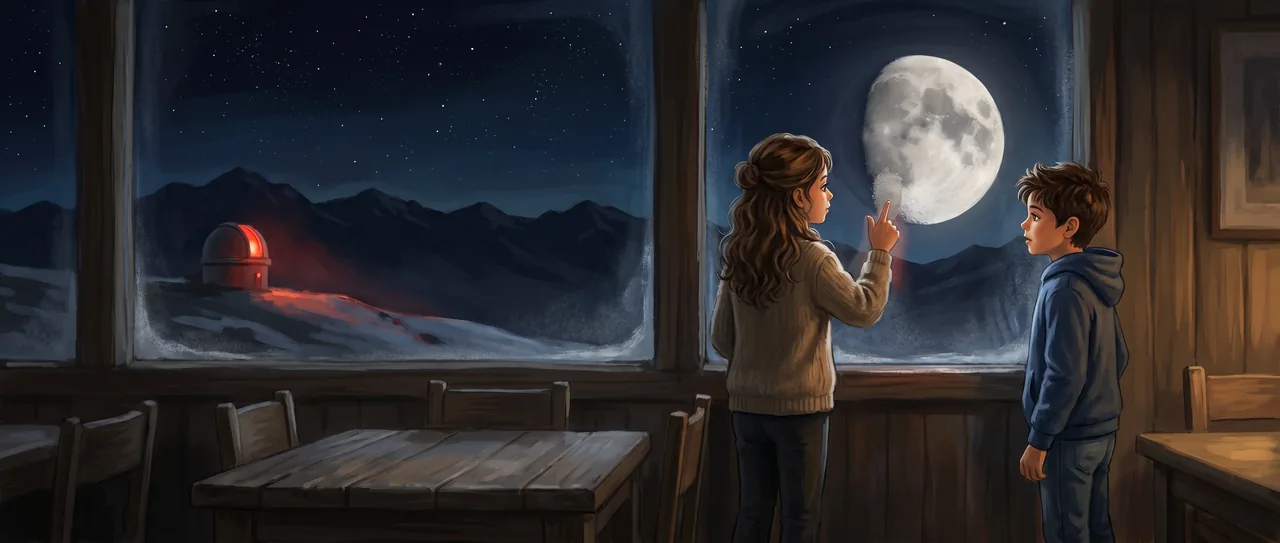
The mess hall was empty now. The other students had gone to the dormitory or back to the telescopes. Through the window, the plateau stretched out flat and dark toward the Andes, and above the mountains the Moon hung, three-quarters full, patient as aeli clock that had found its final position.
Maya stood and walked to the window.
"It's not still," she said. "That's what I keep getting wrong. I keep looking at it and thinking it's still, like a picture someone hung up there. But it's spinning. It's spinning at exactly the speed that makes it look still. Those are completely different things."
Soren came to stand beside her. He could see Grimaldi out near the western limb, right where the libration charts said it should be. Tomorrow night it would tuck back, hiding behind the curve.
"Do you think it's creepy?" he asked. "That it got locked?"
"No," Maya said. "I think it's the opposite of creepy. I think it found where it belongs."
Soren looked at her.
"Not like fate," she said quickly. "Like physics. It tried every other speed and they were all wrong. They all had friction. They all got slowed down. The only speed that doesn't have friction is the one where the bulge faces Earth and stays there. So that's where it ended up. It found the one configuration that lets it just go."
Soren thought about writing that down. Then he thought that some things didn't need to be written down because they weren't going to leave.
"There are people," he said slowly, "who would look at the Moon every night of their lives and never notice that it doesn't rotate from where they're standing. They'd never notice that the same craters face us every single time."
"I know," Maya said.
"And then there are people who would notice and it would keep them up at night."
"I know," Maya said again.
They stood there. The Moon moved across the sky at the speed the Earth's rotation dictated, and the Moon rotated at the speed its long surrender to gravity had settled on, and from the plateau in Chile these two motions combined into what looked like nothing happening at all.
Maya pressed her fingertip to the glass, right over the terminator line where the sunlit part of the Moon gave way to shadow.
"There's a whole side we never see from here," she said. "Not the dark side. It gets just as much sun. Just the other side. Facing out."
"Facing everything else," Soren said.
Down the hill, someone turned on the red light at the observatory dome, and its glow caught the edge of Maya's fingerprint on the glass, a small smudge of oil and warmth on the cold window, pointed at a world that had been falling toward them, and spinning, and slowing, for four and a half billion years, and had finally, finally come to rest in the one position that let it keep going forever.
The red light pulsed once, twice, and held steady.
Read the interactive version, listen to the narration, and earn a gold star →
A science-verified short story for curious kids · Curiosity Land