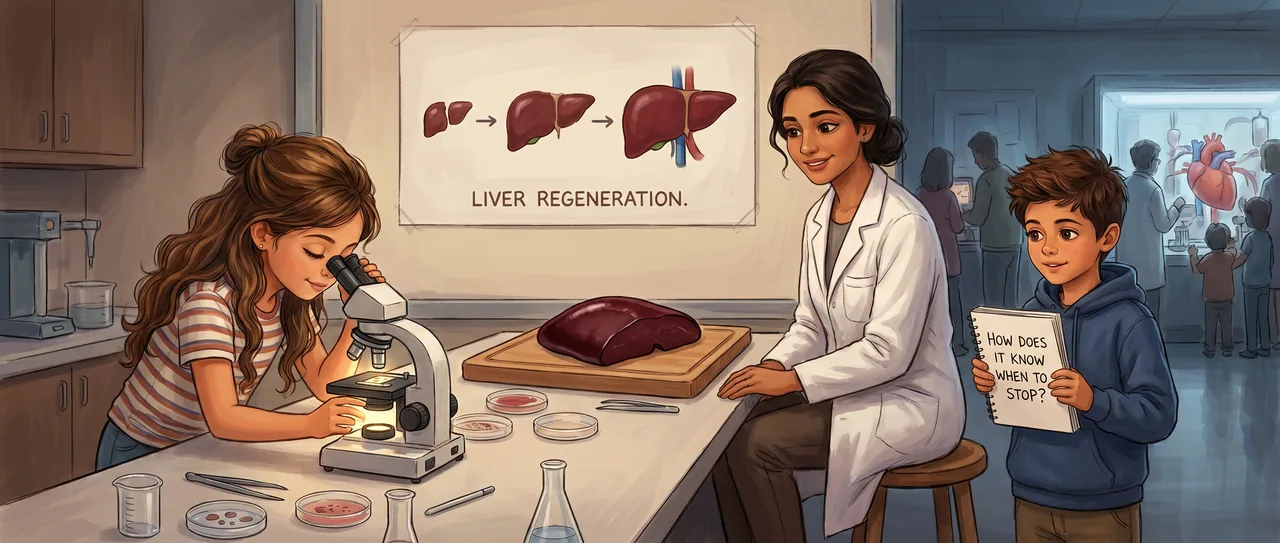
The Organ That Refuses
The heart was getting all the attention.
Of course it was. The university's STEM open house had a whole station where you could watch a pig heart pump colored water through tubes, and every kid in the building had crowded around it, phones out, shouting about how gross and cool it was.
Maya and Soren stood at the next table over, the empty one, where a graduate student named Priya was slicing something dark and wet on a cutting board.
"Nobody ever comes to the liver station," Priya said. She did not sound sad about it. She sounded like someone stating a weather report. "Hearts are dramatic. Livers are not dramatic."
"What is that?" Soren asked, pointing at the glistening chunk of tissue.
"Donated bovine liver. Cow. I'm preparing thin sections for the microscopes." Priya sliced without looking up. "You two can look if you want. Or you can go watch the heart. I genuinely do not mind."
Maya was already at the microscope.
The slice under the lens looked like a city. Not a metaphor Maya had expected. Cells packed tight in repeating hexagonal units, each one arranged around a central vein like streets radiating from a town square. Between the hexagons ran tiny channels, almost too small to see.
"It's organized," Maya said. "Like tiles."
"Lobules," Priya said. "Each one is a tiny factory. Each factory does about five hundred different things."
Soren wrote that number down. Then he looked up. "Five hundred? The same organ?"
"More than five hundred, actually. We've catalogued over five hundred distinct biochemical functions. Filtering toxins. Making bile. Storing vitamins. Building proteins your blood needs to clot. Breaking down old red blood cells. Regulating blood sugar. Managing cholesterol. Processing every single medication you've ever swallowed. I could keep going but my advisor says I talk too much at outreach events."
Maya pulled back from the microscope. "That can't be right. Nothing does five hundred things."
"Your phone does more than five hundred things," Priya said.
"My phone was designed by thousands of people."
Priya almost smiled. "Good point."
Soren looked at his notebook where he'd written the number. "So if it fails..."
"Everything fails. Simultaneously. That's why liver failure kills so fast." Priya set down her scalpel. "We can build an artificial heart. Pump and valves. We can build artificial kidneys, basically filters. We cannot build an artificial liver. We have tried. We're still trying. The chemistry is too complex, too interconnected. Five hundred processes running in parallel, each one affecting the others."
The heart station erupted in cheers. Someone had turned up the pump speed.
Maya looked at Soren. Soren was staring at the microscope slide, at the hexagonal city, and she could see him counting something in his head.
"You said you're still trying," Soren said to Priya. "But there's something else, right? Something the liver does that you haven't mentioned."
Priya blinked.
"Because you've got the microscope set up, and you've got the slides, and you could have put anything on the poster." He pointed to the poster behind her station, which showed a liver regrowing in time-lapse illustrations. "But that's what you actually wanted to show people."
Priya set down her scalpel properly this time, parallel to the cutting board edge, and gave Soren her full attention.
"You can cut away seventy percent of a liver," she said. "Seventy percent. And it will grow back. Completely. Full size, full function. It is the only internal organ in the human body that can do this."
"From thirty percent," Maya said.
"From thirty percent. In some cases, from even less. A living donor can give a piece of their liver to someone who needs one, and both pieces will regenerate into complete organs. The donor's fragment regrows. The recipient's fragment regrows. Two full livers from one."
Soren was not writing this down. His pen was still.
"We don't fully understand how," Priya continued. "We know some of the signals. Hepatocyte growth factor, cytokines, a cascade of chemical triggers. But the mechanism that tells it when to stop growing, how it knows what size to become, why it rebuilds function and not just mass, that's still an open question. A big one."
Maya leaned forward. "It knows its own size?"
"It grows back to approximately the original size and then stops. Every time. We don't know how it measures."
The heart station was winding down. A few kids drifted past. One glanced at the liver poster and kept walking.
"You could cut a heart in half and it would just die," Maya said. Not a question.
"Yes."
"Lungs?"
"No."
"Brain?"
"Absolutely not."
"So the most complicated organ, the one doing five hundred things at once, is the one that can rebuild itself. The simpler ones can't."
Priya opened her mouth. Closed it. Opened it again. "I never framed it that way. But yes. That's exactly the paradox."
Soren finally wrote something. One line. He held it so Maya could read it: Why would the most complex organ be the one that learned to come back?
Maya took his pen. Wrote underneath: Maybe that's why it had to.
Priya was watching them. Not the way adults usually watched, with that patient smile that meant they were waiting for the conversation to end. She was watching them the way she'd been watching her slides. Like they were data.
"Can I ask you two something?" Priya said. "Everyone who comes to this table, the few who do, they ask how the regeneration works. The mechanism. That's the question I'm trained to answer. But neither of you asked that."
"You said you don't know how," Soren said. "So that question doesn't have an answer yet."
"The interesting question is why," Maya said.
Priya pulled a stool over and sat down at their level. "I've been in this lab for three years. Do you want to know what I actually work on? Not the how. The when. Specifically, the moment the remaining cells detect that the rest is gone. The first signal. The instant it decides to begin. Because something in thirty percent of an organ takes a chemical survey of what's missing, and then initiates the most complex rebuilding project in human biology." She paused. "I don't have an audience for that, usually."
Behind them, the heart pump cycled on and off, on and off, performing its one elegant trick.
Maya pressed her eye back to the microscope, where five hundred invisible processes ran through a hexagonal city that knew its own shape, and Soren turned to a blank page.
Read the interactive version, listen to the narration, and earn a gold star →
A science-verified short story for curious kids · Curiosity Land