The Ones That Won't Sit Still
On Tuesday night MIRA got every single one of Soren's dreams right.
He read the printout at breakfast, still creased from the pillow. Consolidating: multiplication table for sevens. Consolidating: layout of the new school building. Consolidating: Spanish vocabulary, unit nine.
The lab assistants acted like this was normal. They had been running the sleep study for three years. Twenty-seven kids this round, each wearing a soft mesh cap that read electrical patterns while they slept, and MIRA, the program that watched those patterns, matched them against the brain activity recorded during the day, and told you in the morning what your brain had been filing away.
"Ninety-four percent accuracy across all subjects this semester," said Dr. Huang, not looking up from her laptop. She was writing a grant proposal and had been writing it all week. "MIRA is very good at what she does."
Maya was looking at her own printout. She had not said anything for three minutes, which Soren had learned to count.
"What's wrong with yours?" he asked.
She turned it around. Most of the lines were the same kind of thing: consolidating the map they'd studied, the piano melody from music class, the sequence of turns in the maze game they'd all played. But at the bottom, in a different font, a line read: UNCLASSIFIED. LOW CONFIDENCE. PATTERN DOES NOT MATCH ANY RECORDED LEARNING EVENT.
Soren looked at the timestamp. Three forty-seven a.m.
"Do you remember what you were dreaming?"
Maya pulled her sleeve over her hand. "My grandmother's kitchen."
"Were you thinking about it yesterday? During the day?"
"No." She paused. "I don't think I was thinking about it exactly. Someone in the hallway was making tea and it smelled like her house."
Soren wrote that down.
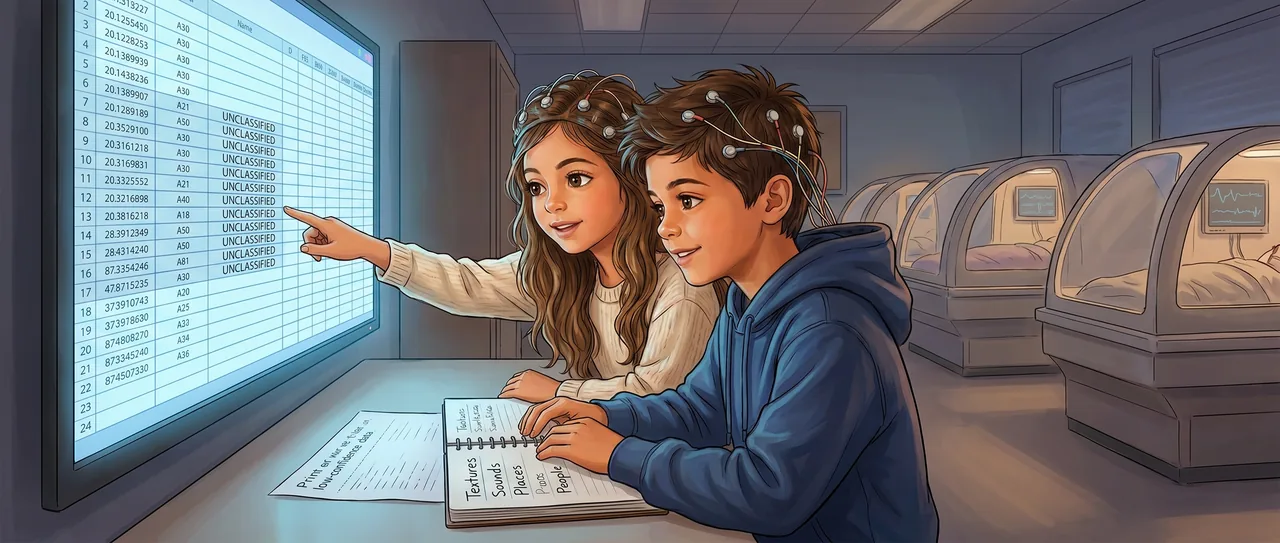
That afternoon, between the memory tasks the researchers had them do, Soren asked Dr. Huang if he could see the full accuracy report. She waved toward the shared screen on the wall without looking away from her laptop. "Knock yourself out."
The spreadsheet was enormous. Three years of subjects, thousands of nights, tens of thousands of identified memories. And in one column, a counter for unclassified events. Soren sorted by that column.
Maya leaned over his shoulder. "There are a lot of them."
There were. Hundreds. MIRA's ninety-four percent was real, but the six percent wasn't random noise. The unclassified events clumped. Some subjects had none at all. Others had five or six in a single week.
"What's different about the people who have more?" Maya asked.
Soren started cross-referencing. The spreadsheet had demographic data, the type of memory tasks each group had been given, even what the subjects ate for dinner. Nothing obvious.
Maya pointed. "Look at the survey."
Every morning, subjects answered a short questionnaire: did you dream? Do you remember the dream? Can you describe it?
The unclassified events almost always lined up with one particular answer on the questionnaire. Not "no, I don't remember." They lined up with "yes, I remember, but I can't really describe it."
Soren pulled his notebook out and started listing what those subjects had written in the free-response box.
"The way my dog's ears felt." "Being at the lake but not any specific time at the lake." "The sound of my dad's car in the driveway, not any one time, just the sound." "My best friend's laugh but I can't say which laugh."
"These aren't events," Maya said.
"They're definitely memories, though."
"But they're not a time and a place. They're not a fact. They're more like," she stopped, tried again, "they're what's left after you've remembered something so many times that the edges dissolve."
Soren looked at the mesh cap on the table. During the day, MIRA recorded your brain while you learned specific things. A melody. A map. A list of words. Then at night, it looked for those same patterns replaying. That was how it matched. The input had to come first.
But the tea smell in the hallway wasn't a learning event. Nobody recorded Maya's brain while she smelled it. Nobody recorded her grandmother's kitchen at all, ever, because it wasn't part of the study. It was part of her.
And more than that. The memories in the free-response box weren't single moments. They were something a brain had built out of dozens of moments, maybe hundreds, blurred together until they became a feeling with no specific timestamp.
MIRA could match a pattern she had seen before. She couldn't match a pattern that was never one pattern. That was always many.
"She can read the filing cabinet," Soren said. "She can't read the ones that won't sit still in a folder."
Maya took the notebook from him, which she only did when she was excited. She flipped to a blank page and started listing the unclassified descriptions again, but this time she was grouping them.
Textures. Sounds that weren't a specific sound. Places that weren't a specific visit. People who were a feeling more than a face.
"These are the most important ones," she said. "These are the ones that are actually you. Not the sevens table. Not Spanish unit nine. The ones your brain made out of a whole life of something."
Soren watched her writing. He was thinking about his own printout, the clean and correct one, every memory identified. He was thinking about the thing he couldn't name about the way his house smelled when it rained. He was thinking about whether MIRA would ever see it, and then he was thinking that maybe seeing it would require being a person who had stood in that hallway a thousand times on a thousand different rainy days.
"We should tell Dr. Huang," he said.
They found her still at her laptop. She listened for about ninety seconds, then held up one hand.
"The unclassified events are noise. They're below our confidence threshold. They're not part of the study."
"They're not noise," Maya said. "They're the ones MIRA can't see because they were never one thing."
Dr. Huang looked at them over her glasses. For a moment something shifted in her face, the expression of a person whose grant proposal was about accuracy rates and who had just been handed a question about what accuracy might be missing.
"Show me your groupings," she said.
That night, lying in her pod with the mesh cap on, Maya thought about the tea smell in the hallway. She thought about her grandmother's hands around a white cup. She thought about whether her brain was, right now, replaying that memory, and whether MIRA was watching the signal spike and finding nothing in its database to call it, no label, no category, just a bright unreadable pulse that meant something enormous and had no name.
She closed her eyes and let it be unclassified.
In the morning, at the bottom of her printout, the same line: UNCLASSIFIED. LOW CONFIDENCE. PATTERN DOES NOT MATCH ANY RECORDED LEARNING EVENT.
Maya held the paper up so Soren could see it across the breakfast table, and both of them smiled.
Read the interactive version, listen to the narration, and earn a gold star →
A science-verified short story for curious kids · Curiosity Land