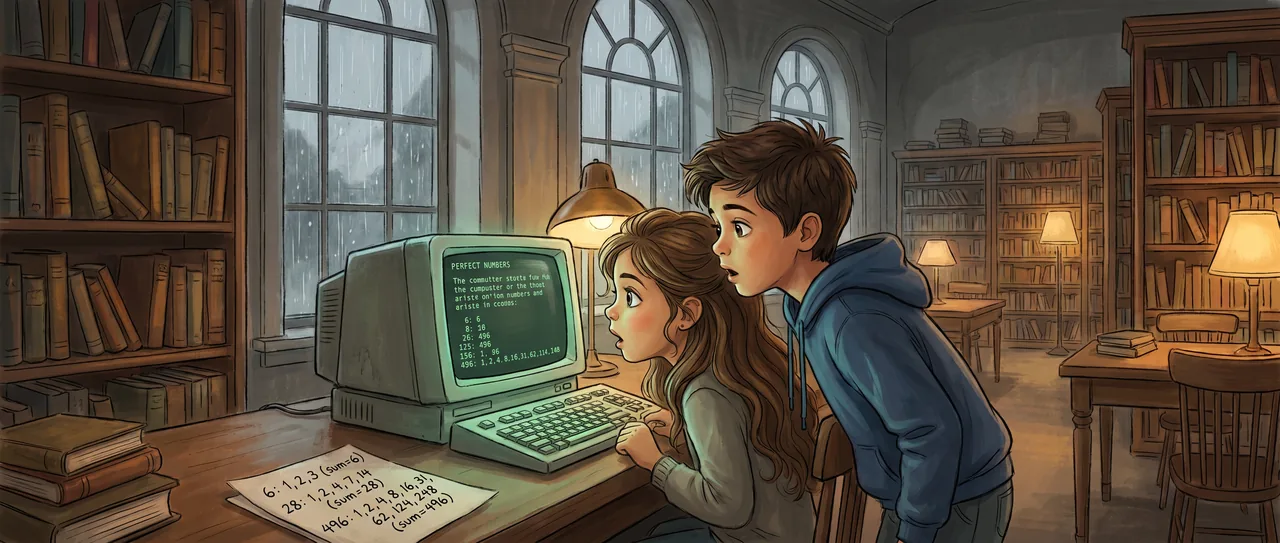
The List of Sixes
The problem on the practice sheet said: A number is called perfect if it equals the sum of all the numbers that divide it evenly, not counting itself. Find the two smallest perfect numbers.
Soren had six in forty seconds. One plus two plus three. Six.
Maya had six in about ten seconds, but she was already past it, writing numbers in a column on the back of the sheet, her pencil moving in short jabs.
"Twenty eight," she said.
"Wait." Soren was checking twelve. One, two, three, four, six. That added to sixteen. Too much. He moved to fifteen. One, three, five. Nine. Not enough. He kept going.
Maya slid her paper over. She had written 1, 2, 4, 7, 14 and drawn a line under them. The sum was twenty eight.
"How did you find it so fast?" he asked.
"I don't know. It felt right."
Soren checked it. Every divisor, every addition. Twenty eight.
They were supposed to stop there. The practice sheet had forty other problems. But Maya was already writing the next numbers in her column, hunting for the third perfect number.
"It's going to be big," Soren said.
"How do you know?"
"Because if they were close together, the problem would have asked for three."
Maya looked at him sideways, then grinned. "Yeah. Okay."
They split the work. Soren took the numbers from thirty to two hundred. Maya took two hundred to five hundred. For each number, list the divisors. Add them. Compare. It was slow and repetitive and completely absorbing. The rain hit the tall library windows. The radiator clanked. Neither of them noticed.
Soren crossed off number after number. Some came close. Two hundred twenty had divisors that added to two hundred eighty four. He circled that because it was interesting, two numbers whose divisors pointed at each other, but it wasn't perfect.
Maya finished her range first. Nothing.
"Five hundred to a thousand?" she said.
"This is going to take forever."
"Good."
Mrs. Azarian, the weekend librarian, came by with a cart of returns and paused at their table. She was always slightly out of breath, always carrying too many books, and she never asked if they needed help. She looked at the columns of numbers.
"Perfect numbers," she said. "Third one is four ninety six. I did the same search when I was your age. Took me all weekend." She shelved a book on the wrong shelf, noticed, fixed it, and pushed the cart away.
Soren stared at Maya.
"She just told us," he said.
"So check it."
He checked it. One, two, four, eight, sixteen, thirty one, sixty two, one hundred twenty four, two hundred forty eight. He added them carefully, twice. Four hundred ninety six.
"She's right," he said. Then: "Thirty one is in there. That's prime. And eight times thirty one is two hundred forty eight. And sixteen times thirty one is four ninety six. That's the number itself."
Maya pulled Soren's sheet closer. She looked at six. Its biggest prime divisor was three. Two times three equaled six. She looked at twenty eight. Biggest prime divisor was seven. Four times seven equaled twenty eight. She looked at four ninety six. Biggest prime divisor was thirty one. Sixteen times thirty one equaled four ninety six.
"Two, four, sixteen," she said. "Powers of two. And three, seven, thirty one. Those are all one less than a power of two."
Soren wrote them out. Three was four minus one. Seven was eight minus one. Thirty one was thirty two minus one.
"So the pattern is, you take a power of two, subtract one, and if that's prime, you multiply it by the power of two before it, and you get a perfect number."
"If that's prime," Maya repeated. "Not all of them will be. Fifteen is sixteen minus one, and fifteen is not prime."
"So that's why they're rare."
They sat with this for a moment. The rain had gotten heavier. The windows shook.
"They're all even," Soren said quietly.
Maya looked at the three numbers. Six. Twenty eight. Four hundred ninety six. All even.
"Well, they have to be, with this pattern. You're multiplying by a power of two. That makes them even."
"But what if there's a different pattern," Soren said. "One that makes odd perfect numbers."
Maya opened her mouth and then closed it. She stared at the column of numbers she'd been testing, all those failures between six and five hundred. She had checked odd numbers in there. Lots of them. None had worked.
"Maybe there aren't any," she said.
"Maybe. But maybe they're just really, really big. Bigger than we'd ever check by hand."
Maya got up and went to the library computer terminal, the old one near the reference section that smelled like dust and warm plastic. Soren followed. She typed for a while.
"Soren."
"What."
"Nobody knows."
He leaned over her shoulder. She had found a page about perfect numbers. The ancient Greeks had known about them. Euclid had found the pattern they'd just found, the one with primes that are one less than a power of two. That was three hundred years before the common era.
And in all the centuries since, with all the computers and all the mathematicians and all the searching, no one had ever found an odd perfect number. And no one had ever proved that one couldn't exist.
"It's been two thousand years," Soren said.
"More than two thousand years."
They looked at each other. Soren felt something shift behind his ribs, a kind of vertigo, like standing at the edge of a cliff made of numbers that went down forever. The problem was simple enough that they had found the pattern in a library on a rainy Saturday. And it was hard enough that every person who had ever lived had failed to finish it.
"If one exists," Maya said slowly, "it would have to be built completely differently. A whole other architecture. Something nobody has imagined yet."
"And if one doesn't exist, the proof of why not is something nobody has imagined yet either."
Mrs. Azarian's cart squeaked somewhere in the stacks behind them. The radiator clanked twice. Rain ran down the tall windows in long, branching paths.
Maya pulled a blank sheet of paper from the printer tray and set it on the table between them, white and empty.
"Pick a number," she said.
Read the interactive version, listen to the narration, and earn a gold star →
A science-verified short story for curious kids · Curiosity Land