The Last Hundred
The problem was that the math worked perfectly and the birds were dying anyway.
Maya had the spreadsheet open on the refuge's old tablet, the one with the cracked corner that Dr. Vasquez kept meaning to replace. Three years of data. Colony size, eggs per nest, chicks fledged, predation events. Soren had copied the numbers into his notebook in three neat columns because he said he could see patterns better on paper, and Maya had stopped teasing him about it in June.
"The habitat's the same," Maya said. "Same beach. Same fencing. Same amount of protected nesting area."
"Same number of volunteers scaring off dogs," Soren added. He was not smiling.
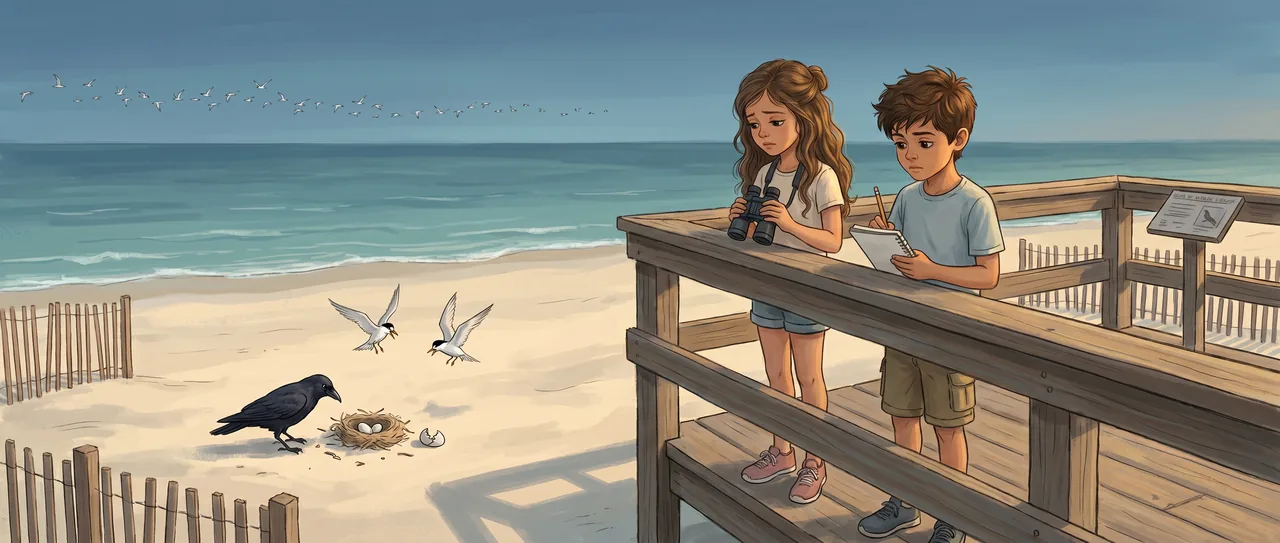
They were sitting on the observation platform above Beach Section C, where three hundred and twelve least terns had nested two years ago. Last year, two hundred and nine. This year, Dr. Vasquez's count said ninety-one.
The fencing was intact. The signs were posted. The dogs were leashed. The habitat had not changed at all. But the colony was falling like something pushed it.
"She thinks it's the foxes," Soren said. He meant Dr. Vasquez, who was currently two sections down, radio-tagging a gull she suspected of nest predation. Dr. Vasquez was brilliant about gulls. She had published three papers on gull behavior. She saw gulls and foxes in everything.
"The fox predation rate hasn't changed, though," Maya said. She tapped the column. "Look. Four percent. Four percent. Three point eight percent. If anything it went down."
"So why are fewer chicks surviving?"
Maya pulled her knees up. She had that expression Soren recognized, the one that meant she had seen the shape of something but didn't have the name for it yet.
"What if we're looking at this backward," she said.
"Backward how?"
"We keep asking what's killing them. What if the question is what was keeping them alive?"
Soren wrote that down. Not because he thought it was the answer, but because it changed the direction of the question, and that was worth recording.
They walked the perimeter of Section C at the approved distance, binoculars up. The terns wheeled and screamed above their nests. Maya had learned to love the screaming. It meant the colony was alert, aggressive, willing to dive at threats.
But today the screaming sounded thinner.
"Count the mobbing birds," Maya said suddenly.
Soren trained his binoculars on a crow that had wandered near the eastern edge of the colony. Three terns rose to chase it. They dove, shrieking. The crow dodged lazily and kept walking.
"Three," Soren said.
"Two years ago, how many birds would have mobbed a crow?"
Soren thought about the videos Dr. Vasquez had shown them during orientation. Clouds of terns descending. Twenty, thirty birds at once, striking with their beaks, a wall of fury that sent crows and foxes and gulls running.
"A lot more than three," he said.
The crow reached a nest. It ate the egg in four seconds. The three terns screamed and dove, but three was not enough to stop a crow that had learned it could take the hit.
"It's the same number of foxes," Maya said, talking fast now. "The same number of crows. The same predation pressure. But the colony's defense doesn't scale down proportionally. It collapses."
"Because ten birds can't do what thirty birds did," Soren said. "They can't cover the same perimeter. They can't overwhelm a predator the same way."
"And it gets worse. Because every egg the crow takes means fewer birds next year, which means fewer defenders, which means more eggs taken."
Soren's pencil stopped moving. He looked up from his notebook at the screaming, wheeling, furious, insufficient birds.
"It's a spiral," he said.
"It's a cliff," Maya said. "There's some number where the colony works. Where there are enough birds to defend enough nests to produce enough chicks to keep the colony above that number. And below it, everything falls apart. Not slowly. Fast."
They were quiet for a while. The terns kept screaming.
"We have to tell Dr. Vasquez," Soren said. "She's focused on the foxes. She's trying to reduce predation, but if Maya, if the problem is that the colony's too small to defend itself, then reducing the foxes won't be enough. Not unless you can reduce every predator to zero, and you can't."
"We need to increase the colony," Maya said. "Not decrease the threats."
"How do you increase a colony of wild birds?"
Maya pointed down the coast. "Section F. Dr. Vasquez said they abandoned it three years ago when the nesting substrate degraded. But they replaced the substrate last winter. It's ready. Nobody's nesting there because there are no birds there to attract other birds."
"Terns nest near other terns," Soren said.
"Terns nest near other terns. So what if they thought other terns were already there?"
Soren stared at her. "Decoys."
"Decoys. And sound. Play colony noise through speakers. Make Section F look occupied. Split the colony across two sections so neither one is so small that the defense collapses. Or better, attract new birds from other colonies passing through."
"That's, I mean, does that work?"
"I don't know. But it's the right shape."
They found Dr. Vasquez at Section A, crouched over her radio equipment with her hat on sideways and gull data spread across three clipboards. She listened with the particular expression of someone being interrupted from work she considered urgent.
"The fox population is the proximate cause," she said when they finished.
"But the fox population hasn't changed," Maya said.
"The colony's relationship to the fox population has changed," Soren said. "Because the colony got smaller."
Dr. Vasquez opened her mouth, closed it, and pulled one of Soren's data columns toward her. She ran her finger down the numbers.
"The per-nest predation rate should have stayed constant," she said slowly. "If the threat was external. But it didn't."
"It accelerated," Maya said.
Dr. Vasquez sat back. She took her hat off. She put it on again. She looked out at Section C, where the thin line of terns screamed at the sky.
"I have decoys in the equipment shed," she said. "Left over from a plover project in twenty-nineteen. I need to make some calls."
She was already reaching for her phone, already somewhere else, and Maya and Soren walked back to the observation platform alone.
The sun was low. The terns were settling. Out on the sand, the three defenders had regrouped at the colony's edge, heads turning in unison, watching for the crow.
Soren counted them under his breath.
Ninety-one birds, defending the minimum of everything they had.
Read the interactive version, listen to the narration, and earn a gold star →
A science-verified short story for curious kids · Curiosity Land