The Color Between
Soren's aunt Lina was impossible to mix paint for.
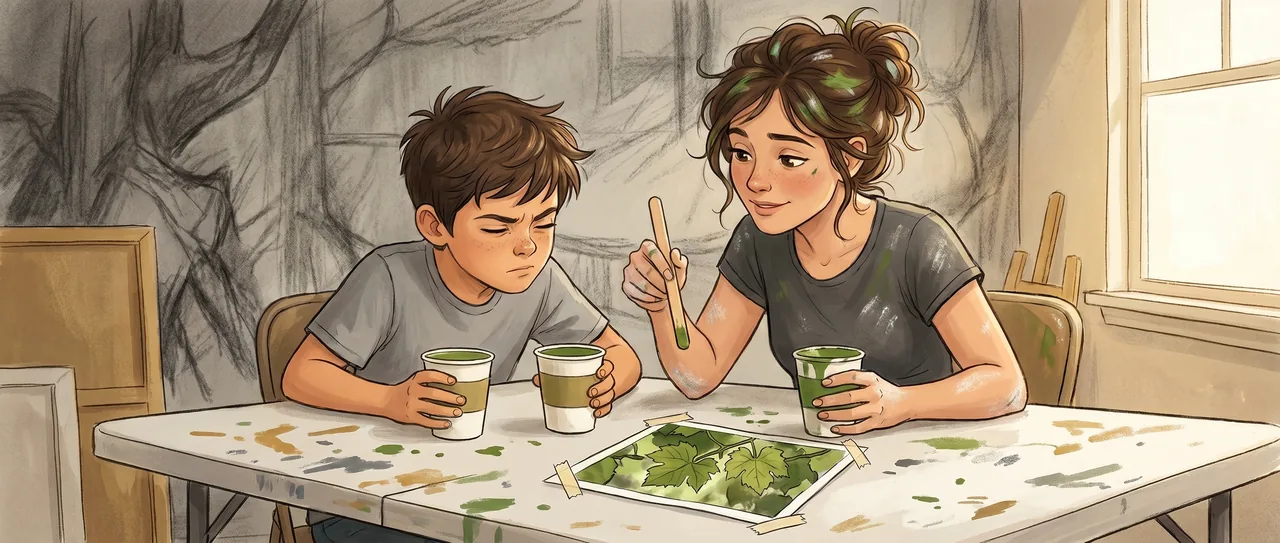
Not difficult. Impossible. He had been standing at the folding table for forty minutes, squeezing cadmium yellow and ultramarine blue into a paper cup, stirring with a wooden stick, and holding it up for her approval. She kept saying no.
"It's green," Soren said. "It is extremely green."
"It's the wrong green." Lina didn't look away from the mural wall, where she was sketching outlines in charcoal. She had paint in her hair and chalk dust on both elbows and she spoke to him the way she spoke to everyone, which was sideways, while doing three other things. "It buzzes."
"Buzzes."
"Too much yellow. Not yellow. There's something in it. An orange that shouldn't be there."
Soren looked at the cup. It was green. The same green as the reference photo taped to the table, the one showing the vine leaves Lina wanted for the mural's border. He held the cup next to the photo. Match. Clearly a match.
He wrote in his notebook: She says it buzzes. I can't see the buzz.
He tried again. Less yellow this time. More blue. He stirred until the color was uniform, held it up.
Lina glanced over. "Closer. But it's still not quiet."
"Quiet," Soren repeated.
"The green in the photo is quiet. Yours is arguing with itself."
Soren set the cup down. He was not frustrated, exactly. He was working on something. The problem was not that he was bad at mixing paint. He had mixed paint before. He had matched colors before. Other people had looked at his mixtures and said yes, that's right. But Lina kept seeing something he couldn't see, and the interesting part, the part that made him pick up his notebook again, was that she wasn't making it up.
He knew she wasn't making it up because of the way she flinched. When he held up the wrong green, she reacted before she had time to think about it. The same way you pull your hand off a hot pan. Her face just did something, fast and involuntary, and then she found words for it.
He flipped back through his notebook to something he'd copied from a library book two weeks ago, for no particular reason except that it had seemed strange enough to write down.
Most humans have three types of cone cells. Some women have four. A fourth cone between red and green. They may see colors other people cannot. Estimated twelve percent of women.
"Aunt Lina," Soren said. "How many colors are in that green?"
"What do you mean how many?"
"If you look at the green in the photo. Is it one color, or is it made of colors?"
Lina stopped sketching. She turned around for the first time in twenty minutes and actually looked at him. Then she looked at the photo. She was quiet for a while.
"There are at least three," she said. "There's the green, and then there's a sort of warm thing underneath it, and then right at the edge where the light hits, there's something I don't have a word for. Between gold and brown but not either."
"I see one color," Soren said.
"One?"
"Green."
Lina stared at him. Then she laughed, not unkindly. "I thought you were just being sloppy with the mixing."
"I thought you were being difficult."
"Fair enough."
Soren wrote: She sees three colors where I see one. This is not about opinion or training. She has different hardware.
He looked at his cup of green paint. It was still just green. But now he understood that Lina's eyes were pulling the mixture apart the way his ears could pull apart a chord on a piano. She heard the individual notes in the green, and one of them was wrong.
"Can you mix it?" he asked. "If I can't see what you see, I can't match it. But you can."
"I've always mixed my own paint," Lina said. "Nobody ever gets it right. I figured I was just picky."
She came to the table and picked up the yellow and the blue and a tube of raw umber that Soren had not considered. She squeezed amounts so small they were barely visible. She stirred. She held the cup next to the photo and tilted it in the light, and something in her face settled.
"There," she said.
Soren looked at Lina's green and then at his green. They were the same. They were the same green. He held them side by side, switching hands, squinting.
"I literally cannot tell the difference," he said.
"I know," Lina said. And then, quieter, "I have always known the colors were there. I just thought everyone else was being lazy about it."
Soren sat down on the folding chair. The mural wall was huge in front of him, all charcoal outlines and empty space. In a few hours it would be full of color. Lina's color. Colors she could see and name, colors she could see and not name, colors she could see that had no names at all because the languages were built by people with three kinds of cone cells, not four.
He tried to picture it. Twelve percent of women. That meant roughly one in eight. He thought about his school, his street, the grocery store. One in eight women walking around with a sense that didn't match anyone else's, with no way to prove it, no way to share it. Seeing a world richer than the one everyone agreed on, and being told they were just picky.
He thought about what other senses might vary. What other spectrums might be wider for some people and narrower for others. What it would mean if every person carried a slightly different window, and nobody's window was the whole thing.
He opened his notebook. He didn't write anything. He closed it again.
"Aunt Lina," he said. "What color is my shirt?"
She glanced at him. "Which layer?"
"There's only one layer. It's a grey t-shirt."
"Soren," she said, picking up her charcoal again, already turning back to the wall, "nothing is grey."
He looked down at his shirt for a long time, at the ordinary fabric he had pulled from a drawer that morning without thinking. He held his sleeve up to the light and turned it, slowly, the way Lina had turned the cup of paint.
Read the interactive version, listen to the narration, and earn a gold star →
A science-verified short story for curious kids · Curiosity Land