Sixty Pennies
The demonstration had been a disaster.
Mr. Huang had promised the parent volunteers a dazzling show. Carbon arc lamps, bright flashes, the works. Instead, the power supply had surged, the lamp had popped, and a fine black soot now coated the inside of the glass bell jar like the world's saddest snow globe. The parents had smiled politely and moved on to the bake sale table.
Now it was Saturday morning, and Maya and Soren were the only two who had shown up to help clean the lab. Mr. Huang had left them a note on the whiteboard: "Wipe down stations. Bell jar is trash. Sorry about yesterday. Back by noon."
Soren was wiping down the counter near the bell jar when he stopped.
"Maya."
"Yeah."
"Come look at this soot."
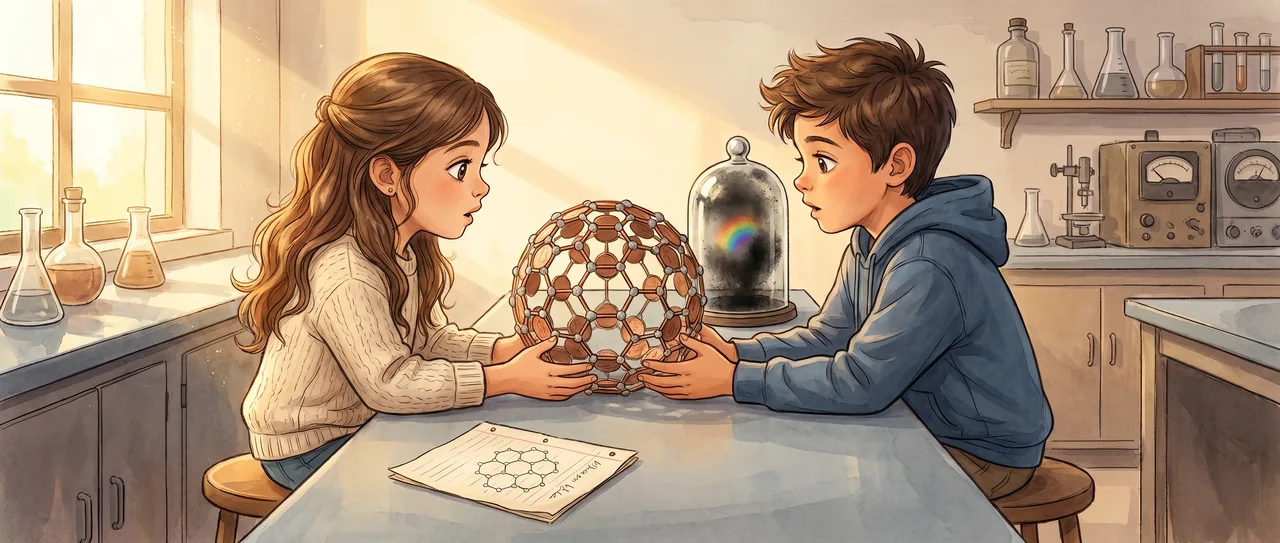
Maya set down her spray bottle and walked over. Inside the bell jar, the black residue was thick and velvety. But where the arc had been hottest, right at the center of the scorch mark, the soot had a different texture. Almost oily. A faint rainbow sheen, like gasoline on a puddle.
"That's not regular soot," Maya said.
"No," Soren said. "It isn't."
He ran his finger along the outside of the glass, tracing the edge of the sheen. "The arc was just carbon electrodes, right? Carbon burning in helium. Mr. Huang said helium because it doesn't react with anything."
"So everything in there is just carbon," Maya said. "Carbon and nothing else."
"Then why does it look different here?"
Maya pulled a stool over and sat down, staring at the jar the way she sometimes stared at a math problem that was about to tip. "Carbon does three things," she said. "Diamond. Graphite. Soot. That's it."
"That's what we learned," Soren said.
He said it in the specific way that meant he was leaving room for being wrong.
Maya picked up Mr. Huang's note, flipped it over, and started drawing. A hexagon. Then another hexagon next to it, sharing one side. Then more, tessellating outward like chicken wire.
"Graphite," she said. "Flat sheets. Hexagons forever."
"Right."
"But Soren. A flat sheet of hexagons goes on forever. What if it didn't? What if it had to close?"
Soren sat down on the next stool. "Like a ball."
"Like a ball. Can you tile a ball with hexagons?"
He thought about it. Really thought about it, the way he did, going step by step. He picked up the spray bottle and looked at the cap. "Soccer balls," he said slowly. "Soccer balls aren't all hexagons. They have pentagons too. The white patches are hexagons and the black patches are pentagons."
Maya grabbed a handful of pennies from the donation jar that was still sitting on the counter from the failed fundraiser. She started arranging them in a ring on the lab bench. Five pennies in a tight circle. Then she added pennies around the outside, trying to make it curve.
"It won't work flat," she said. "Five pushes it into three dimensions. Here, hold these."
They didn't have glue or tape or anything that would hold pennies in a dome shape. So they used what they had. Maya rolled small bits of cleaning putty into balls and started connecting pennies edge to edge, building outward from the first ring of five.
Soren counted as they went. He always counted.
"Five in the first ring. Then you need one between each of those to make a hexagon around each pentagon. That's ten more. Fifteen."
"And it's curving," Maya said. The structure was already pulling itself off the table, wanting to be round. She had to hold it gently.
"More pentagons," Soren said. "You need another pentagon to keep it curving, right?"
They kept building. Soren kept count. The shape grew under their hands, and it was strange because they were not deciding what it should look like. They were just following the rule. Hexagons everywhere, but when the surface needed to curve, a pentagon. And the pentagons kept showing up exactly where they had to, evenly spaced, as if the geometry was making its own decisions.
The shape closed.
Not almost closed. Not roughly closed. The last penny clicked into place and the sphere was perfect.
"How many?" Maya asked.
"Sixty," Soren said. He had counted twice. "Twelve pentagons and twenty hexagons. Sixty vertices. Sixty pennies."
They both sat there holding it, one hand each, the copper sphere the size of a grapefruit between them, and neither of them spoke for a moment because the thing in their hands was not a thing they had built. It was a thing that had wanted to exist.
"That's what the soot is," Maya said quietly. "In the hot part. Where the arc was. Carbon atoms doing exactly this."
"Sixty atoms," Soren said. "In a ball."
"And nobody told them to. The heat just. Let them."
Soren set the penny sphere down carefully on the lab bench. It rocked once and settled. He pulled out his notebook, then stopped. He looked at the bell jar instead.
"The guys who found this," he said. "They weren't trying to make it either, were they?"
"No," Maya said. "Mr. Huang told us. They were trying to simulate what happens in stars. Red giants. Carbon in a dying star."
"And they got this instead."
"And they got this instead."
Soren looked at the sphere of pennies. Sixty cents. The most symmetrical molecule ever found, and two chemists had stumbled onto it while pretending to be a star. And now two kids had stumbled onto it while cleaning up a mess.
"Soren," Maya said. "How many shapes like this are there? That we haven't found yet? Because nobody made the right accident?"
The bell jar sat on the counter, its black soot ordinary on the edges, iridescent at the center. A record of something that the universe had always known how to make, waiting inside every carbon arc for someone who would bother to look at the residue instead of wiping it away.
Mr. Huang's note said the bell jar was trash.
Maya picked it up with both hands and set it on the windowsill where the light came through.
Read the interactive version, listen to the narration, and earn a gold star →
A science-verified short story for curious kids · Curiosity Land