What the Phones Learned in the Dark
The problem was simple. They had forty-three photos of shells and needed ten thousand.
"We could ask people to upload their pictures," Soren said, scrolling through the forum post he'd drafted. The weekend coding workshop had given them access to a basic machine learning framework, a room with terrible Wi-Fi, and a mentor named Davi who was mostly on a phone call in the hallway.
"They won't," Maya said.
"Why not?"
"Because I wouldn't." She held up her own phone. "I have two hundred shell photos on here. They've got my location in the metadata. Some have my little brother in the background. One has the inside of my ear because he grabbed the phone. I'm not uploading them to some server."
Soren put his pen down. "So people have exactly the data we need. Thousands of shell photos, sitting on their phones. And they won't share them. And we can't blame them for not sharing them."
"Right."
They sat with that for a while. Through the window, the tide was pulling back, leaving the dark wet flats that smelled like iron and salt. Somewhere out there, on the phones of every beachcomber and tourist and marine biology student in the region, were the photos that could train their model. Locked away by something that wasn't selfishness. Something that was actually reasonable.
Soren opened his notebook and drew two circles. One he labeled OUR SERVER. The other he labeled EVERYONE'S PHONES. Between them he drew a wall.
"What if the wall is the point," Maya said.
Soren looked up.
"What if instead of the photos coming to the model, the model goes to the photos?"
Soren's pen hovered. "You mean, send the model out. To their phones."
"Send a copy of it. A little unfinished copy. Their phone looks at their photos, learns something, and sends back just the learning. Not the photos. Just, I don't know, the adjustment. What it figured out."
"That's," Soren started, then stopped. He wrote the word GRADIENT on the wall between his two circles, with an arrow pointing from EVERYONE'S PHONES toward OUR SERVER. Then he stared at it.
"The photos never move," he said slowly.
"The photos never move. We never see them. We never store them. We just get the lesson they taught."
Davi stuck his head in, phone still against his shoulder. "You two need anything? More training data?"
"We're figuring something out," Maya said, not looking up.
Davi nodded and vanished back into the hallway.
Soren was already reading, flipping through the framework documentation on his laptop. "There's a name for this. Federated learning. It's real. It's an actual technique people use." He turned the screen so Maya could see. "Each device computes its own gradient update locally. Only the update gets shared. Then the central model averages all the updates together and sends the improved model back out for another round."
"So our server never touches a single photo."
"Not one. It just collects these little nudges from thousands of phones. Each nudge says something like, I saw a razor clam and the model was wrong about it, here's the direction it should adjust. But you can't reconstruct the photo from the nudge. It's like, imagine someone tastes a hundred different soups and tells you the overall recipe needs more salt. You don't know what any individual soup tasted like. You just know the direction to move."
Maya pulled up a blank architecture diagram and started sketching. "Round one. We push a bad model to everyone. It knows nothing. It thinks every shell is a scallop."
"Each phone runs it against their own photos. Gets the errors. Computes how the model should change to be less wrong, based on what it saw locally."
"Sends back only the change. We average all the changes together. Push the updated model back out. Round two."
"And the model gets smarter and smarter, trained on data it never saw."
They looked at each other.
"How many rounds?" Maya asked.
"Depends. Hundreds, maybe. But each round, thousands of phones contribute at once." Soren leaned back. "There could be a phone in someone's pocket right now, at the beach, training our model on their private photos while they eat a sandwich. And they'd never have to trust us with anything."
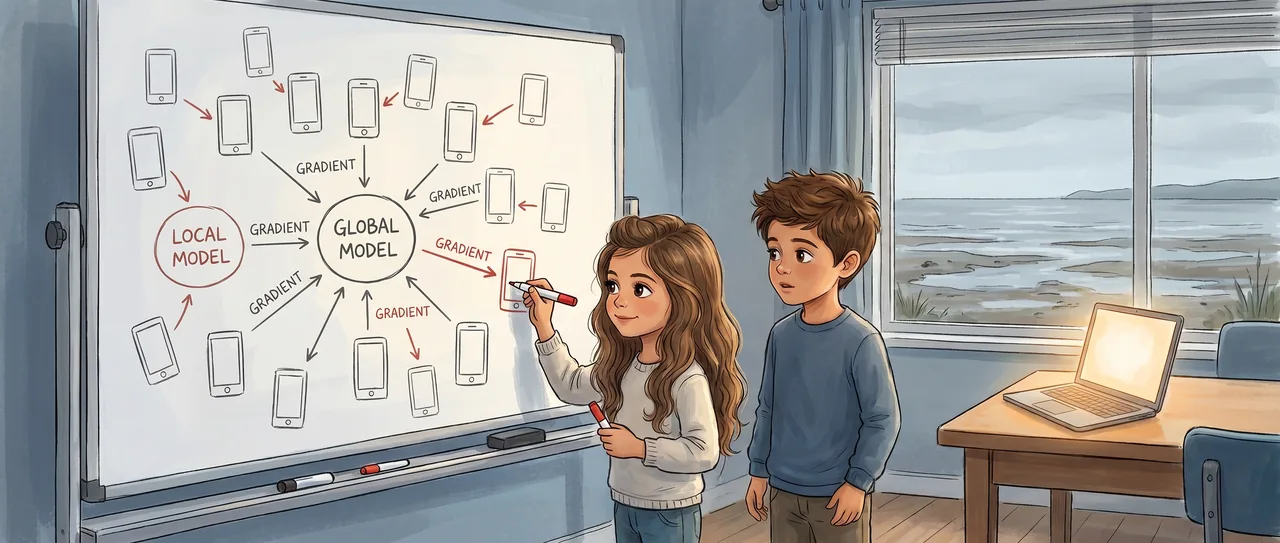
Maya went quiet in the way she did when something was rearranging itself in her head. She picked up a marker and went to the whiteboard. She drew one phone. Then ten. Then a loose swarm of them, filling the board.
"Soren. Think about what this actually means."
"I am thinking about it."
"No. Bigger. Not just our app. Think about medical data. Think about hospitals that can't share patient records because of privacy laws. Each hospital trains on its own patients, sends the gradient, and the model learns from all of them. A doctor in a rural clinic gets a model trained on millions of cases from everywhere, and not a single patient file ever left the building it was created in."
Soren's pen was moving fast now. "Language. Every keyboard on every phone, learning how people actually type and autocorrect, without anyone reading anyone's messages."
"The knowledge moves. The data stays home."
The tide was coming back in. They could hear it through the open window, the slow return of water to sand. Davi finished his call and looked in again, saw the whiteboard covered in arrows and circles and the word GRADIENT written seven times, and quietly closed the door.
Maya was pacing. "This is why it works. This is why it has to be this way. Not because privacy is an obstacle to get around. Because privacy is the thing that makes people willing to participate at all. The wall isn't blocking the learning. The wall is what makes the learning possible. More people contribute because they never have to give anything up."
Soren set his pen down. He looked at the swarm of phones Maya had drawn on the whiteboard. Each one a tiny box with nothing coming out of it except a single small arrow. Each arrow pointed inward, toward a model at the center that none of them owned but all of them had taught.
He picked up the marker and drew one more phone at the edge, half off the whiteboard, barely part of the swarm at all.
Maya uncapped a second marker and drew its arrow pointing in.
Read the interactive version, listen to the narration, and earn a gold star →
A science-verified short story for curious kids · Curiosity Land