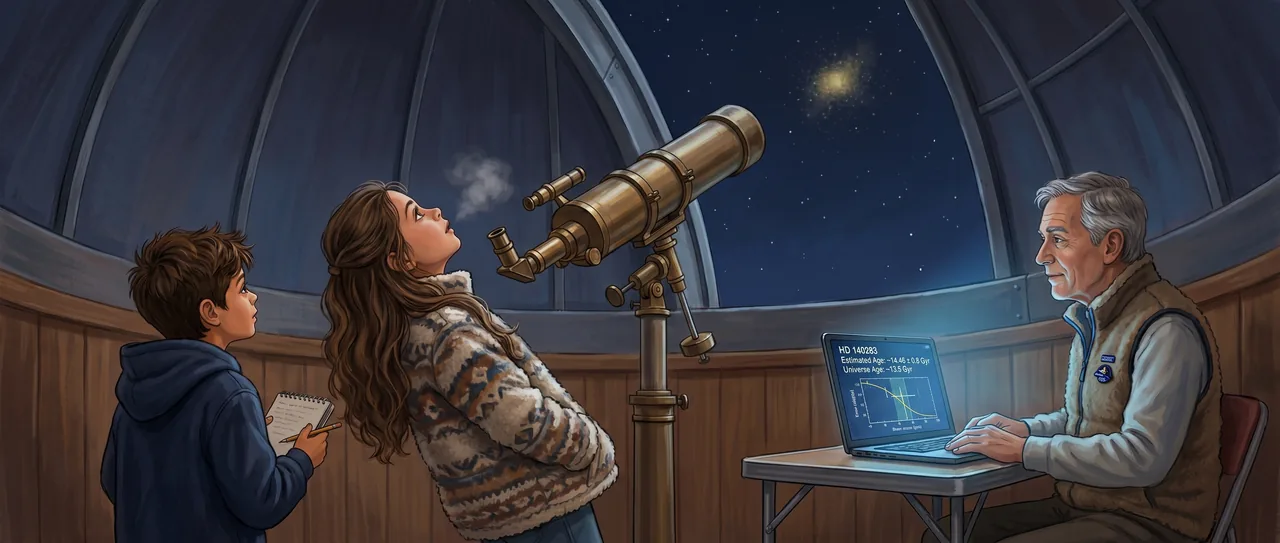
The Star That Shouldn't Be
The volunteer running the observatory was arguing with himself.
Not out loud, exactly. But Soren could see it. The man kept pulling up the same chart on his laptop, frowning, closing it, then opening it again thirty seconds later. He had introduced himself as Gerald. He wore a fleece vest with a pin that said ASK ME ABOUT MESSIER OBJECTS, but every time someone asked him a question, he answered while looking at his screen.
Maya leaned over to Soren. "He's not listening to anyone."
"He's listening to something," Soren said.
They were the youngest people at the public viewing night by about forty years. The hilltop outside Tucson was cold and dry, the sky enormous. Gerald had pointed the observatory's fourteen-inch telescope at a fuzzy ball of light near the top of the sky and told everyone it was Messier thirteen, a globular cluster, half a million stars packed into a sphere about a hundred and forty-five light-years across.
"It looks like a dandelion," one of the adults had said.
"It looks like something is holding them together," Maya had said, and Gerald had looked at her for the first time, really looked, and then gone back to his laptop.
Now the crowd was thinning. The adults drifted toward their cars, satisfied. Soren stayed at the eyepiece. The cluster was granular at the edges, individual stars separating from the glow like salt grains on the rim of a bowl. At the center they blurred into pure light, too many to count, too close to tell apart.
He pulled out his notebook and wrote: stars at center are unresolvable. Not because faint. Because too many.
"Gerald," Maya said, standing next to the man's folding table. "What's wrong with the chart?"
Gerald blinked. "Nothing's wrong with it."
"You keep closing it and opening it."
He laughed, a short surprised sound. "Okay. Fair. You know what a globular cluster is, right? You're looking at one."
"Old stars," Maya said. "Some of the oldest in the galaxy."
"Some of the oldest anywhere," Gerald said. "That's actually the problem." He turned the laptop so she could see. The chart showed a single star's data. HD 140283. Estimated age: fourteen point four six billion years, plus or minus eight hundred million.
"The universe is thirteen point eight billion years old," Soren said from the telescope.
Gerald pointed at him without looking up. "Exactly."
Maya stared at the number. "That star is older than the universe."
"The error bars bring it back into range. Barely. But for a while, the best estimate we had said this star existed before there was anything for it to exist inside of." Gerald closed the laptop again. Opened it. "It's called the Methuselah star. And it's not in M thirteen, but it's the same kind of star. Same ancient population. The globular clusters are full of them. Stars that push right up against the age of everything."
"So either the stars are younger than they look," Soren said, "or the universe is older than we think."
"Or we're measuring one of them wrong," Gerald said. "Or both of them wrong. In complementary directions. Take your pick." He said it like someone who had been taking his pick all evening and hadn't found one he liked.
A car started in the parking lot below. Gerald glanced at his watch. "I need to close up in twenty minutes."
He walked to the dome controls to adjust the slit opening. Maya came to the telescope and pressed her eye to the eyepiece.
She was quiet for a long time.
"Soren. The stars at the edges. The ones you can see individually."
"Yeah."
"They're all the same color."
"Yellowish," Soren said. "I noticed that too."
"Why would they all be the same color?"
Soren had written this down already, but he hadn't written an answer because he didn't have one. He thought about it. Stars had different colors because they had different temperatures. Different temperatures because they had different masses, or were at different stages of their lives. If all the visible stars in the cluster were the same color, that meant they were all at the same stage.
"They were all born at the same time," he said slowly.
"All of them. Half a million stars, born together, and they've been flying around each other ever since. For almost as long as there's been a universe to fly around in." Maya pulled back from the eyepiece. Her breath made a cloud in the cold air. "Gerald said the age estimate pushes right up against the age of everything. So these stars formed basically as soon as stars could form."
"Among the very first," Soren said.
"Then there's nothing behind them. You look at those stars and there's no earlier chapter. That's the beginning."
Soren looked at the cluster chart Gerald had left up on the laptop. The error bars. Plus or minus eight hundred million years. A margin of uncertainty almost as long as the entire history of complex life on Earth, and the answer still came out too close, too tight, pressing against the boundary of the possible.
"The error bars are the interesting part," he said.
"What do you mean?"
"Everyone talks about the error bars like they fix the problem. Like oh, the star is probably a little younger than fourteen point five billion, and the universe is definitely thirteen point eight, so it fits. But that means we're measuring something about a single star, thousands of light-years away, that's so precise it nearly broke cosmology. We're within a few hundred million years of the age of everything. From here. With math."
Maya looked at him. Then she looked up, not at the telescope, but at the open slit in the dome, where the actual sky came through.
"Gerald," she called across the dome.
"Fifteen minutes," he said.
"Is anyone working on getting the error bars smaller?"
Gerald stopped adjusting the dome slit. He turned around. For the first time all evening, he wasn't looking at his laptop.
"Several teams," he said. "The next generation of measurements might pin it down to plus or minus a few hundred million years."
"And if it still comes out too old?"
Gerald opened his mouth. Closed it. He smiled, the way someone smiles when the question is better than any answer they have.
"Then we learn something new about the universe," he said.
Maya turned back to the telescope. Soren held his notebook open to a blank page but didn't write anything yet. Above them, through the slit in the dome, the real M13 hung in the winter sky, half a million ancient stars holding each other in place, older than almost everything, patient as a question that hadn't been answered yet.
Read the interactive version, listen to the narration, and earn a gold star →
A science-verified short story for curious kids · Curiosity Land