The Second Swing
Maya said she could predict it.
That was how the argument started, in the physics building lobby on the second morning of robotics camp, standing in front of a machine that had no business being beautiful.
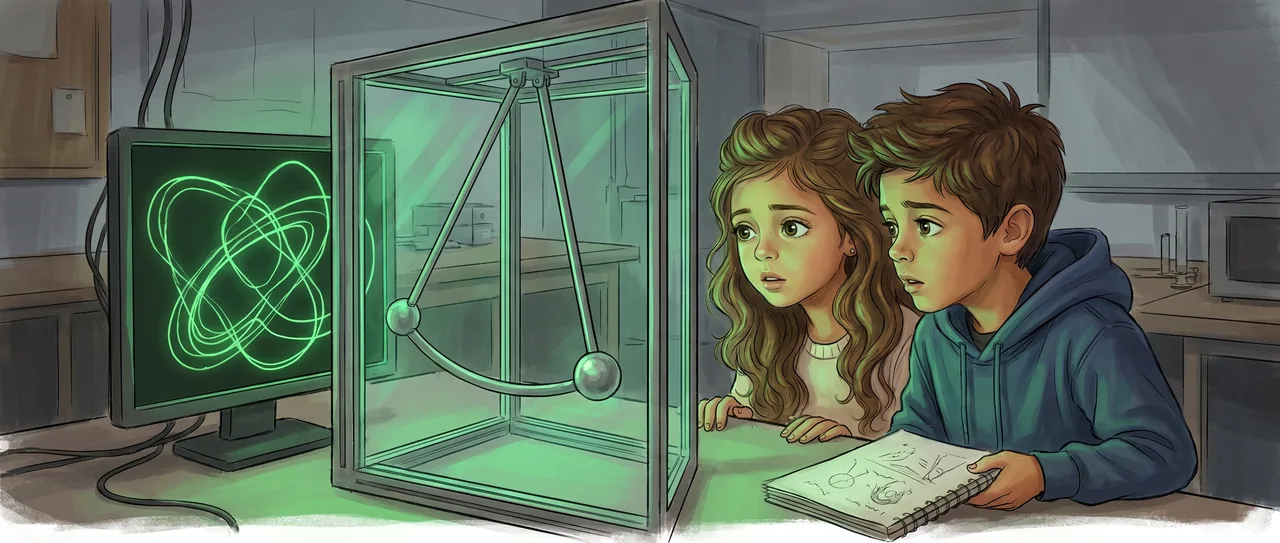
Two metal arms hung from a pivot on a steel frame. The upper arm swung from the top, and the lower arm swung from the end of the upper arm, free to spin in any direction. A graduate student had set it going before disappearing down the hall with a coffee cup and a phone pressed to her ear. A small sign taped to the frame read: DO NOT TOUCH. RECORDING IN PROGRESS.
A camera on a tripod pointed at the pendulum. A computer screen beside it traced the path of the lower arm's tip in green light, drawing loops and whorls like a signature written by someone having a dream.
"It's just two sticks," Maya said. "Gravity pulls them. They swing. I can predict which way the bottom one goes next."
Soren watched the lower arm whip around, pause, reverse, whip the other direction. "No you can't."
"Watch. It's about to swing left."
It swung right. Then it spun in a full circle. Then it almost stopped entirely before lurching into a wild figure eight.
"Okay," Maya said. "But I can learn the pattern."
"What if there isn't one?"
"There has to be. Look at the top arm. It's just swinging back and forth. Normal. Boring. Pendulum stuff. The bottom arm has to follow the rules too. Same gravity. Same metal. Same air."
Soren opened his notebook and drew the two arms, quick and rough. The top arm, sure, he could sketch its arc. The bottom arm he drew as a scribble, because that was what it was doing.
"Try again," he said.
"Right," Maya said. She stared for four full seconds. "Left."
The arm went left. Maya grinned.
"Again," Soren said.
"Left again."
The arm kicked straight up, spun over the top, and came down on the right side.
Maya pressed her lips together.
They tried fourteen more times. Soren kept count. Maya got three right. Out of sixteen total, three.
"That's worse than a coin flip," Soren said. He didn't say it to be mean. He said it because it was true and because it bothered him as much as it bothered her.
"But it's not random," Maya said. "It can't be. Nothing is touching it. No one is pushing it. It's just swinging."
She was right, and Soren knew she was right, and that was the part that made him stare at his scribble-drawing like it was a word in a language he almost spoke.
The graduate student came back. She had red hair pulled into a knot and a coffee stain on her sleeve and the look of someone who had been awake since yesterday.
"Don't touch it," she said, not looking up from her phone.
"We didn't," Soren said. "Why can't we predict the bottom arm?"
The student glanced at them, then at the pendulum, then back at them. "You tried to predict it?"
"Sixteen times," Maya said.
"How many did you get?"
"Three."
The student almost smiled. "I ran a simulation last week. Gave the computer the exact length of both arms, exact mass, exact starting angle, down to six decimal places. It predicted the real pendulum's motion for about two and a half seconds. After that, the simulation went one way and the real pendulum went another. Completely different paths."
"But you gave it all the information," Soren said.
"Almost all the information. I was off by maybe a millionth of a degree in the starting angle. A millionth. Doesn't matter for the top arm. For the bottom arm, after a few seconds, that tiny difference has grown so large that the two paths have nothing in common." She took a sip of coffee. "I have to go check my other setup. Seriously, don't touch it."
She left.
Maya and Soren stood there.
"A millionth of a degree," Maya said.
"And the rules are the same," Soren said. "The math is the same. Gravity is the same. The answer is completely determined by the starting position."
"But you'd have to know the starting position perfectly. Not almost perfectly. Perfectly."
"And you can't. You can't measure anything perfectly."
Maya watched the lower arm trace a path that looked like it was about to repeat, then didn't, then almost did, then veered away into something new.
"So the rules are simple," she said. "And the outcome is impossible."
Soren looked at his notebook. He had written: two arms, gravity, no friction (almost), deterministic. Below that he had written: unpredictable.
Those two words should not have lived on the same page. Deterministic meant the future was locked in, fixed by the present, no randomness anywhere. Unpredictable meant you could not know that future no matter how hard you tried.
Both were true. At the same time. About the same machine.
He felt the floor of something shift. Not the building's floor. Something underneath the building, underneath everything he thought he understood about how knowing the rules meant knowing the answer.
"Maya."
"Yeah."
"Weather is like this. The whole atmosphere. It's deterministic. Physics, all the way down. And we can predict it for about ten days, and then it just..."
"Becomes this," Maya said, pointing at the pendulum.
Soren looked at the green trace on the computer screen. It had been drawing for hours, maybe all night. The path never crossed itself in quite the same way. Every loop was close to a previous loop but not the same. It was drawing a shape that would never be finished, never repeat, and never break a single law of physics.
"The rules don't break," Maya said quietly. "They just build up."
Soren started to say something and then stopped, because the lower arm had paused at the top of its arc for one held breath, perfectly still, balanced on an edge so thin that the next tenth of a second could send it in any direction. The whole future of its motion compressed into a point too small to measure.
Then it fell, and it went somewhere neither of them had guessed, tracing a line of green light across the screen that had never existed before in the history of the machine.
Maya leaned closer to the glass.
The pendulum kept swinging, obedient and wild.
Read the interactive version, listen to the narration, and earn a gold star →
A science-verified short story for curious kids · Curiosity Land