The Planet That Lost Its Skin
The lab smelled like burnt coffee and carpet cleaner. Dr. Achebe had left them alone twenty minutes ago to take a phone call and hadn't come back.
Maya didn't mind. The MESSENGER data was better without someone narrating over it.
She scrolled through orbital photographs of Mercury's surface, each one labeled with coordinates and dates from a spacecraft that had burned up years before either of them was born. Soren sat at the next monitor, working through a density table he'd copied into his notebook. He'd been quiet for a while.
"Something's wrong with Mercury," he said.
Maya looked over. "What kind of wrong?"
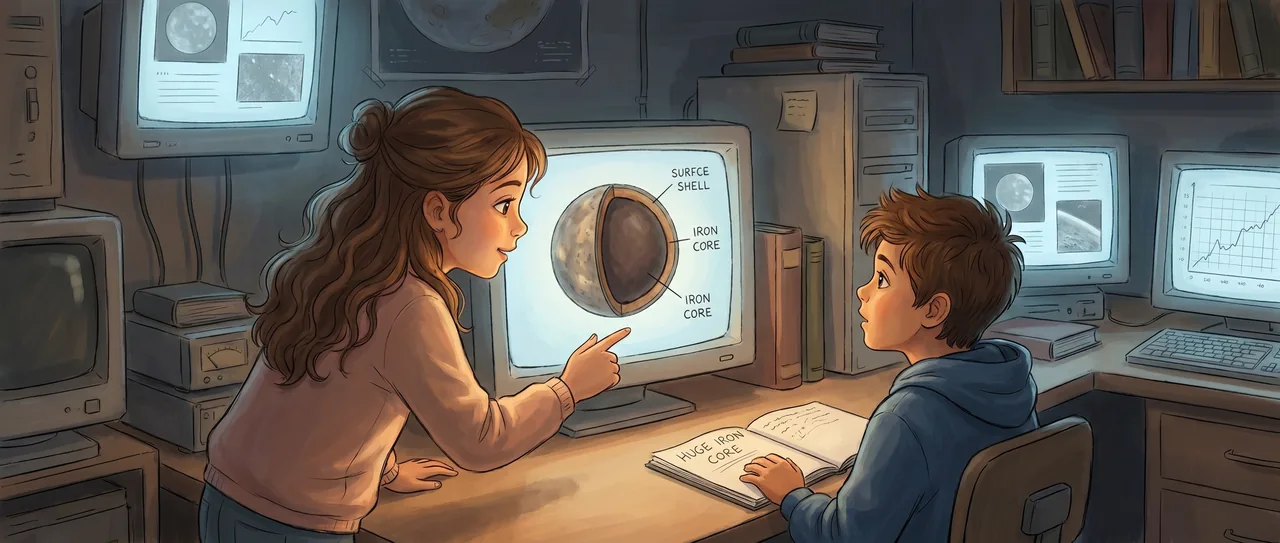
"The numbers wrong." He tapped his pencil against the notebook page. "So Mercury is the smallest planet in the solar system. Smaller than some moons. But its core takes up eighty-five percent of its radius. Earth's core is only about fifty-five percent."
"That's a lot of core for a little planet," Maya said.
"That's what I mean. It's like if you peeled an orange and the peel was paper-thin and the rest was all pit. Mercury is almost all iron core with just this thin rocky shell around it."
Maya pulled up a surface image. Smooth plains stretched across the photograph, ghost-flat and pale. "These plains were lava once," she said. "Dr. Achebe said the MESSENGER team confirmed it. Volcanic flows that covered huge areas."
"Right. So Mercury had volcanoes. Big ones. Which means it was hot enough inside to melt rock and push it to the surface."
"So it had a thicker outside layer at some point," Maya said. "You need deep rock generating heat and pressure to drive volcanism like that."
Soren wrote something down. Then crossed it out. Then wrote it again.
"Here's the part that bothers me," he said. "Where did the rest of it go?"
Maya turned her chair to face him fully. "The rest of what?"
"The rest of Mercury. If the core is eighty-five percent of the radius, then the mantle and crust are just this thin layer. But you just said it used to have enough mantle to power massive volcanism. So either it started with a much thicker rocky layer and lost it, or something else happened that I can't figure out."
Maya pulled up the density numbers on her own screen. Mercury: five point four three grams per cubic centimeter. Almost as dense as Earth, but Earth was much bigger, with enormous gravitational compression squeezing its interior tight. Mercury was tiny. It shouldn't be that dense unless it was made of something unusually heavy. Like a planet that was mostly iron.
"It's like finding a peach pit on the sidewalk," she said slowly, "with just a tiny bit of fruit still stuck to it. And trying to figure out what happened to the peach."
"Exactly." Soren flipped back a page. "I looked up the main hypotheses. One idea is that the Sun's radiation blasted lighter rock away early on, kind of vaporized the outer layers. Another is that a giant impact stripped Mercury's mantle off. Like something enormous hit it and knocked its skin away."
"A collision."
"A collision so big it tore off most of the rocky material and left the iron core exposed. Well, almost exposed. With just enough mantle remaining to produce that last period of volcanism."
Maya stared at the smooth plains on her screen. Frozen lava, billions of years old. The last breath of a planet that had already lost most of itself.
"But nobody knows for sure," she said. It wasn't a question.
"Nobody knows for sure. The giant impact model has problems. The vaporization model has problems. There are others. None of them fully explain it."
Dr. Achebe appeared in the doorway, phone still in hand. "Sorry about that. Are you two finding anything interesting in the data sets?"
"Dr. Achebe," Maya said. "Has anyone figured out why Mercury's core is so big?"
He leaned against the doorframe and smiled in a tired way that made him look like he'd been asked this before and liked the question anyway. "No. That's one of the genuine open questions in planetary science. We have models. We have preferences. We don't have proof." He glanced at his phone again. "I need five more minutes. There are spectral composition charts in the folder marked Northern Plains if you want something new to chew on."
He left.
Soren was already opening the folder. Maya watched him spread the charts across the desk, his pencil moving between columns. She turned back to her screen and pulled up a size comparison. Mercury beside Earth. Mercury beside the Moon. The iron core drawn inside it like a dark seed, swollen, dominating, almost the whole world.
A planet that was mostly engine. Mostly interior. A thin, thin shell of rock over an iron heart so large it seemed impossible.
"Soren. What if it wasn't one event?"
He looked up.
"What if Mercury got hit more than once? Or got stripped by radiation and then hit? What if the reason nobody can make one model work is that it wasn't one thing?"
"Multiple events," Soren said. He didn't dismiss it. He sat with it. "That would explain why the single-cause models all have gaps. But it would be really hard to prove."
"Is anyone trying?"
"The BepiColombo mission is on its way there right now. European and Japanese spacecraft. It's supposed to enter orbit and measure Mercury's interior structure more precisely than MESSENGER ever could."
Maya looked at the smooth plains photograph again. Lava that had flowed across a world that was already a wound. A planet that had been bigger, once. That had lost almost everything except its core and still, in its last volcanic era, had pushed melted rock up through what little it had left.
"It kept going," she said.
Soren set his pencil down. "What?"
"After whatever happened to it. After it lost most of its mantle. It still had enough heat to make volcanoes. It kept going."
Soren looked at the tiny planet on his screen, the iron core drawn so large it nearly touched the surface, the shell of rock so thin it barely registered.
He picked up his pencil and wrote three words in his notebook.
Maya leaned over. "What did you write?"
Soren looked at the page for a moment, then read aloud: "It kept going."
He closed the notebook.
Read the interactive version, listen to the narration, and earn a gold star →
A science-verified short story for curious kids · Curiosity Land