The Ones Who Drift
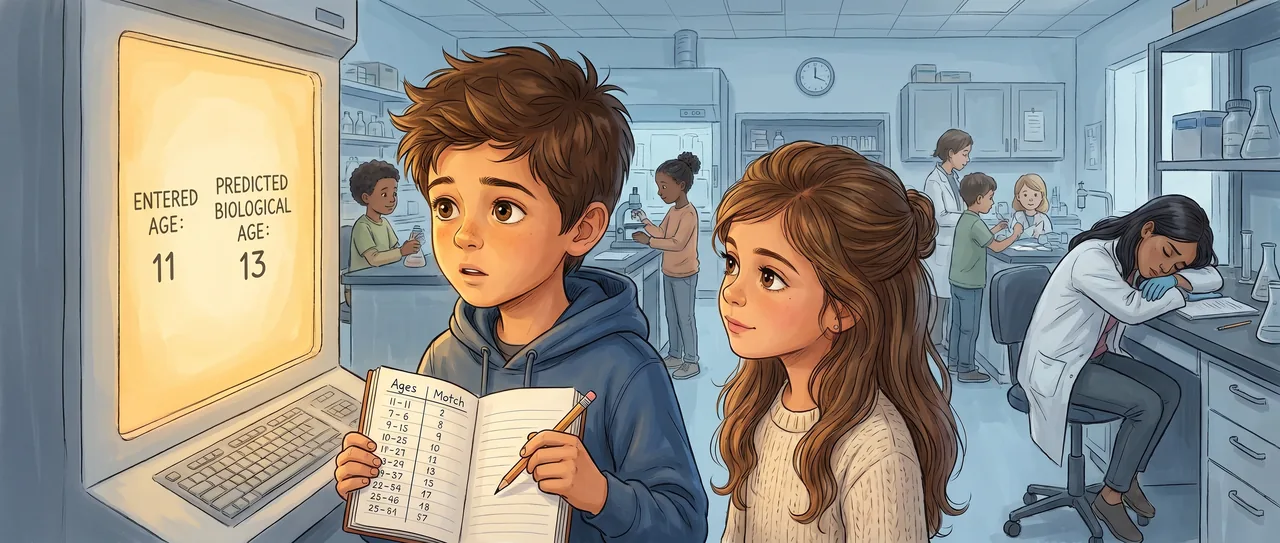
The line for the cheek swab station wrapped around the atrium twice. Soren had been watching the screen above the booth for forty minutes, writing down every result.
The screen showed two numbers side by side. On the left, the age each volunteer typed in. On the right, the age the computer predicted from their spit. Most of the pairs were close. A woman who said she was thirty-four got a prediction of thirty-five. A man who said fifty-one got forty-nine. The crowd clapped each time, like it was a magic trick.
Maya was not watching the screen. She was watching the numbers in Soren's notebook.
"You're writing them all down," she said.
"Forty-two people so far," Soren said.
"Why?"
"Because the ones that are wrong are more interesting than the ones that are right."
Maya leaned over. In Soren's careful columns, most predictions landed within a year or two. But three results were circled. A woman who entered forty-six but got a prediction of thirty-nine. A teenager who entered sixteen but got twenty. And a man who entered sixty and got fifty-two.
"The off ones all go the same direction for the older people," Maya said. "Younger than they should be. Except the teenager. He went older."
Soren nodded slowly. "Except I don't know what makes someone's biological age different from their actual age. That's the part I can't figure out."
The graduate student running the booth was named Priya. She had dark circles under her eyes and kept checking her phone between swabs. When the line finally thinned, Maya walked up.
"What exactly is the computer reading?" Maya asked.
"Methylation," Priya said, not looking up from her phone. "Little chemical tags on your DNA. They don't change your genes, they just tell your genes when to be quiet and when to be loud. You accumulate a pattern of them as you age. The AI learned that pattern from about fourteen thousand people, so now it can look at your pattern and guess how old you are."
"How old your cells think you are," Soren said.
Priya glanced at him. "That's actually a better way to put it, yeah."
"Can we try it?" Maya asked.
Priya handed them each a swab. They scraped the insides of their cheeks and dropped the swabs into little tubes. Priya fed the tubes into a sequencer the size of a toaster. "Takes about twelve minutes," she said, and went back to her phone.
While they waited, Soren flipped back through his notebook. "The woman who got thirty-nine instead of forty-six. What if her cells just haven't been through as much?"
"Through as much what, though?" Maya said.
"I don't know. That's the question."
Maya picked up the laminated info card on the table. She read it twice, fast, her lips barely moving. "It says here that methylation patterns respond to environment. Stress. Nutrition. Pollution. Smoking. Even loneliness. The tags change based on what's happened to you, not just how many years have passed."
Soren sat very still. "So the computer learned a clock. But the clock doesn't just measure time."
"It measures something that usually correlates with time," Maya said.
"Usually."
They looked at each other.
The screen pinged. Priya turned it around so they could see. Maya's result appeared first. Entered age: eleven. Predicted biological age: eleven.
Soren's came up next. Entered age: eleven. Predicted biological age: thirteen.
The number sat there on the screen, plain and indifferent.
Soren stared at it. He didn't say anything for several seconds.
"Huh," Priya said, finally putting her phone down. "That's a bigger gap than usual for a kid. The model's less accurate for people under eighteen, though. Smaller training set. I wouldn't worry about it."
But Maya was watching Soren, and Soren was doing something she recognized. He was not upset. He was not worried. He was holding the number in his head and turning it, the way he turned everything, looking for the mechanism.
"My dad was sick for a long time," Soren said quietly. "Two years. I was nine and ten."
Priya opened her mouth, then closed it. She clearly did not know what to say to that.
Maya did not say she was sorry. She said, "You think that's in there? In the tags?"
"The card says stress changes them. That was stress." He paused. "That was a lot of stress."
"But the AI doesn't know that," Maya said. "It just sees the pattern and guesses an age. It wasn't trained on why the tags are there. Just that they are."
Soren picked up the info card and read the part about the training data. Fourteen thousand volunteers. Ages, methylation profiles, and nothing else. No column for what happened to them. No field for the year their dad was in the hospital, or the year they slept on the waiting room couch so many times they stopped noticing the smell of the floor cleaner.
"So every single person the AI learned from had a life," Soren said. "And the AI turned all of that into one number."
"An average," Maya said. "It learned the average story."
"And when someone's story isn't average, it just shows up as noise. As an error." Soren looked at his notebook, at the three circled results. Three errors. Three lives that didn't match the model. "The gap is the interesting part. The gap is where the actual person is."
Priya was listening now, phone forgotten on the table. "You know," she said slowly, "there are researchers who study exactly that. The divergence. They call it age acceleration. Some people's clocks run fast. Some run slow. And figuring out why is basically the whole next decade of this field."
"But you'd need more than methylation to figure it out," Maya said. "You'd need the stories."
"Yeah," Priya said. "We would."
Soren looked at his two-column notebook. The ages people entered and the ages the computer gave back. He turned to a fresh page and drew a third column. He didn't label it. He didn't know what to call it yet. But he knew what went there.
The line was forming again. A new group of visitors, ready to see the trick. A girl about eight years old was first, bouncing on her toes, pulling her mother forward.
Maya nudged Soren. "You want to stay?"
"Yeah," he said. "I want to see the ones who drift."
The eight-year-old climbed onto the stool, opened her mouth wide for the swab before anyone even asked, and the sequencer hummed to life.
Read the interactive version, listen to the narration, and earn a gold star →
A science-verified short story for curious kids · Curiosity Land