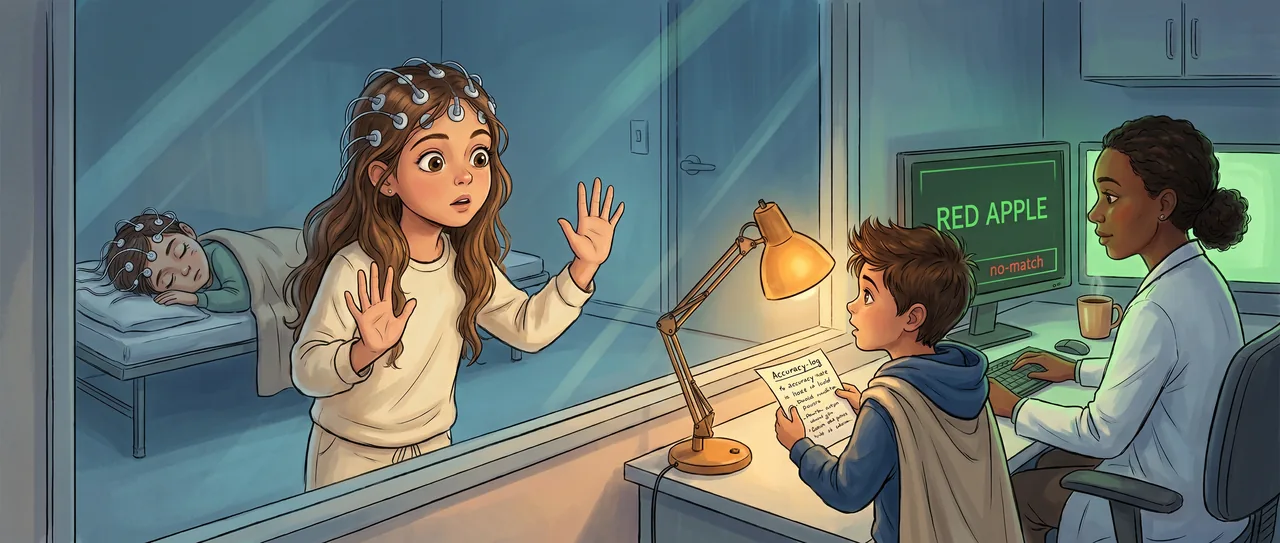
The Ones That Slip
The screen showed a word in green letters: BICYCLE.
Soren looked at Maya. Maya looked at the screen. They both looked at Dr. Achebe, who was already turning back to her own monitor, coffee in one hand, stylus in the other.
"That is what the model thinks you were dreaming about," Dr. Achebe said without looking up. "During your second REM cycle. Were you?"
"I was," Soren said. He pulled his blanket tighter around his shoulders. The sleep lab was cold, and being right felt strange. "I was riding my bike down the hill on Prospect Street. In the dream it was longer than in real life. But yeah. Bicycle."
"Good. The model's running about eighty-two percent today." Dr. Achebe tapped something. "Maya, you're up for the next nap block. Soren, you can review the printouts if you want. The accuracy log is on the table."
She said it the way you'd say help yourself to crackers. Not like she was handing them something important.
Soren found the accuracy log. It was sixty pages of entries: subject number, sleep stage, predicted memory, actual memory, match or no match. He started reading.
Maya was already lying down in the next room, electrodes dotting her scalp like small silver seeds. Through the glass partition, Soren could see her close her eyes. She'd spent the pre-sleep period studying a set of images and word lists, just like he had. The AI would watch her brain replay those memories during sleep, then guess which ones she was consolidating.
He turned pages. Match. Match. No match. Match. Match. Match. No match.
The no-matches interested him. He started writing them down.
Subject fourteen, predicted KITCHEN TABLE, actual was the smell of grandmother's house. No match.
Subject twenty-two, predicted BLUE SQUARE, actual was the feeling of being underwater. No match.
Subject nine, predicted DOG, actual was a sound the subject could not name but associated with early childhood. No match.
Soren read faster. He stopped writing individual entries and started counting. By page forty he went back to the beginning and counted again, more carefully this time.
The model failed on the same kind of memory every time.
Not every time. Almost every time. He counted again. Ninety-one percent of the failures shared something. He wrote the number down, then crossed it out, then wrote it again.
When Maya woke up forty minutes later, the screen said RED APPLE.
"No," Maya said. She was sitting up, rubbing her eyes, still half inside the dream. "It was. I don't know how to say it. It was the way the light looks on the kitchen counter at my dad's apartment at about four in the afternoon. In October. When nobody else is home."
Dr. Achebe typed the response and marked it as a no-match. "The model struggles with some categories," she said. "We're working on it."
"It's not some categories," Soren said.
Dr. Achebe looked up.
"It's one category," he said. He brought the accuracy log to her desk. "I counted the failures three times. The model gets memories right when they're things you can name. Bicycle. Red apple. Kitchen table. Words. Pictures. Stuff with edges. But when people dream about a feeling, or a smell they can't describe, or a sound that doesn't have a word, the model almost always gets it wrong."
Dr. Achebe set down her coffee. She looked at his notes. She looked at him. She was not the kind of adult who pretended to be impressed. She was the kind who got quiet when she was actually thinking.
"What percentage of failures?" she asked.
"Ninety-one percent of the wrong guesses were memories the subjects couldn't put into words easily. I used their own descriptions. If they said a word, like bicycle, I counted it as nameable. If they said something like the feeling of being underwater, I counted it as not."
"That's a rough metric."
"I know. But ninety-one percent."
Maya had come to stand beside him. She read his notes upside down, which she did faster than most people read right-side up.
"The model was trained on labeled data, right?" Maya said.
"Yes," Dr. Achebe said. "People's brain scans paired with their descriptions of what they were remembering."
"So it learned from words," Maya said.
"It learned from language-tagged neural patterns, yes."
Maya looked at Soren. He could see she was already three steps ahead, but she waited, because the thing she was thinking needed his version too.
"The model doesn't fail because it's bad," Soren said slowly. "It fails because the memories don't have words. And the training data was all words. So the model literally cannot see those memories. They don't exist in its world."
"But they exist in ours," Maya said.
Dr. Achebe leaned back. She picked up her coffee, realized it was empty, and put it down again.
"We've been treating the failures as noise," she said, almost to herself. "As a problem to solve. More data, better labels, higher accuracy."
"But you can't label what you can't say," Soren said.
"So every time you add more labels you just get better at the speakable ones," Maya said. "And the unspeakable ones stay invisible. They stay failures. Even though they're real."
The lab was quiet. Through the glass partition, they could see the next volunteer, a boy about their age, already lying down with electrodes on his head. On Dr. Achebe's screen, the model was warming up, ready to watch his brain and guess his dreams using the only tool it had, which was the vast catalogue of things that humans had been able to say out loud.
"How much of memory is like that?" Maya asked. "The kind without words?"
Dr. Achebe opened her mouth, then closed it. She shook her head once.
"We don't know," she said. "We have never had a way to count what we cannot describe."
Maya pressed her hand flat against the glass partition. On the other side, the boy's eyes moved beneath his closed lids, and the model began its quiet, confident, incomplete predictions.
Read the interactive version, listen to the narration, and earn a gold star →
A science-verified short story for curious kids · Curiosity Land