The Oldest Part of You
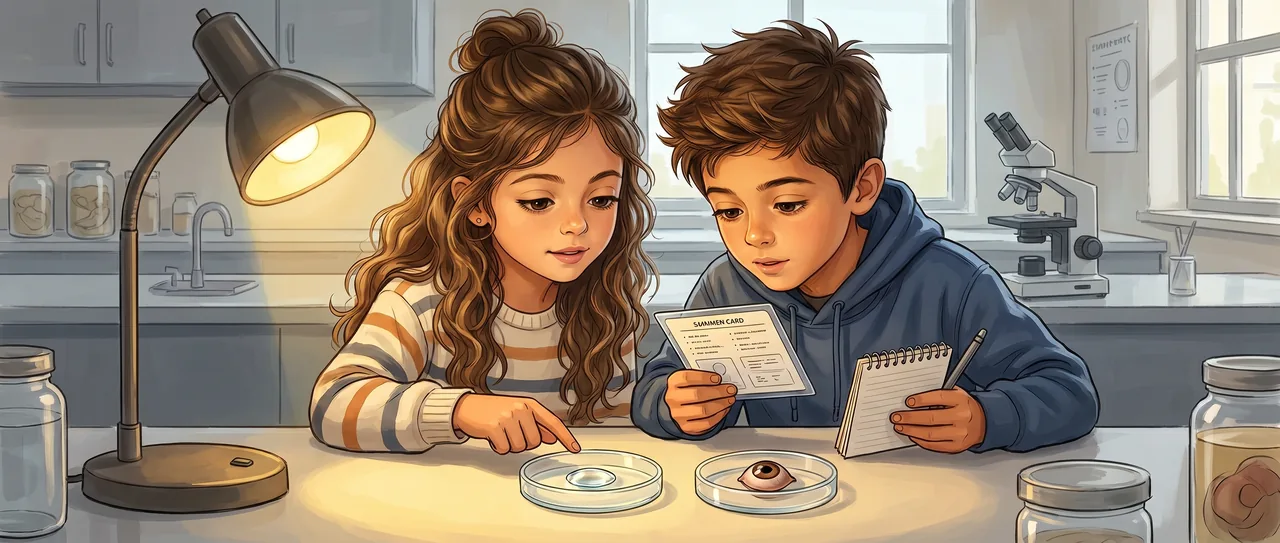
The eye was smaller than Soren expected.
It sat in a shallow glass dish under a bright lamp, preserved and slightly yellow, and the card next to it read DONOR AGE: 82. The retired ophthalmologist, Dr. Watts, was across the room helping a group of younger kids look through a slit lamp. She had told Soren's group they could explore the specimens on their own for ten minutes while she worked with the little ones.
Maya leaned in close. "It's so small. Like a marble that got squished."
"A little bigger than a marble," Soren said. He was reading the laminated information card propped beside the dish. "This says they removed the lens. It's in the other dish."
The other dish held something that looked like a tiny, flattened bead. Clear at the edges, clouded at the center.
"That's a cataract," Maya said. "My grandmother had surgery for that. They put a plastic one in."
Soren picked up the second information card. He read it, then read it again. Then he set it down and looked at the lens in its dish for a long time without saying anything.
"What," Maya said. It was not a question.
"Read it."
She picked up the card. She read aloud, quietly, the way she did when something was catching on her: "The human lens grows throughout life. Unlike most tissues, the lens does not shed old cells. New cells are added to the outer surface, while the oldest cells are compressed into the center. The core of an adult lens contains cells that formed during embryonic development, before birth."
She put the card down.
"Before birth," she said.
"Before birth," Soren repeated.
They both looked at the clouded bead.
"So the middle of that," Maya said, pointing, "those cells are from before this person was born. Eighty-two years ago. More than eighty-two years ago."
"More," Soren agreed. "Because they formed before birth. So those cells in the center are maybe eighty-two years and seven or eight months old."
Maya pulled her hand back slowly, not because she was afraid but because something about the gesture of pointing at it felt suddenly insufficient. "And they never got replaced. They've just been sitting there, in the middle, this whole time. While the person learned to walk. While they went to school. Got old."
"Like tree rings," Soren said. He wrote that down in his notebook, then stopped. "No. Not like tree rings. Tree rings are dead wood. These were cells. They were alive."
"Were they still alive? At eighty-two?"
Soren looked at the card again. "It says they lose their organelles as they get compressed. Their nuclei, everything. They become just these packed transparent fibers. So they're not really alive anymore, but they're not replaced either. They just stay."
"That's why it's cloudy in the middle," Maya said suddenly.
Soren looked at her.
"Those proteins. They've been there for eighty-two years. Longer. They've been there since before this person saw anything at all. And proteins break down over time, right? They clump up. That's the cataract. That cloudy part is the part that's been there the longest."
Soren checked the card. It confirmed it: cataracts form when the proteins in the oldest cells of the lens denature and aggregate over decades.
Maya was quiet for a moment. Then she touched her own eyelid, very gently, with one fingertip.
"I have cells in my eyes right now that formed before I was born."
"So do I," Soren said.
"So does everyone," Maya said. "Everyone who can see. Everyone who's ever seen anything. The very first thing they ever looked at, they looked at it through cells that had already been waiting in the dark."
Soren wrote something in his notebook. Then he crossed it out and wrote something else.
Dr. Watts came back then, slightly out of breath, one of the younger kids still hanging onto her lab coat. "Finding anything interesting over here?"
"Dr. Watts," Soren said, "the cells in the center of the lens. The ones from before birth. Those same cells were the ones this person saw through their entire life?"
"Every single day," Dr. Watts said. She was already turning to answer another kid's question about the slit lamp. "Light passed through those cells for eighty-two years. They were the window. Never replaced, never repaired. Just there." She walked away, gently detaching the younger kid from her coat.
Maya was still touching her eyelid.
"It's not like a hard drive," she said. "It's not storing memories or anything. I know that. But light from everything I've ever seen has gone through those cells. Every single photon. And the cells are still there."
"Everything you'll ever see, too," Soren said. "Until they cloud up."
"If they cloud up."
"When. Apparently most people get cataracts eventually, if they live long enough. Because the proteins are so old they just can't hold their shape anymore."
Maya looked at the preserved lens in its dish. The clouded core, the clearer edges. Youngest cells on the outside. Oldest cells, the pre-birth cells, packed at the center under eighty-two years of accumulated light.
"Soren. When they do cataract surgery, when they take the old lens out and put the plastic one in. They're removing the oldest part of the person."
Soren's pen stopped.
"Older than their bones," Maya continued. "Bones remodel. Skin replaces itself. But those lens cells have been there since before the person breathed air. And then a surgeon just takes them out and puts them in a dish like this one."
They stood there, two eleven-year-olds in a university lab on a Saturday morning, looking at the oldest part of a stranger.
The room was loud with other kids, younger ones pressing their faces against the slit lamp, asking Dr. Watts if they could see their own eyeballs. Soren closed his notebook. Maya took her finger away from her eyelid.
She blinked.
The light came through.
Read the interactive version, listen to the narration, and earn a gold star →
A science-verified short story for curious kids · Curiosity Land