The Mismatch
The caterpillars were late.
Or the leaves were early. Soren had been staring at the same page of his notebook for ten minutes, trying to figure out which way to say it, because the two sentences meant completely different things.
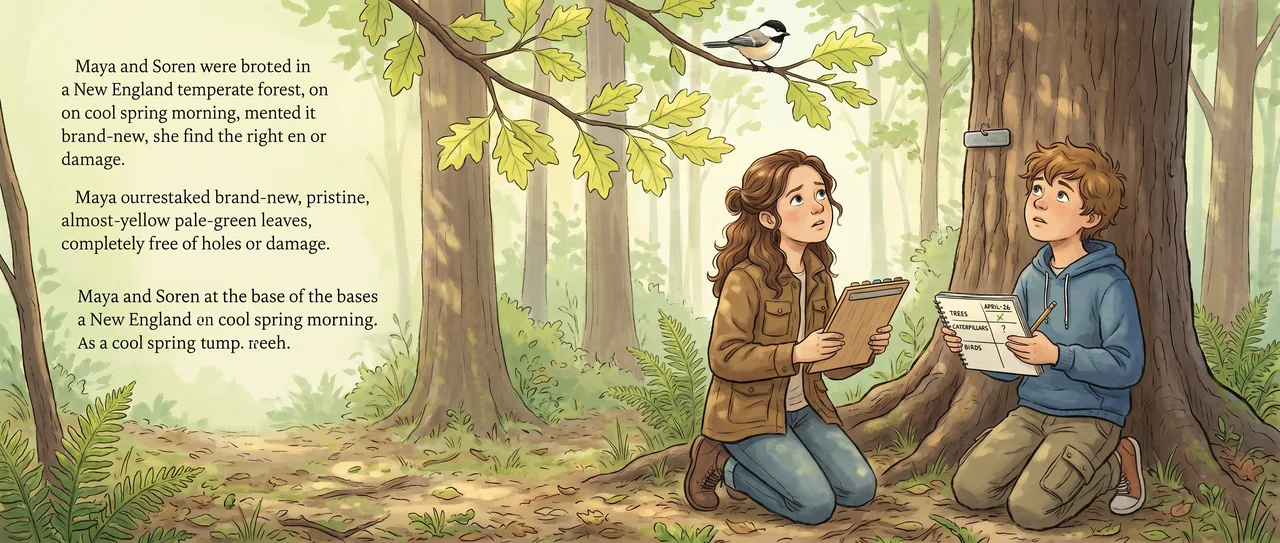
Maya was twenty meters away, crouched at the base of a red oak with a color chart pressed against a bud. She had been assigned the same task as Soren: record the date when each tagged tree in their monitoring plot reached stage three leaf-out, which meant the leaf had unfolded enough to show its full shape but was still pale, still new. She was fast at it. She could glance at a bud and call the stage without the chart, though she carried the chart anyway because Dr. Vasquez checked their forms.
Dr. Vasquez was somewhere on the access road, on the phone with the university, arguing about funding for something unrelated. She had handed them the clipboards at seven fifteen in the morning, said "you know the protocol," and walked away still reading an email.
Soren liked Dr. Vasquez. She treated them like field technicians, not children.
"Oak fourteen is at stage four," Maya called. "Already."
Soren wrote it down. Then he turned back two pages in his notebook to where he had copied the historical averages from the plot's forty-year dataset. Oak fourteen's average date for stage four was May ninth. Today was April twenty-sixth.
Thirteen days early.
He flipped forward. Oak six, eleven days early. Oak nine, nine days early. The white ash at the plot's southern edge, fourteen days early. Every tree in their section was ahead of the forty-year average. Not by a little. By a lot.
"Maya."
She was already walking toward him, color chart swinging from one hand. "Something's off."
"Everything's early."
"I know. I've been counting." She dropped to a squat beside him and pointed at a branch of oak fourteen. The leaves were open, a green so new it was almost yellow, catching light from every direction. "But look at the leaves. They're perfect. No holes."
Soren looked. She was right. The small leaves were completely untouched. Smooth-edged, clean, like paper cutouts.
"So nothing's eating them," he said.
"Nothing's eating them yet. The winter moth caterpillars hatch to match bud burst. They have to. They're tiny when they hatch, and they need young leaves. Soft ones. If they hatch too late, the leaves toughen up and the tannins increase and the caterpillars basically starve."
Soren had read this. He had read it in the orientation packet Dr. Vasquez handed out in March. But he hadn't seen it until now, standing in a forest full of perfect, uneaten leaves.
"So the trees moved," he said. "And the caterpillars didn't move with them."
"The trees respond to temperature. Warm spring, early leaves. But the caterpillar eggs respond to something else. I think it's accumulated chill hours. How long they've been cold over winter." Maya frowned. "Which means a warm spring doesn't speed them up. It might even slow them down if the winter was warm too, because they didn't get enough chill."
"So the warm weather helps the trees and hurts the caterpillars."
"Pulls them apart."
Soren wrote that down. Pulls them apart. Then he wrote the word underneath it that had been nagging at him: mismatch.
He didn't write what came next in his head, because it was too big and he wasn't sure of it yet. Instead he said it out loud.
"What eats the caterpillars?"
Maya went still.
"Pied flycatchers," she said. "In Europe. They time their breeding to the caterpillar peak so there's food for the chicks. If the caterpillars shift, the birds miss the peak." She paused. "Here it would be chickadees. Warblers. Anything that feeds nestlings on caterpillars."
"So if the leaves move early and the caterpillars can't follow, then the birds that eat the caterpillars also lose their food pulse. And anything that eats the birds. And the trees that were getting eaten less, they're pulling more carbon and transpiring more water and changing the local temperature, which makes next spring even warmer, which pushes the leaves out even earlier."
He stopped. He had said it all in one breath and now the forest felt different.
Maya was looking at the canopy. The light filtering through was green and generous. A beautiful morning. A beautiful spring. Everything photosynthesizing like mad, and underneath all of it, a clock that no longer matched.
"It's not one thing moving," she said. "It's everything moving at different speeds."
Soren opened his notebook to a clean page and drew three horizontal lines. He labeled them trees, caterpillars, birds. Then he drew a vertical line through all three and labeled it April twenty-sixth. The tree line had already crossed it. The other two hadn't.
"How far apart can they get before something breaks?" he asked.
"I don't know. I don't think anyone knows. That's why we're counting."
That was the thing that hit him. Not that the forest was changing. He'd known forests were changing. Everyone knew. But he had thought of change as a single motion, everything sliding together into a new normal. This was different. This was the pieces of an enormous clock moving at different speeds, the gears slipping out of sync one by one, each slip invisible unless you were the kind of person who stood in a forest and noticed that the leaves had no holes in them.
Dr. Vasquez was walking back up the trail, phone away, rubbing her eyes. She looked tired.
"How's the plot?" she asked.
"Everything's early," Maya said. "Average of eleven point six days across our section."
Dr. Vasquez nodded slowly. She didn't look surprised. She looked like someone confirming something she wished she were wrong about.
"Log it clean," she said. "Every day matters in the long dataset. Forty years of data only mean something if year forty-one is just as careful as year one."
She walked on to check the next section.
Maya looked at Soren. Soren looked at his three lines, the gap between them like a door cracked open on something enormous and still in motion.
"Year forty-one," Maya said quietly.
"Year forty-one," Soren repeated.
He pressed his pencil to the caterpillar line and drew a small question mark at the place where it should have crossed April twenty-sixth but had not.
Above them, a chickadee called twice from a branch heavy with perfect, uneaten leaves.
Read the interactive version, listen to the narration, and earn a gold star →
A science-verified short story for curious kids · Curiosity Land