The Map That Grew
Soren had been wrong for three weeks, and he was starting to enjoy it.
It had started with a argument. Not with Maya, for once. With himself. He had been trying to memorize the bus routes between his house and every park in the city, all forty seven of them, because his paper notebook had gotten soaked in the rain and he had lost his maps. He thought he could just hold them all in his head. He thought memory was like a box you filled up.
After eleven routes he started confusing Prospect with Pioneer, and by nineteen he was mixing up the numbered streets entirely, and by twenty six he sat on the wrong bus and ended up at a recycling center.
Maya had not laughed. She had done something worse. She had said, "Huh," and then gone quiet for two full days.
Now they were standing in a university neuroscience lab because Maya's mother had dropped them at the open house and gone to get groceries. The lab smelled like floor wax and warm electronics.
"Look at this," Maya said. She was already three displays ahead of him.
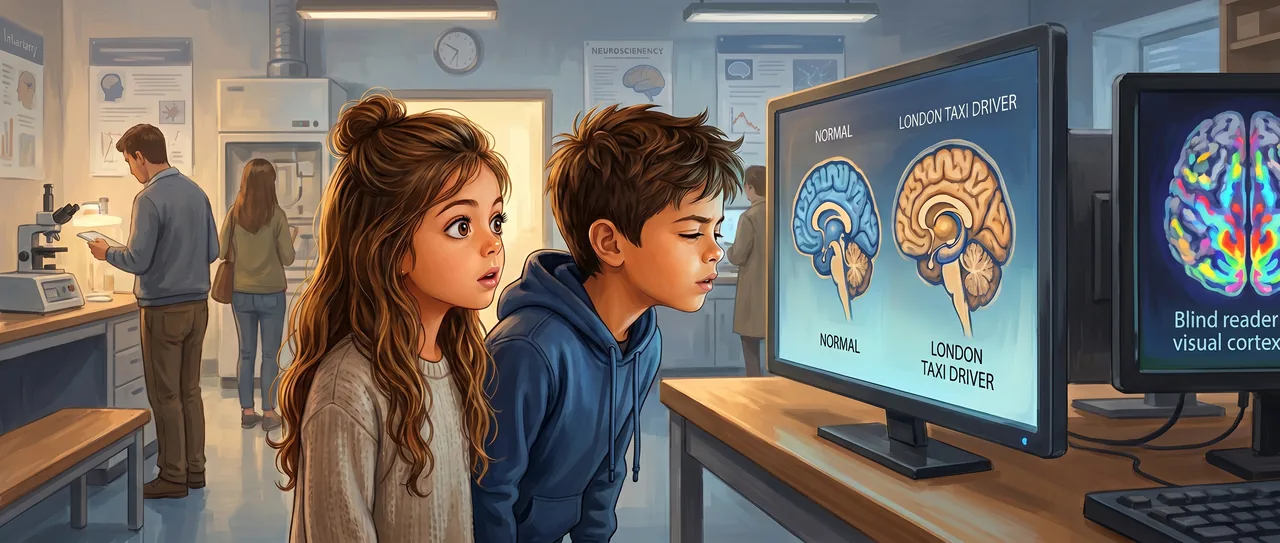
The screen showed two brain scans side by side. Both were cross sections, the brain sliced like a hard boiled egg viewed from above. Labels pointed to a curved structure deep inside each one, like a seahorse made of grey tissue. The hippocampus.
The left scan was labeled NON TAXI DRIVER. The right scan was labeled LONDON TAXI DRIVER, 14 YEARS EXPERIENCE.
Soren could see the difference without reading the caption. The seahorse shaped region on the right was bigger. Noticeably, physically bigger. The posterior part bulged outward like it had been inflated.
"They memorize twenty five thousand streets," Maya said. "Every lane. Every alley. It takes them three or four years just to pass the test. They call it the Knowledge."
"And their brains actually change shape?"
"Not shape. Size. That part grows."
Soren stared. He had always assumed brains were finished. That you got what you got, and then you just used it, like a calculator that came out of a box.
"So the routes aren't just stored in there," he said slowly. "The routes built more of it."
Maya was already moving to the next display.
This one stopped Soren cold.
It showed brain scans of a person who had been blind since birth, reading Braille. The visual cortex, the part at the back of the brain that processes what the eyes see, was lit up bright. Not the touch regions. Not the language regions. The visual cortex.
The panel explained it simply: in people who are born blind, the brain repurposes the visual cortex for other senses. The region that would have processed light and color and motion instead processes the feeling of fingertips on raised dots. It processes sound and language. The brain, denied one kind of input, did not leave that territory empty. It rewired it. It colonized it for something new.
Soren read the panel twice. Then a third time.
"Maya."
"I know," she said. She was standing very still, which for Maya was remarkable.
"The brain doesn't just store things," Soren said. "It becomes different. Physically. Depending on what you do with it."
"Depending on what you ask it to do," Maya said.
A graduate student with a lanyard and a coffee stain on her sleeve appeared beside them. "You two have been here longer than any of the adults," she said. She did not say this in a talking to children voice. She said it like she was reporting data.
"Can I ask you something?" Soren said.
"That's what the open house is for."
"The taxi drivers. Does it go the other way? If they retire and stop navigating, does the hippocampus shrink back?"
The graduate student tilted her head. "There's some evidence that it does. Use it or lose it isn't exactly wrong, but it's not the whole picture either. We're still figuring that out."
"So it's not permanent," Soren said.
"Nothing about brains is permanent. That's sort of the whole point." She took a sip of coffee and wandered toward a group of adults who were poking at a rubber brain model.
Maya turned to Soren. "Your bus routes."
"What about them?"
"You said you hit a wall at twenty six. But you'd been doing it for what, a week?"
"Nine days."
"The taxi drivers take years, Soren. Years. And their brains grow new tissue to hold it. You gave your brain nine days."
Soren opened his mouth, then closed it. He thought about the recycling center. He thought about how frustrated he'd been, how he had assumed there was something wrong with his memory, some limit he'd hit like a ceiling.
But that wasn't what had happened. He had been standing at the beginning of something that takes years, and he had expected to be at the end of it in nine days.
"I wasn't bad at it," he said.
"You were early at it."
He looked back at the taxi driver scans. Fourteen years. Twenty five thousand streets. And the brain had responded by building more of itself, physically, structurally, the tissue expanding to meet the demand.
And the blind readers. Their brains had not given up on the unused visual cortex. They had not left it dark. They had flooded it with new purpose, repurposed millions of neurons for touch and sound and language, made something extraordinary out of what wasn't there.
Maya was watching his face. "You're doing that thing," she said.
"What thing?"
"Where you're quiet but your eyes are moving like you're reading."
"I'm thinking about what else this means."
"Tell me."
"Everyone's brain is different," Soren said. "Not just because of genetics. Because of what they've done. Every single person who has practiced something, learned something, paid attention to something, their brain is literally, physically shaped by that. A musician's brain is different from a surgeon's brain is different from a taxi driver's brain. And not just a little bit. Measurably."
Maya nodded once.
"So nobody's brain is the standard one," Soren said. "There's no normal brain. There's just what you've asked yours to become."
Maya did not nod this time. She was looking past Soren, at the scan of the blind reader's visual cortex blazing with activity from fingertips pressing dots. An entire region of the brain, millions of neurons, refusing to go unused. Finding a new way in.
"Route twenty seven," he said to Maya. "You want to come with me? I think it starts at the corner of Eighth and Elm."
Maya was already walking toward the door.
Read the interactive version, listen to the narration, and earn a gold star →
A science-verified short story for curious kids · Curiosity Land