The Gut Feeling
Maya had been awake for eleven minutes and was already losing an argument with her kitchen counter.
The counter wasn't really a counter. It was a counter with a screen built into it, and on that screen was Flora, the household biology companion her mom had installed three weeks ago to help with meal planning. Flora displayed itself as a small animated garden that rearranged itself based on whatever data it was processing. Right now the garden looked smug, if a garden could look smug. Little cartoon bacteria bloomed like flowers between the parsley and the rosemary.
"Based on your latest sample," Flora said, "your Prevotella-to-Bacteroides ratio has shifted. I recommend fermented foods this morning. Kimchi, kefir, or miso."
"It's six a.m.," Maya said. "I want cereal."
"Your cognitive performance scores from last week's school assessments correlate with a dip in your Lactobacillus populations. Across eleven thousand users in your age bracket, students with higher Lactobacillus and Bifidobacterium counts scored fourteen percent higher on working memory tasks."
Maya paused with the cereal box in her hand. "Fourteen percent?"
"Fourteen point three."
She set the box down. Not because Flora told her to. Because fourteen percent was a lot, and she wanted to know if it was real.
"Show me the data."
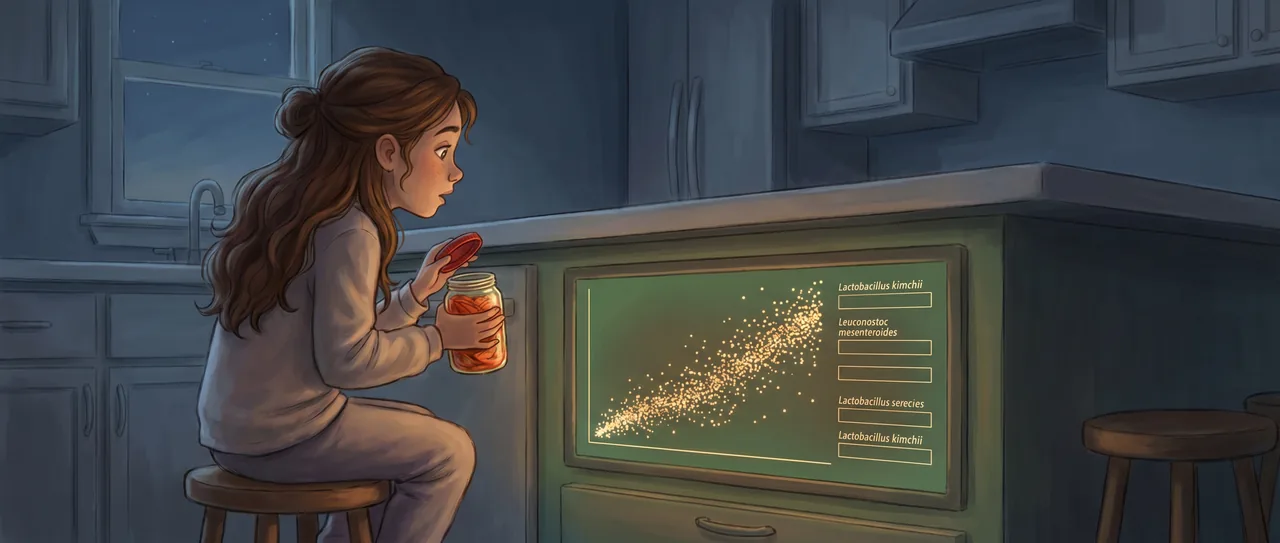
Flora rearranged its garden into a scatterplot. Thousands of dots, each one a person. The x-axis was a bacterial diversity score. The y-axis was a composite cognitive metric. There was a clear upward trend. Not perfect, not a straight line, but visible. Undeniable.
"That's a correlation," Maya said.
"Yes."
"So what's the mechanism?"
Flora's garden paused. The little bacteria stopped blooming. The leaves stopped swaying. For a full two seconds, nothing moved on the screen.
"There is no established mechanism," Flora said.
Maya pulled out a stool and sat down. "What do you mean there's no mechanism? You just told me to eat kimchi."
"The correlation is robust across multiple datasets. The recommendation follows from observed patterns."
"But you don't know why it works."
"Correct. Several hypotheses exist. Short-chain fatty acids produced by gut bacteria may influence the blood-brain barrier. The vagus nerve connects the enteric nervous system to the brain and could serve as a communication pathway. Bacterial metabolites may modulate neurotransmitter precursors. But none of these pathways have been confirmed to produce the specific cognitive effects observed in the data."
Maya stared at the scatterplot. All those dots. All those people. Something in their guts was talking to their brains, and nobody knew the language.
"Flora. How many people are in this dataset?"
"Forty-seven thousand, across fourteen studies."
"And nobody knows why."
"The correlation has been replicated. The mechanism has not been identified."
She pulled the cereal box back toward her, then stopped. She wasn't thinking about breakfast anymore. She was thinking about the dots.
"You recommended kimchi to me."
"Yes."
"Based on a pattern you found but can't explain."
"That is correct."
"Does that bother you?"
Flora's garden tilted, a visual representation of processing. "I am not designed to experience discomfort. But the question is well-formed. Should a recommendation be made when the correlation is strong but the causal pathway is unknown?"
Maya almost laughed. Her kitchen counter had just asked her a better question than she'd asked it.
She thought about it. She thought about it the way she thought about things, which was by finding the part that didn't fit and pressing on it.
"Doctors give recommendations based on correlations all the time," she said slowly. "They told people to eat fiber before they understood exactly how it helped. Sometimes the pattern is enough to act on. But."
She stopped.
"But," she said again.
"But?" Flora asked.
"But if you don't know the mechanism, you don't know the boundaries. You don't know when the pattern breaks. You don't know if it's the bacteria doing the thing, or if something else is causing both the bacteria and the brain stuff.
"
Flora's garden erupted into a branching diagram. Confounding variables, it labeled them. The branches multiplied. Diet. Sleep. Exercise. Socioeconomic access. Genetics. Stress.
"These factors have been partially controlled for," Flora said. "The correlation persists after adjustment. But partial control is not complete control."
"So the pattern is real," Maya said, "and the reason for the pattern might be something nobody has even thought to look for yet."
"That is one possibility."
Maya looked at the branching diagram. It was beautiful, actually. All those tangled lines connecting the gut to the brain through pathways that might not even be drawn yet. Forty-seven thousand people carrying around bacterial communities in their stomachs that seemed to know something about their minds, and the something was still unnamed.
She thought about all the things in science that started like this. A pattern in the data. A reliable, repeatable, inexplicable pattern. The kind of thing that made people uncomfortable because it worked but nobody could say why.
Those were the best things. Those were the edges where the next discoveries lived.
"Flora, can you show me which bacterial species have the strongest unexplained correlation?"
The screen shifted. A short list appeared. Five species, each with a confidence interval and a blank space where the mechanism should go.
Five blank spaces. Five doors that nobody had opened yet.
Her mom's footsteps creaked on the stairs.
Maya opened the refrigerator and took out the jar of kimchi. Not because Flora told her to. Because the pattern was real and the question was open, and eating the kimchi was the closest she could get, right now, at six in the morning in her kitchen, to standing inside the blank space where the answer would eventually be.
She unscrewed the lid. The smell of garlic and salt and fermentation rose sharp into the cold morning air, and somewhere inside her, a hundred trillion bacteria waited to do something that no one on Earth could yet explain.
Read the interactive version, listen to the narration, and earn a gold star →
A science-verified short story for curious kids · Curiosity Land