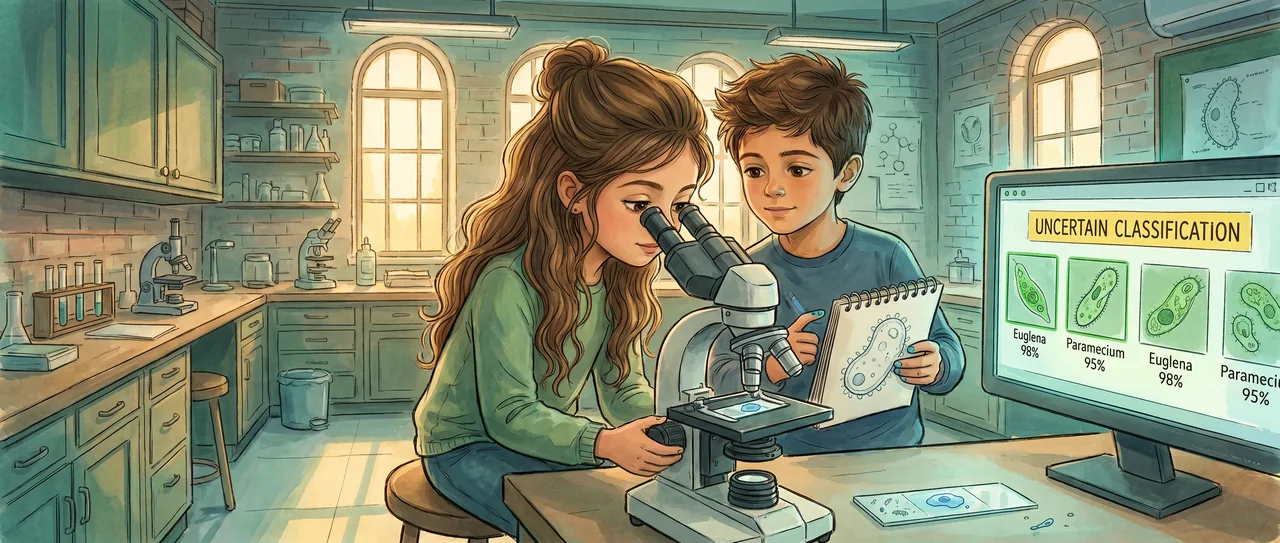
The Cell That Would Not Be Named
The AI said "uncertain classification" for the third time, and Soren stopped breathing.
He had been feeding pond water samples through the microscope for forty minutes while Maya sorted their collection jars by date. The community lab was mostly empty on Saturday mornings. Dr. Bassi, who ran the open hours, was in the back room arguing with someone on the phone about a grant application. Her voice rose and fell like weather.
The system they used was called CellSight. It had been trained on eleven million microscopy images. It could identify over four hundred cell types from shape and texture patterns alone, and it was better at it than most biologists. Soren had watched it work all summer, labeling diatoms and amoebas and rotifers faster than he could write their names. It never hesitated.
Until now.
The first time the yellow banner appeared, uncertain classification, Soren assumed he had smudged the slide. He cleaned it. Prepared a new mount from the same jar. Found the same cell.
The second time, he adjusted the focus, thinking maybe the image was too blurry for pattern matching. The cell sharpened. The banner stayed.
The third time, he called Maya over.
"Look at this," he said.
Maya leaned into the eyepiece. The cell sat in the lower right quadrant of the field of view, slightly larger than the Euglena drifting past it. It had a defined membrane. Some kind of internal structure. A faint greenish tint that could have been chloroplasts or could have been the light.
"It looks like a cell," Maya said.
"CellSight doesn't know what it is."
Maya straightened up. She looked at the screen where the AI's analysis panel listed everything else on the slide. Paramecium caudatum, confidence ninety-eight percent. Closterium moniliferum, confidence ninety-six percent. Twelve other identifications, all above ninety. And then one yellow entry at the bottom. Uncertain classification. Confidence below threshold.
"It classified everything else," Maya said.
"Three times. Three different slides."
Maya pulled a stool over and sat down. She did not touch the microscope yet. She just looked at the screen, at the AI's attempt to match the cell against its categories. The system showed its three closest guesses. Each one had a confidence below forty percent. The shape was wrong for all of them. The internal texture didn't match.
"Okay," she said. "So either we messed something up, or."
"Or," Soren agreed.
They both knew what the other option was. Artifacts happened all the time. Air bubbles. Fiber fragments. Debris that looked biological under magnification. Dr. Bassi had shown them a piece of lint once that looked exactly like a tardigrade if you squinted.
But CellSight was trained on artifacts too. It could identify common contaminants. It hadn't flagged this as debris. It had flagged it as uncertain.
"Which jar?" Maya asked.
Soren pointed. It was the sample from the drainage ditch behind the elementary school. They had collected it on Thursday because Maya noticed the water had a weird shimmer to it, not oily, more like the surface was thick.
Maya opened the jar and held it up to the window light. Greenish. Slightly cloudy. Normal pond water smell, which was not a pleasant smell.
"Let me make a slide," she said.
She did it carefully. One drop. One coverslip, lowered at an angle the way Dr. Bassi had taught them so no air bubbles got trapped. She put it on the stage.
CellSight began identifying. The usual parade of microorganisms. And then, near the edge of the drop, another one.
Uncertain classification.
"Same cell," Maya said. "Different slide, different drop. It's real."
Soren had his notebook open. He was sketching what he saw through the eyepiece. The shape was roughly ovoid but slightly asymmetrical, like a bean that had been pressed on one side. The membrane had a texture he hadn't seen before. Not smooth like an animal cell. Not rigid like a plant cell wall. Something in between. Bumpy in a regular pattern.
"The texture is weird," he said. "CellSight uses texture as a primary feature for classification. If the texture doesn't match anything in its training set."
"Then it's something the system has never seen," Maya finished.
"Or something nobody has ever photographed for a training set."
That was different. That was an important difference. CellSight had been trained on eleven million images, but those images came from samples that biologists had already collected, already classified, already published. If something was rare enough, or lived in a specific enough habitat, it might never have made it into the dataset.
A drainage ditch behind an elementary school was not exactly a well-studied ecosystem.
Maya was quiet for a moment. Then she said, "We need to rule out artifact."
"How?"
"If it's biological, it should respond to staining."
Soren went to the supply cabinet. Dr. Bassi kept basic stains available for open hours. He came back with methylene blue, which binds to nucleic acids. If the cell had DNA or RNA, it would take up the stain.
Maya added a drop to the edge of the coverslip and let capillary action pull it through. They waited thirty seconds. Soren counted in his head.
The cell turned blue.
Not the pale, diffuse blue of a staining artifact. A structured blue. Darker in the center, where a nucleus would be. Lighter around the edges. Whatever this was, it had genetic material. It was alive.
"It's real," Soren said.
Maya tilted her head at the screen. "CellSight still says uncertain."
"Good," Soren said. He surprised himself by saying it.
Because uncertain was the honest answer. The system had been built to say what it knew and what it didn't. And right now, what it didn't know was sitting on their slide, stained blue, alive, doing whatever it was doing in a drainage ditch that nobody had ever thought to look at carefully.
From the back room, Dr. Bassi's phone call got louder and then abruptly stopped. A door opened.
"You two still on pond water?" she called, already distracted, already looking at her own laptop.
"Dr. Bassi," Maya said. "Can you come look at something?"
Something in Maya's voice made Dr. Bassi look up. She crossed the room. She looked through the eyepiece for a long time. She looked at the AI panel. She looked at the three slides Soren had set aside in a row, labeled in his careful handwriting with the date, the sample source, and the word unknown.
She straightened up slowly.
"Where exactly is this drainage ditch?" she asked.
Maya pulled up the map on her phone and zoomed in. Soren reached over and placed his finger on the spot, still stained faintly blue at the fingertip from where he had touched the slide.
Read the interactive version, listen to the narration, and earn a gold star →
A science-verified short story for curious kids · Curiosity Land