Every Word at Once
Soren's aunt Petra had said they could watch, not touch. Then her phone rang and she walked into the hallway, still talking about server costs, and didn't come back for forty minutes.
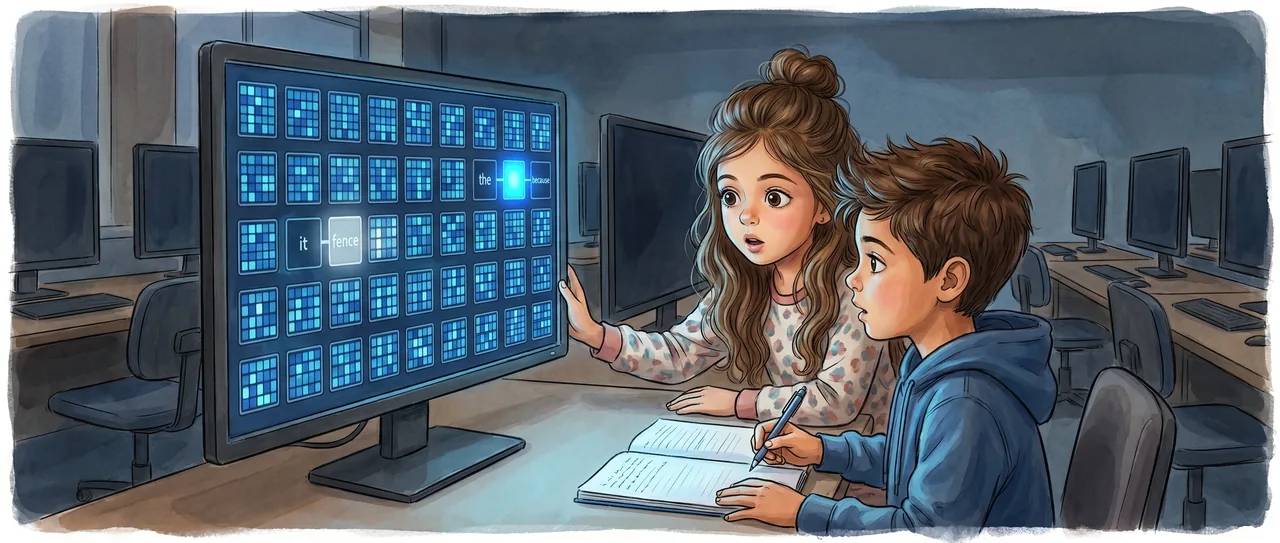
The screen showed a grid. Rows of words along one side, the same words along the other, and the squares between them glowed in different shades of blue. Some squares were almost white. Some were so dark they nearly vanished.
"The fox jumped over the fence because it was low," Maya read from the top of the screen. She pointed at the grid. "What is this?"
"Attention weights," Soren said. He'd read the handout Petra had left on the desk. "It's what the model is doing when it reads that sentence. Every word is looking at every other word. At the same time."
"Looking how?"
"Like, deciding how much each word matters to each other word. The bright squares mean a strong connection. The dark ones mean almost none."
Maya leaned closer. The word "it" had a row of mostly dark squares. But one square blazed pale, almost white, connecting "it" to "fence."
"That's wrong," Maya said.
"What?"
"It was low. The thing that was low. It's the fence, not the fox. And the model got it right. But nobody told it what 'it' means."
Soren looked at the handout again. "It says here there are no grammar rules in the model. No one programmed 'a pronoun refers to the nearest compatible noun' or anything like that. It just learned."
"Learned from what?"
"Text. Billions of sentences. It read them and figured out the patterns on its own."
Maya pulled up a keyboard. Soren almost said they weren't supposed to touch, but Maya was already typing.
The fox jumped over the fence because it was tall.
The grid reappeared. This time the bright square connected "it" to "fox."
"It switched," Maya said. "One word changed and the whole pattern flipped. Because if the thing was tall, it jumped over. That's the fox. If the thing was low, it got jumped over. That's the fence."
Soren sat down. He pulled his notebook out but didn't write anything yet. He was staring at the grid.
"It's not doing grammar," he said slowly. "It's doing meaning."
"Try another one," Maya said.
He typed: The trophy didn't fit in the suitcase because it was too big.
The bright square connected "it" to "trophy."
He changed one word: The trophy didn't fit in the suitcase because it was too small.
The bright square jumped to "suitcase."
"Same sentence," Maya said. "Same structure. Same everything except big and small. And it knows. It knows that if something is too big, that's the trophy, and if something is too small, that's the suitcase. How does it know?"
"Because that's how the world works," Soren said. "Big things don't fit inside. Small containers can't hold things. And it learned that from reading."
"But it's never seen a trophy. Or a suitcase."
They sat with that for a moment.
Maya typed fast: The cat sat on the mat because it was tired.
Bright square on "cat."
The cat sat on the mat because it was comfortable.
The connection wavered. The square between "it" and "cat" was medium blue. The square between "it" and "mat" was almost as bright.
"It's not sure," Soren said. "Because both could be comfortable. The cat could be comfortable. The mat could be comfortable."
"It's uncertain the same way I'd be uncertain," Maya said. She wasn't looking at the screen now. She was looking at something farther away.
Soren wrote in his notebook: Not rules. Weights. Relevance. The machine learned what matters to what, the way we do, by hearing enough language.
Then he stopped writing because something was bothering him. "Maya. It's doing this to every word at once. Not reading left to right. Every word is attending to every other word simultaneously."
"So?"
"So when we read, we go in order. We hear 'the fox' and then 'jumped' and we build the picture piece by piece. This thing takes the whole sentence in at once. Every relationship, all at the same time. That's not how we think."
"How do you know that's not how we think?"
Soren opened his mouth. Closed it.
"When you read a sentence," Maya said, "do you actually go word by word? Or do you just suddenly understand it? Like, the meaning is already there before you've finished reading?"
"I don't know," Soren said. "I actually don't know."
Petra came back. She had a coffee now and looked like she'd forgotten they were there. "Oh. You're still here. Did you touch anything?"
"We typed some sentences," Maya said.
"Into the attention visualizer?" Petra glanced at the screen. "Oh, that's just a demo. It shows one layer of one attention head. The full model has ninety-six heads across thirty-two layers. Each one attending to something different."
"Different how?" Soren asked.
"Some heads learn syntax. Some learn coreference. Some learn things we can't name yet. We look at what they attend to and sometimes we just don't understand why a head is connecting two words. But it works. The model gets the right answer."
Petra's phone rang again. She looked at it, looked at them, looked at the screen. "Don't break anything," she said, and walked back out.
Maya had already typed a new sentence.
Soren watched the grid appear. Ninety-six patterns this time, tiled across the screen. Some were sparse, almost empty. Some were dense with light. Some showed patterns he could almost read, like one head connecting every verb to its subject. But others were strange. One head connected the word "the" to the word "because" across every sentence they'd tried, bright as a lamp, and he could not imagine why.
"There are things in here it learned that we never taught it," Soren said. "And things it learned that we can't even describe."
Maya put her hand on the corner of the monitor, not blocking the view, just touching the frame.
Soren looked at the grid where one attention head blazed with connections no researcher could name, linking words for reasons no one had yet understood, and he turned to a new page.
Read the interactive version, listen to the narration, and earn a gold star →
A science-verified short story for curious kids · Curiosity Land