Every Cell Remembers
Soren's mother had said he could sit in the break room, but the break room smelled like burned coffee and someone's leftover curry, and the vending machine hummed at a frequency that made his teeth itch. So he wandered.
The lab was mostly empty. Saturday evening. His mother was down the hall calibrating something she had described three times in words he almost understood. The open house had ended hours ago, but the posters were still taped to the walls of the corridor, and Soren read them the way he read everything, which was slowly, and twice.
One poster stopped him.
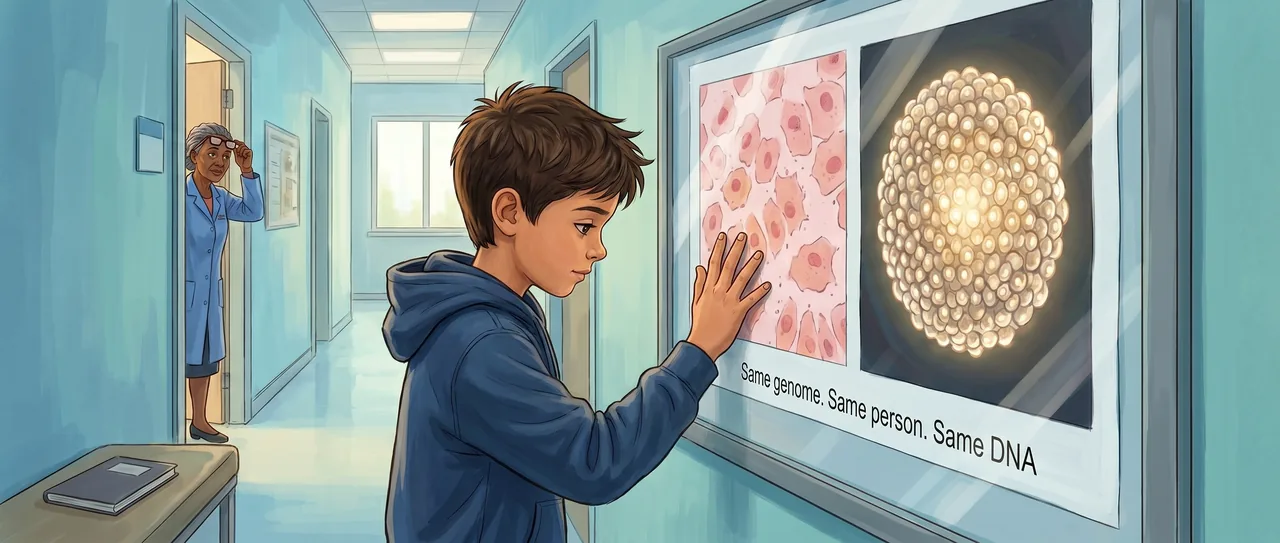
It showed two photographs side by side. On the left, a clump of cells, pinkish, flat, stretched out like tiny fried eggs. The label said "human dermal fibroblasts." On the right, a tight round colony of cells, luminous, packed together like a little planet. The label said "induced pluripotent stem cells."
Below both photographs, in small print: "Same genome. Same person. Same DNA sequence."
Soren read it again. Same DNA. He touched the poster. The skin cells and the stem cells had the same genes. Every single one. The difference was not what they had. It was what they were doing.
He pulled out his notebook and wrote: HOW DOES A CELL KNOW WHAT IT IS?
Then, underneath: AND WHAT HAPPENS WHEN IT FORGETS?
"You're Linda's kid."
Soren turned. A woman in a blue lab coat stood in the doorway of the adjacent room, holding a pipette in one hand and a granola bar in the other. She had reading glasses pushed up on her forehead and looked like she had been working for about fourteen hours, which, Soren would learn, she had.
"I'm Dr. Achebe. Your mom said you might be roaming. You want to see what the poster's actually about?"
Soren followed her in.
The lab bench was cluttered with dishes and tubes and a microscope connected to a monitor. Dr. Achebe sat down heavily and gestured at the screen.
"Look," she said. "These are skin cells from a biopsy. Boring, ordinary, fully committed skin cells. They've decided what they are. They make keratin, they stick to each other, they do skin-cell things."
On the screen, the cells lay flat and separate, each one minding its own business.
"Now." She tapped a few keys and a different image came up. The same tight, glowing colony from the poster. "These are the same cells. Three weeks later. We introduced four genes. Just four. Oct4, Sox2, Klf4, c-Myc. We call them the Yamanaka factors, after the scientist who figured it out. And the cells forgot they were skin."
Soren stared at the screen. "They forgot."
"Reversed. Reprogrammed. Whatever word you like. The DNA didn't change. Not one base pair. We just told four genes to turn on, and those four genes told other genes, and those genes told other genes, and eventually the whole pattern shifted. The cell stopped reading the chapter called 'skin' and went back to the table of contents."
Soren wrote that down. Table of contents.
"So every cell in my body has the same book," he said.
"Exactly the same book. Your liver cells, your neurons, your blood cells, the cells in your eyeballs right now. Identical library. They're just each reading a different chapter, and they've got all the other chapters sort of, bookmarked but closed. Silenced. Locked up with chemical tags. Methyl groups, histone modifications. It's like putting a padlock on pages you're not supposed to read."
"And the four genes pick the locks."
Dr. Achebe paused with the granola bar halfway to her mouth. "That's not a bad way to put it. Yeah. They pick the locks. All of them. The cell can read every chapter again, which means it can become anything again."
Soren looked at his own hand. He turned it over, studying the skin on his palm, the lines there, the tiny ridges. Every cell in that hand contained the instructions to become a neuron. A heart muscle cell. A cell in the lining of his stomach. The instructions were not missing. They were just quiet.
"Dr. Achebe," he said. "When you reprogram them, do they all make it?"
"No." She said it simply, not softening it. "Most don't. Maybe one in a thousand, sometimes fewer. The ones that do, we can grow into colonies, and those colonies can become almost any cell type in the body. We've made beating heart cells from skin. Neurons that fire. Retinal cells."
"From skin."
"From skin."
Soren pressed his pen against the notebook page without writing. Something was building in his head that he did not have the shape for yet.
"The cells that don't make it," he said. "What happens to them?"
"Some just stay skin cells. Some start to change but get stuck partway. Some die. Reprogramming is rough. You're asking a cell to undo years of identity. That's not trivial."
Soren thought about the word identity. A cell didn't have a brain. It didn't have opinions or memories. Its identity was just which genes were on and which genes were off. A pattern. A habit of expression that reinforced itself, day after day, division after division. The cell was skin because it kept doing skin things, and it kept doing skin things because it was skin.
And four genes could interrupt that loop.
"Could you do it the other direction?" he asked. "Take a stem cell and make it think it's skin? Specifically skin?"
"That's called directed differentiation. It's what half this lab works on. Harder than it sounds, because you need the right signals in the right order. But yes. We're learning."
Soren closed his notebook. Then opened it again.
"Dr. Achebe. The DNA doesn't change."
"Not one letter."
"So nothing is actually lost. Ever. In any cell. It's all still there."
Dr. Achebe looked at him for a long moment. She put down the pipette. "That," she said, "is the thing that made Yamanaka's career. The thing nobody believed until he proved it. Every cell in your body is still carrying the complete set of possibilities it had the day you were a single fertilized egg. They're just not using them."
She turned back to her bench, already reaching for a tube, already half somewhere else.
Soren walked back to the corridor. He stood in front of the poster again. The two photographs. The flat skin cells and the glowing colony. Same genome. Same person. Same DNA.
He held his hand up next to the poster, fingers spread, and looked at the skin pulled tight across his knuckles. Thirty-seven trillion cells in his body, every single one carrying the whole book, every single one reading only its own page.
He pressed his palm flat against the glass.
Read the interactive version, listen to the narration, and earn a gold star →
A science-verified short story for curious kids · Curiosity Land