What Burning Gives
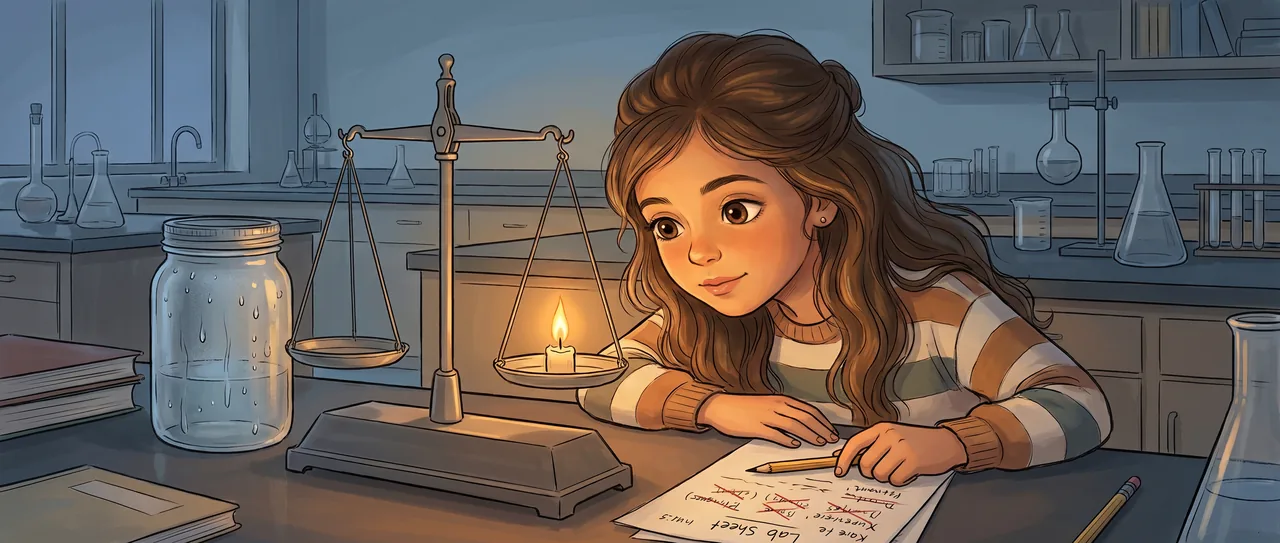
The candle had been burning for four minutes and twelve seconds when it went out.
Maya wrote the time on her lab sheet and stared at the empty jar. She was supposed to be making up the experiment she had missed last Thursday. Mrs. Okoro had left the instructions on the bench and gone to her office down the hall, saying she would be back in twenty minutes and to please not set anything on fire that was not meant to be on fire.
The instructions said: Light a candle. Place a glass jar over it. Record how long it takes to go out. Explain why it goes out.
Maya had done the first three. The fourth one was the problem.
She knew what she was supposed to write. The candle uses up the oxygen in the jar. No oxygen, no fire. She had read the textbook. She could write that sentence right now and be done and walk home.
But she kept looking at the jar.
Something was bothering her. The candle had not just stopped, like a switch flipped. It had flickered first. Gotten smaller. Struggled. And there was moisture on the inside of the glass now, tiny droplets she had not put there.
She lit another candle. Put the jar over it again. This time she watched the flame instead of the clock.
It burned bright for a while. Then the flame shrank, turned bluer at the base, and flickered three times before it died. The smoke curled up and hit the top of the jar and had nowhere to go.
The candle used oxygen. Fine. But it also made something. The moisture was new. The smoke was new. The flame changed color before it died, which meant something about the air inside the jar was different even before the oxygen was gone.
Maya pulled the jar off and smelled it. Waxy. Warm. Not the same as regular air.
She sat on the lab stool and thought about what Mrs. Okoro had told them two weeks ago, almost as a joke. She had said that for over a hundred years, the smartest chemists in Europe believed that when things burned, they released an invisible substance called phlogiston into the air. Fire was not something eating the oxygen. Fire was the phlogiston escaping from the object. Everything that could burn was full of phlogiston, and burning was just the phlogiston leaving.
The class had laughed. How could anyone believe that? It was so obviously wrong.
Maya had laughed too. But now, sitting alone with the dead candle and the fogged jar, she was not laughing.
Because if she were being honest, and she watched the candle without knowing anything about oxygen, what she saw was exactly what the phlogiston people saw. Something visible leaving the candle. The wax getting smaller. Smoke and heat pouring out. The candle lost weight, lost mass, lost substance. If nobody told you to look for what the fire was eating, all you would see was what the fire was giving off.
The phlogiston idea was not stupid. It was what the experiment actually looked like.
She lit a third candle. This time she weighed the candle first on the lab scale. Fourteen point six grams. She let it burn for exactly two minutes, uncovered, then blew it out and weighed it again. Thirteen point nine grams.
The candle lost zero point seven grams. Where did it go? Into the air. As heat, as light, as smoke, as that waxy smell, as the water droplets on the glass. The candle gave something to the air.
So the phlogiston people were not making things up. They were describing exactly what they saw. The problem was not their observations. The problem was that they did not have the idea of oxygen yet. Not just the word. The concept. The idea that air was not one thing but a mixture, and that one part of that mixture was being consumed.
You could not discover oxygen by looking harder at fire. You had to invent a completely new way of thinking about what air was.
Maya pulled her lab sheet toward her and read the question again. Explain why the candle goes out.
She picked up her pencil. Put it down. Picked it up again.
She did not write the answer from the textbook.
She wrote: The candle goes out because the oxygen in the jar is consumed during combustion. But if I did not already know oxygen existed, I would have no reason to think that. What I can actually observe is the candle losing mass. I can observe smoke, heat, light, water vapor, and a change in the flame color. All of these observations are consistent with something leaving the candle, not something in the air being used up. The reason the phlogiston theory lasted over a hundred years is that it matched what combustion looks like. The only way to see oxygen was to weigh the air, not just the candle. You had to measure what you could not see changing.
She stopped writing. Her hand was shaking a little, which was strange, because nothing scary had happened.
But something had shifted. Because if the smartest people in the world could look at fire for a hundred years and not see oxygen, not because they were stupid but because they did not have the concept yet, then what was she looking at right now, today, that she did not have the concept for?
What was in front of everyone, obvious as fire, waiting for someone to invent the right idea?
Mrs. Okoro came back. She picked up Maya's lab sheet and read it, and her eyebrows went up, and she read it again.
"This isn't what the question asked for," she said.
"I know," Maya said.
"You'll get partial credit at best."
"I know."
Mrs. Okoro set the paper down. She looked at Maya for a long moment, and something crossed her face that was hard to read. Not approval exactly. More like she was remembering something from a long time ago.
"Lavoisier weighed everything," Mrs. Okoro said quietly. "The air, the metal, the ash. He weighed what nobody thought to weigh. That was his whole trick."
She handed the lab sheet back.
"Full credit," she said, and walked out.
Maya sat alone in the lab. The third candle was still on the scale, smaller than it started. She struck a match and lit it one more time and watched the wax disappear, gram by gram, into something she could not see.
Read the interactive version, listen to the narration, and earn a gold star →
A science-verified short story for curious kids · Curiosity Land