Three Marbles
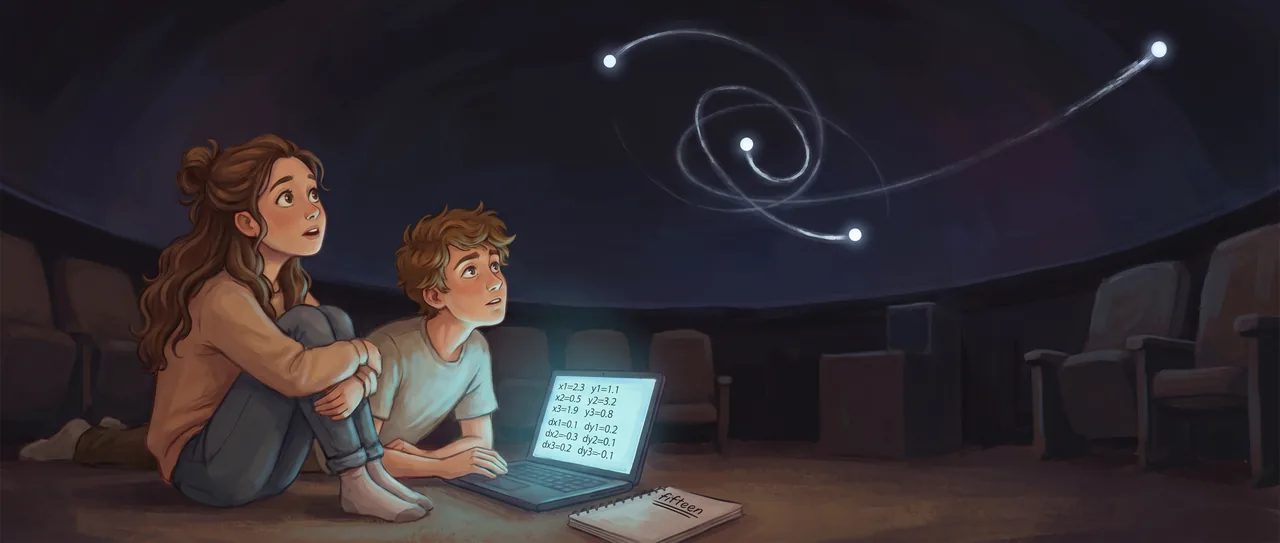
The planetarium projector was off, but Soren had plugged his laptop into the auxiliary port, and now the dome above them showed three white dots instead of stars.
"Okay," Maya said. "Hit it."
Soren pressed enter. The three dots began to move.
They'd been working on this for two weeks. The science fair project was supposed to be simple: simulate gravity. Two objects pulling on each other. Soren had written the code himself, line by line, checking every equation against three different textbooks. Two dots orbiting each other worked perfectly. Clean ellipses, just like the diagrams.
Then Maya had said, "Add a third one."
Now the three dots swung across the dome in wide, swooping arcs. They circled each other, then flung apart, then crashed back together in a tumbling knot.
"It's beautiful," Maya said.
"It's wrong," Soren said. He was frowning at his notebook, where he'd written the initial positions and velocities. "I must have a bug. Watch, I'll restart it with the exact same numbers."
He stopped the simulation. Typed the same values in. Pressed enter.
The dots moved. And for the first several seconds, they traced the same paths. Then one of them swung a little wider. Then the other two shifted. Within thirty seconds, the pattern was completely different.
"You changed something," Maya said.
"I didn't." He showed her the screen. Same six lines of initial conditions, copied and pasted.
Maya sat up straighter. "Run it again."
He did. Same start. Same first few seconds. Then the dots wandered off into a new dance, nothing like either of the previous two.
"Soren. You didn't change anything."
"I know."
They stared at the dome. The dots looped and dove.
"So the math is right," Maya said slowly. "And the numbers are the same. But the answer is different."
Soren opened his mouth, closed it, opened it again. "Floating point," he said.
"What?"
"The computer can't store perfect numbers. It rounds. Just a tiny bit. Like, the fifteenth decimal place."
"That's basically nothing."
"Yeah." He watched the dots. "That's basically nothing."
Maya pulled her knees up to her chest. "So a difference smaller than basically nothing gives you a completely different future."
Soren flipped to a new page in his notebook. He wrote: three bodies, same start, different result. Rounding error at fifteen decimal places. Then he underlined fifteen and stared at it.
Ms. Voss, the planetarium technician, came through the side door carrying a box of replacement bulbs. She glanced up at the dome. "That's pretty. What's the pattern?"
"There isn't one," Maya said.
Ms. Voss set the box down. "Then it's random?"
"No," Soren said, too quickly. Then, more carefully: "It follows the rules perfectly. Gravity pulls each one toward the other two, and the code calculates it step by step. There's nothing random in it."
"But there's no pattern," Maya repeated.
Ms. Voss looked between them, shrugged pleasantly, and went back to sorting bulbs. She was already humming.
Maya slid over to the laptop. "Let me try something." She changed one digit. The starting position of the third dot, shifted by one ten-thousandth.
The first five seconds looked almost identical. Then the trajectories peeled apart like shuffled cards.
"Soren. What if you could measure the positions perfectly? Like, infinite decimal places. No rounding at all. Could you predict it then?"
He thought about this for a long time. "Mathematically? I think you'd need a formula. A single equation that gives you the answer for any time, without calculating every step."
"So is there one?"
"For two bodies, yes. Newton solved that. Ellipses."
"For three?"
Soren pulled up a browser and started reading. Maya watched the dots. After a few minutes he looked up from the screen with an expression she hadn't seen before. Not confusion. Something past confusion.
"There isn't one," he said. "There's no general solution. People have been trying for over three hundred years. There are special cases, specific arrangements that work. But for three random objects pulling on each other with gravity, there is no formula. You can only simulate it, step by step. And every step, the tiny errors grow."
"Two is solvable," she said. "Three is not."
"Two is solvable. Three is not."
"And the universe has more than three things in it."
Soren set his pen down.
Above them, the dots kept moving. One swung close to another, got caught in a tight spiral, then was flung outward toward the edge of the dome. The remaining two settled into something that looked almost like an orbit. Almost.
"So the universe is doing this all the time," Maya said. "Every star pulling on every other star. And nobody can write down what happens next. Not because we're not smart enough. Because the answer isn't that kind of answer."
"It's deterministic," Soren said. "The rules decide everything. But the rules don't give you a shortcut. You have to live through it to find out."
Ms. Voss had finished with her bulbs and was watching the dome now, standing by the door with her arms folded. She didn't say anything.
Maya reached over and changed the starting position by one millionth. They watched. The dots began together, as always. Then came the moment, twelve seconds in, when the paths forked.
Soren pointed at the dome. "Right there. That's where we lose it."
"We don't lose it," Maya said. "It just becomes new."
Soren wrote that down. Then crossed it out. Then wrote it again.
"This is our project," Maya said. "Not two bodies. This. The thing that can't be solved."
"The judges are going to ask what the answer is."
"The answer is that there isn't one. And that's the actual, real, true answer. Three hundred years of the best mathematicians who ever lived, and the answer is: you have to watch."
Soren almost smiled. "You think the judges will like that?"
"I think the judges will hate it."
They both laughed. Above them, the three dots kept falling toward each other and missing, following rules that were perfectly known and perfectly unpredictable, tracing paths that had never existed before and would never exist again.
Maya reached for the laptop and changed the fifteenth decimal place by one.
Read the interactive version, listen to the narration, and earn a gold star →
A science-verified short story for curious kids · Curiosity Land