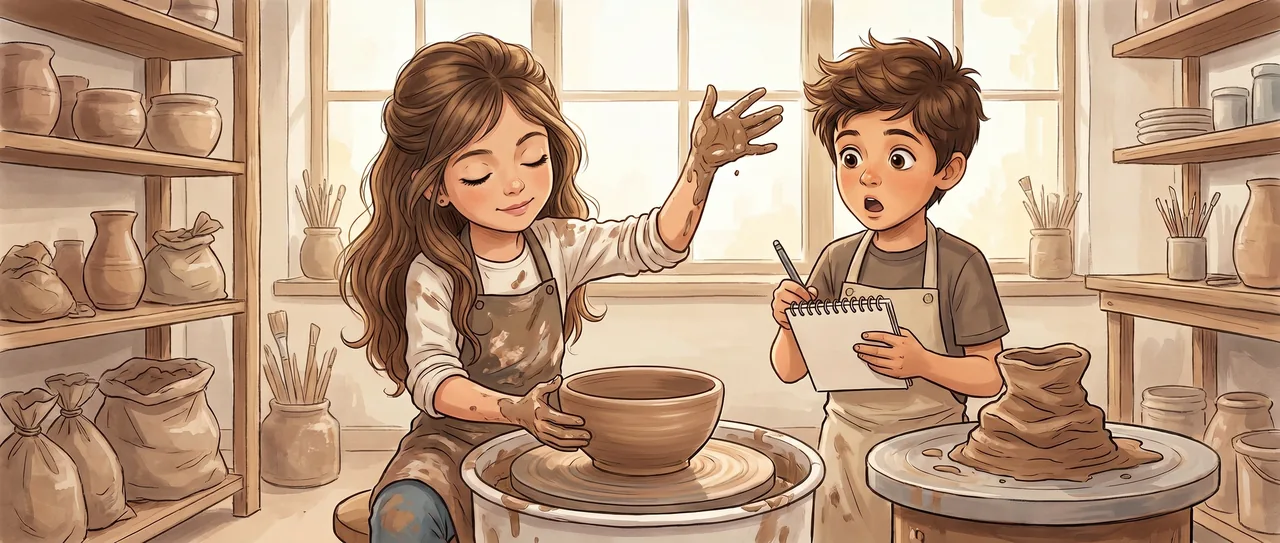
The Wrong Hand
Maya's left hand knew what to do.
That was the problem. She was supposed to be using her right.
The pottery wheel hummed beneath her fingers, and the lump of clay wobbled like something alive. Mrs. Denton had said to center it with both hands, firm and steady, but Maya had been throwing pots with her mom since she was seven, and her left hand kept taking over. Pulling the clay up. Pressing it open. Doing things she hadn't asked it to do.
"Stop," she told her hand.
It didn't stop. The clay rose into a wobbly cylinder anyway.
At the wheel beside her, Soren was having the opposite problem. His hands did exactly what he told them. And what he told them was, apparently, wrong. His clay looked like a volcano that had given up halfway.
"I'm thinking too much," he said.
"You're thinking the right amount," Maya said. "Your hands just haven't caught up."
"That doesn't make sense. My hands don't think."
Maya opened her mouth, then closed it. Because he was right. That didn't make sense. She tried again with her right hand leading, pressing the clay the way Mrs. Denton had demonstrated. The wall of the pot collapsed inward. Her left hand twitched.
"See, but watch this," she said. She closed her eyes and let her left hand do whatever it wanted. The clay pulled up smooth and even, almost by itself. She opened her eyes. A small, clean bowl sat on the wheel.
"You didn't even look," Soren said.
"I know."
"That's weird, Maya."
"I know."
Soren wiped his hands on his apron and pulled out his notebook. He wrote something, then looked at her hands like they were specimens. "Do it again. But this time, try to explain what you're doing while you're doing it."
Maya slapped a new lump of clay on the wheel. She wet her hands, cupped the clay, and started talking. "Okay, so I'm pressing in with my left thumb at the top while my palm pushes from the outside, and my right hand is just, it's, wait."
The clay wobbled. The wall went uneven. She pressed harder to fix it and punched straight through.
"It got worse," Soren said, writing.
"Why did it get worse? I was doing the same thing."
"You weren't, though. You were doing the same thing plus describing it."
Maya stared at the ruined pot. She had been throwing clay for four years. Four years. Her hands knew this. Except they didn't know this, because hands don't know anything. Hands are meat and bone and tendon.
"Where does it go?" she asked.
Soren looked up from his notebook. "Where does what go?"
"The knowing. When I practice something a thousand times, where does the knowing go? Because it's not in my muscles. I just proved that. My right hand has the same muscles as my left. Same tendons, same bones, basically the same strength. But my right hand is useless at this."
Soren put his pen down. He flexed his own hands, opening and closing them. "Okay. So if the knowing isn't in the muscles."
"It's somewhere else."
"It's in your brain."
"Obviously it's in my brain. But it's in a part of my brain I can't talk to. Because when I tried to talk to it, when I tried to describe what I was doing, it fell apart. Like talking wrecked it."
Soren sat very still. Then he picked up his pen again and drew a line down the middle of a page. On one side he wrote TALKING. On the other he wrote DOING.
"Try the opposite," he said. "Try to do something you've never done. Something brand new. But talk through every step."
He pushed his lump of clay toward her. It was still a volcano.
"Throw it left-handed," Maya said. "You've never done this. Talk through every single move."
Soren repositioned himself at the wheel. He narrated everything. "Wetting my hands. Pressing in from both sides. The clay is pushing back. I'm going to try to open it with my thumbs. Pressing down. It's off-center. I'm correcting. Pressing from the right. Too much."
The pot was terrible. Lumpy, uneven, thick on one side and thin on the other.
But it was a pot.
"Now try it without talking," Maya said.
Soren threw another lump on the wheel. Pressed his lips together. Reached for the clay.
His hands froze. He sat there for three full seconds, fingers hovering over the clay, with an expression like someone trying to remember a word they'd just been saying.
"I don't know what to do first," he said. "When I was talking, I knew."
"Because the talking was doing the work. For you, right now, talking IS the thinking. Your brain hasn't moved it somewhere else yet."
Soren looked down at his terrible pot and then at Maya's clean bowl and she could see him understanding something large.
"It moves," he said. "That's what practice does. It moves the knowing from the part of your brain that talks to a part that doesn't. A part that's faster. A part that doesn't need words."
"And once it moves, words get in the way."
They both looked at their hands. Same skin, same bones, same muscles. But different.
Mrs. Denton walked by and glanced at Maya's bowl. "Beautiful. You've got good hands."
Maya almost corrected her. She almost said it's not my hands. But instead she just watched Mrs. Denton move to the next student, watched her adjust the student's grip with fingers that corrected the position automatically, without hesitation, without thought. Decades of teaching, moved to whatever silent place practice sends things.
Soren was writing in his notebook, but he stopped and set it on the table.
"I want to try again," he said. "No talking this time. I want to see how lost I get."
He put his hands on the clay and closed his eyes, and the wheel began to spin, and his fingers pressed into something they did not yet know.
Read the interactive version, listen to the narration, and earn a gold star →
A science-verified short story for curious kids · Curiosity Land