The Water That Remembered
The first filter failed on a Tuesday.
Maya held the glass up to the window of the desalination plant and tilted it. The water looked clean. It tasted clean. But the sensor strip Soren dipped into it bloomed orange, which meant salt was still getting through.
"That's the third one this week," said Mr. Achebe, the plant engineer, already turning back to his console. He had forty-seven other things breaking at the same time. The whole island was running on half its freshwater capacity, and the new zeolite cartridges that were supposed to fix everything were doing exactly nothing. "I'll call the supplier again. You two can head home."
But Maya was already pulling the failed cartridge from its housing, turning the white cylinder in her hands. It was lighter than she expected. Like holding a piece of chalk.
"Soren. Come look at this."
Soren came. He always came when Maya said it like that, because it meant she had noticed something she could not yet name.
"This is supposed to be a zeolite filter," she said. "Like the ones in the spec sheet."
"Clinoptilolite," Soren said, because he had read the spec sheet twice and written down the word because it was satisfying to spell. "The pores are supposed to be uniform. Like, exactly the same size, over and over, through the whole crystal structure. That's the entire point."
"Right. So every pore is the same width. And molecules that are too big can't fit through. And molecules that are the right size slip in and get trapped." Maya turned the cartridge over. "So why does this one look different from the other two that failed?"
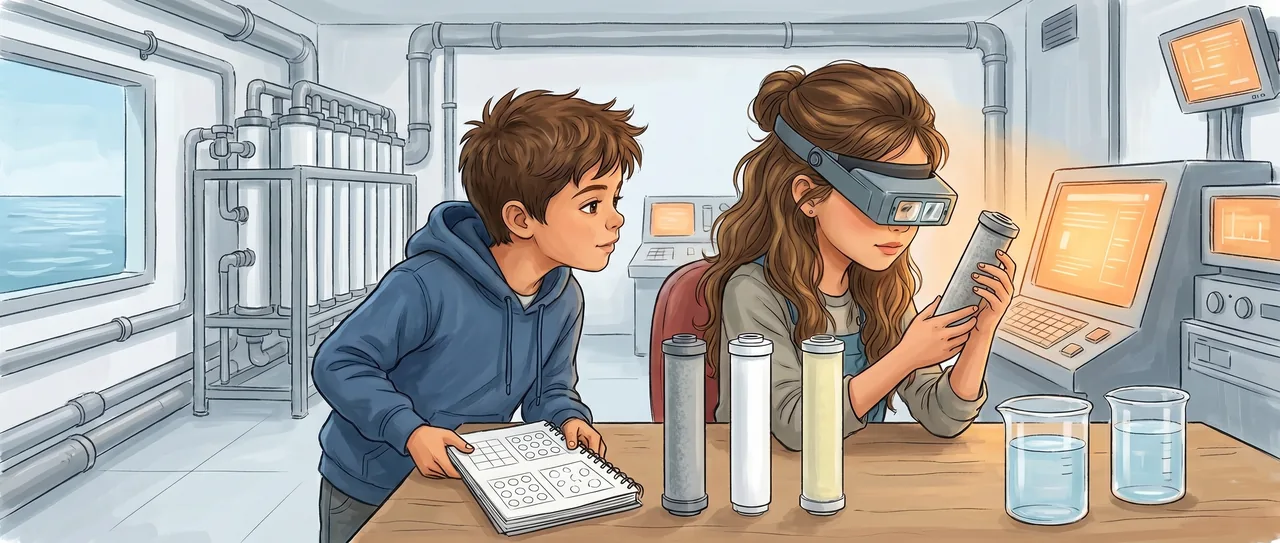
She set all three cartridges on the worktable. Soren leaned in. She was right. The first one had a faintly grayish tinge. The second was pure white. The third had a barely visible yellowish cast.
"If they're all the same zeolite, they should look the same," Soren said.
Mr. Achebe glanced over from his console. "Different batches. Supplier said it's cosmetic. Doesn't affect performance."
Maya said nothing. She picked up the gray one and held it under the magnifying visor mounted on the worktable.
"Soren, look at the surface."
He looked. Under magnification, the surface of the gray cartridge was rough, almost sandy. The white one was smoother. The yellow one was somewhere between.
"If the crystal structure is right, the surface shouldn't matter," Soren said slowly. "The filtering happens inside the pores. Molecules bump into the crystal, and if they're small enough, they enter the channels. Water molecules go through. Salt ions don't, because they're surrounded by water molecules that make them too bulky to fit."
He paused, because he was thinking. Maya waited. She liked the way Soren thought. He built things in order.
"Unless," he said, "the pores aren't the right size."
"Or aren't there at all," Maya said.
Soren opened his notebook and drew a grid of tiny circles, evenly spaced. "This is what zeolite is supposed to look like. Every pore identical. Like a building where every door is exactly the same width. A water molecule fits through. A hydrated sodium ion doesn't. It's too wide. It bounces off. That's the sieve."
He drew a second grid, but this time the circles were random sizes. Some huge, some tiny, some missing.
"And this is what happens if the crystal didn't form right. The doors are all different sizes. Big ions walk right through the big doors."
"So these aren't real zeolites," Maya said. "Or they're bad ones. The crystal structure is wrong."
"Mr. Achebe," Maya called across the room. "When did the supplier change?"
He looked up, distracted. "About three months ago. New contract. Cheaper. Why?"
"Because these aren't working like zeolites. The pore structure is wrong. The water is going through, but so is everything else. There's no selection happening."
Mr. Achebe walked over. He looked at the two beakers. He looked at the three cartridges. He picked up the gray one and rubbed the surface between his fingers, and something shifted in his expression.
"I assumed they were certified," he said quietly.
"Can we use the old supplier's cartridges?" Soren asked.
"I have six left in storage. Enough to run one bank for maybe two weeks." Mr. Achebe was already pulling up his console. "I'll get the old supplier on the line tonight."
While he made the call, Maya and Soren loaded the six remaining good cartridges into the filter bank. Maya locked each one into its housing with a quarter turn. Soren ran the diagnostics. When the first clean water came through and the sensor strip stayed pale blue, neither of them cheered. They just looked at each other.
"Six angstroms," Maya said. "That's how wide the pores are. In the real ones."
Soren tried to picture it. He could not. It was smaller than anything he had ever imagined being precise about. Smaller than light could show you. And yet the whole system, the whole island's drinking water, depended on every single one of those pores being exactly that wide. Not seven angstroms. Not five. Six.
"How do you build something that precise?" he asked. "Not in a factory. In a rock."
"You don't build it," Maya said. "It builds itself. The atoms stack up, silicon and aluminum and oxygen, and the geometry only works one way. So the pores come out the same every time. Every single time. For billions and billions of pores."
Soren stood very still.
An entire crystal that organized itself, atom by atom, into a structure so regular that it could sort the world by shape. Not because someone designed it. Because the atoms had no other choice.
Maya pressed her hand flat against the side of the filter housing, feeling the faint vibration of water moving through a billion doors, each one exactly wide enough to let the right thing pass.
Read the interactive version, listen to the narration, and earn a gold star →
A science-verified short story for curious kids · Curiosity Land