The Watched Pot
The atom was supposed to decay.
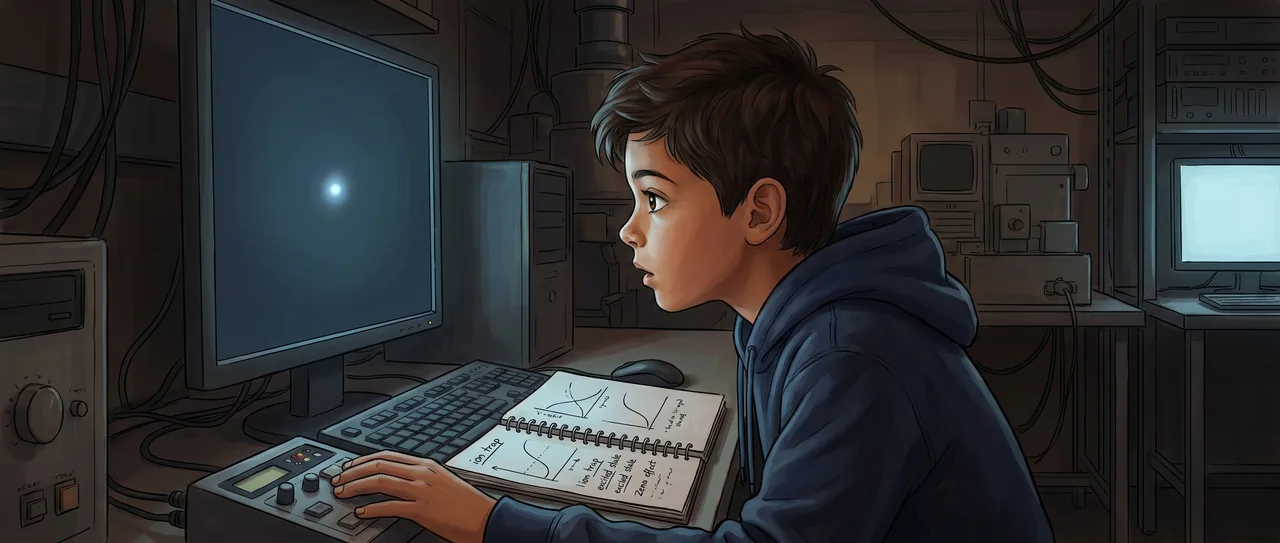
Soren checked the screen again. The beryllium ion sat in its trap, glowing faintly in the camera feed, and it was not doing the thing it was supposed to do. According to Dr. Hallez, the ion had been prepared in an excited state. According to Dr. Hallez, it should transition to its ground state within a few hundred milliseconds. According to the screen, it had been sitting there for eleven seconds, still excited, still glowing, still exactly where it started.
Dr. Hallez was not available to ask about this. Dr. Hallez was in the hallway, arguing with someone from the dean's office about the budget for the open house, her voice carrying through the door in sharp, clipped phrases that made it clear she would not be back soon.
Soren wrote in his notebook: Ion prepared 11:42. Expected decay within ~300ms. Still in excited state at 11s. He underlined the eleven. Then he added a question mark.
The experiment was simple, or at least Dr. Hallez had called it simple when she set it up for the weekend visitors. A single trapped ion. A laser to prepare its state. A detector to watch it. The visitors were supposed to see the ion glow, learn that atoms have energy levels, eat a cookie, and leave. Soren had stayed.
He had stayed because Dr. Hallez said he could run it himself while she handled the budget problem. He had stayed because the ion was beautiful, a single atom pinned in electric fields like a firefly caught in a jar made of math. And he had stayed because something was wrong.
Fourteen seconds now. Still glowing.
Soren pulled up the measurement log on the computer. The detector was pulsing every five milliseconds. He could see the entries scrolling, thousands of them, each one a tiny check: still excited, still excited, still excited. Like someone opening an oven door over and over to see if the cake was rising.
He reached for the detector settings. The pulse rate was adjustable. Dr. Hallez had set it high because, she said, she wanted good data for the visitors. Lots of measurements. Clear signal.
Soren paused with his hand over the keyboard.
He thought about the oven door. His grandmother said that if you keep opening the oven to check a souffle, it collapses. You have to leave it alone. You have to stop looking.
But this was the opposite. The ion was not collapsing. The ion was refusing to change at all.
He looked at the measurement rate again. Every five milliseconds, the detector checked. Every five milliseconds, the ion was found in its excited state. And every five milliseconds, it stayed there.
Soren opened his notebook to a fresh page and wrote: What if checking is the problem? Not the souffle problem. The opposite problem. What if looking at it too much is what keeps it stuck?
He sat with that for a moment. It sounded ridiculous. Looking at something does not change whether it happens. You can stare at a ball on a hill and it still rolls down.
But this was not a ball. This was a single atom, and Dr. Hallez had spent twenty minutes that morning explaining that atoms do not follow the same rules as balls. She had said this with the particular intensity of someone who had spent her whole career on that single fact and still found it astonishing.
Soren changed the measurement rate. He set it to once every five hundred milliseconds instead of once every five. One hundred times less frequent. Then he reset the ion to its excited state and watched.
Three hundred milliseconds. The first measurement hit.
The glow was gone. The ion had decayed.
He stared at the screen. He set it back up. Prepared the excited state again. This time he set the measurement rate to once per second.
The ion decayed in under four hundred milliseconds.
He set the measurement rate back to every five milliseconds.
The ion held. Five seconds. Ten. Fifteen. Twenty. Still excited. Still glowing. Held in place by nothing but the act of being watched.
Soren forgot to write it down. He just sat there, looking at the single bright point on the screen, thinking about what it meant that his looking was the thing doing this. Not his hands. Not a tool he had aimed at it. The measurement itself. The check. The question asked every five milliseconds, are you still there, are you still the same, and the atom answering yes, yes, yes, and the answering being the thing that kept it true.
He ran it four more times. High measurement rate: the ion stayed. Low measurement rate: the ion decayed. High again: it stayed. He varied the rates, mapping the boundary. There was a curve to it. The more frequently he checked, the longer the ion survived. Not a little longer. Enormously longer. The relationship was not gentle.
He filled three pages.
The door opened. Dr. Hallez came back in, looking tired, holding a cookie she had clearly taken from the visitor table.
"Everything okay in here?" she asked.
"The ion won't decay," Soren said.
She looked at the screen. Then at the measurement settings. Her eyebrows rose.
"Ah," she said. "I set the pulse rate too high for the demo. I forgot that would happen." She took a bite of the cookie.
"You forgot," Soren repeated.
"It's called the quantum Zeno effect," she said, chewing. "After the old Greek paradox. If you measure a quantum system frequently enough, you effectively prevent it from evolving. Continuous observation freezes the state. It's real. It's well established. It is also, honestly, one of those things that never stops being a little weird." She looked at his notebook. "You found the curve."
"I found the curve," Soren said.
"Most grad students don't bother mapping it," she said. She took another bite. "I'll want a copy of those pages."
She wandered over to her desk and started answering emails, already somewhere else.
Soren turned back to the screen. The ion was still glowing, still pinned in its excited state by the relentless five-millisecond pulse of the detector. He reached for the keyboard and turned the detector off entirely.
The glow vanished almost instantly.
He turned the detector back on, and the next prepared ion held again, caught in the beam of attention like a moth that would not land as long as you kept your eyes on it.
Soren leaned closer to the screen, watching the atom that could not change while he watched it, and he did not blink.
Read the interactive version, listen to the narration, and earn a gold star →
A science-verified short story for curious kids · Curiosity Land