The Unnamed Pattern
The bee was wrong.
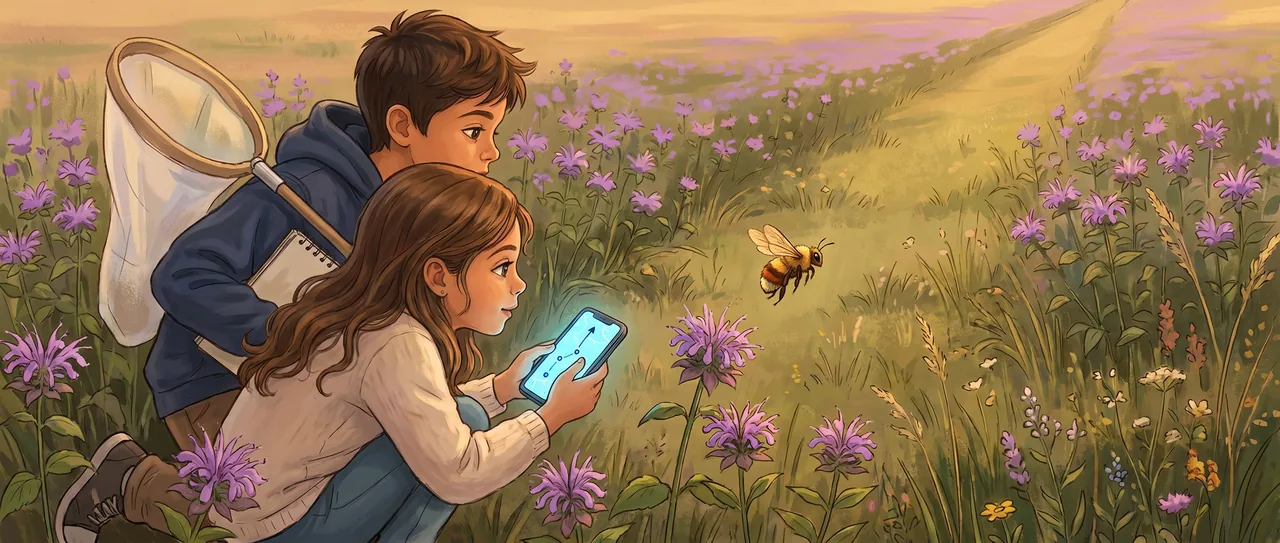
Maya knew it the way she knew when a chord in a song went somewhere unexpected. Not bad. Just wrong. She was crouched beside a patch of wild bergamot at the edge of the corridor trail, holding her phone steady while her AI companion, Lark, catalogued what the camera saw. The bee was golden brown with a russet band across its abdomen, working the flower heads with a slow, heavy persistence that reminded Maya of someone trying to finish a meal they hadn't ordered.
"Bombus pensylvanicus," Lark said in her ear. "American bumblebee. Confidence ninety-four percent."
"That's wrong," Maya said.
"The identification?"
"No. The bee."
She didn't mean the species. She meant the location. She had spent three summers doing corridor surveys, and she had never once seen an American bumblebee this far north. She had seen them in her aunt's garden in Kansas. She had seen them in southern Iowa during last year's migration count. She had never seen one in Manitoba.
She stayed very still. The bee moved to the next flower cluster.
"Lark, what's the northernmost confirmed record for pensylvanicus?"
"Current range maps show consistent observations up to approximately southern Minnesota and southern Wisconsin. Sporadic historical records exist further north, but no confirmed sightings above the forty-eighth parallel in the last twelve years."
Maya looked at the GPS coordinates in the corner of her screen. Fifty point one degrees north.
Two hundred kilometers past the edge of the map.
She pulled out her radio. "Soren. Trail four. Bring your kit."
He arrived eleven minutes later with a sweep net over one shoulder and his notebook already open, which meant he had been writing about something else entirely and hadn't closed it. He knelt beside her without asking what she had found, because she was still watching, and when Maya was still watching, the right thing to do was watch with her.
The bee had moved to a second bergamot stand. It was still foraging. Slow. Deliberate.
"American bumblebee," Maya said.
"Here?" Soren said.
That was all he needed to say. He pulled out his own phone and let his companion, Reef, confirm the identification independently.
"Bombus pensylvanicus," Reef said. "Confidence ninety-six percent. This observation is outside the species' documented range. Would you like to flag it?"
"Flag it," Soren said. "And pull up every pensylvanicus observation in the network from this season."
The map appeared on both their screens. Maya watched the dots populate. Kansas. Missouri. Iowa. Illinois. The usual constellation, like a heat signature centered on the Great Plains. Then three dots she hadn't expected. One in central Minnesota, from May. One in northwestern Wisconsin, from early June. And now theirs, in southern Manitoba, from today.
Three dots. Three months. A line pointing north.
"That's a jump," Soren said. "That's not a gradual range expansion. That's, what, two hundred kilometers in a single season?"
"The Minnesota and Wisconsin observations were flagged by other surveyors," Reef said. "Neither has been incorporated into the species range model yet. Your observation is the third anomalous data point."
Maya sat back on her heels. Three data points. Nobody had connected them because nobody had asked the question yet. Each surveyor had seen one wrong bee and flagged it and moved on.
"What would make them jump like that?" Soren asked. Not to Reef. To Maya.
"I don't know," she said. "It's not just warmth. The corridor's been here for eight years. The bergamot established four years ago. Maybe it's the flowers catching up to the temperature, and the bees catching up to the flowers."
"But that would be gradual," Soren said.
"Unless there's a threshold," Maya said. "Like, the corridor finally connected enough habitat patches that there's a continuous path of forage going north. And this year it crossed some line where the distance between patches got short enough for a bumblebee to actually make it."
Soren wrote that down. Then he crossed out the word "make" and wrote "traverse" and then crossed that out too and wrote "make" again. Maya didn't comment.
"Reef," Soren said, "is there a named pattern for this? A species jumping two hundred kilometers along a habitat corridor in one season?"
"No established term describes this specific pattern. Rapid range expansion events are documented in some species following habitat restoration, but a multi-hundred-kilometer northward shift along a rewilded corridor within a single season has not been formally described or named in the literature."
Soren looked at Maya.
"It doesn't have a name," he said.
"Not yet," she said.
The bee lifted off the bergamot. It hovered for a moment, heavy and improbable, and then it flew north along the corridor, following the unbroken line of wildflowers that stretched toward the horizon. Maya watched it until she couldn't see it anymore, which took longer than she expected because she had very good eyes and the corridor was very straight.
"There might be a fourth data point by the end of summer," she said. "Further north. Someone else might see one."
"Or we might be wrong," Soren said. "Three points isn't a pattern. It's a suggestion."
"Three points is exactly a pattern," Maya said. "It's the smallest possible pattern. Two is a coincidence. Three is a line."
Soren didn't argue with that. He was looking at the map on his phone, at the three dots connected by nothing but time and latitude and a corridor of flowers that humans had planted in old soybean fields because someone had thought it might matter.
Dr. Vasquez, their camp coordinator, came by at dinner. She was distracted, sorting through data from the eastern survey teams, and she glanced at their flagged observation the way someone glances at a headline while looking for a different article.
"Nice catch," she said. "Probably a stray. We'll see if it shows up in the fall audit."
She moved on.
Maya and Soren looked at each other across the picnic table.
"She didn't see the other two dots," Maya said.
"She didn't ask," Soren said.
That night, they submitted their observation with a note requesting correlation with the Minnesota and Wisconsin sightings. Soren wrote the note. Maya edited it down to three sentences. Reef attached the GPS coordinates, the confidence scores, the timestamp, the temperature, the humidity, the flower species, and thirty-two seconds of video showing a golden brown bee with a russet band working wild bergamot at fifty point one degrees north.
Maya leaned against the porch rail of the survey cabin and looked north along the corridor, where the bergamot was a dark smudge against the last light, and the grasses moved, and something she could not see was still flying.
Read the interactive version, listen to the narration, and earn a gold star →
A science-verified short story for curious kids · Curiosity Land