The Thing That Wanted to Be Round
Maya had broken the soap.
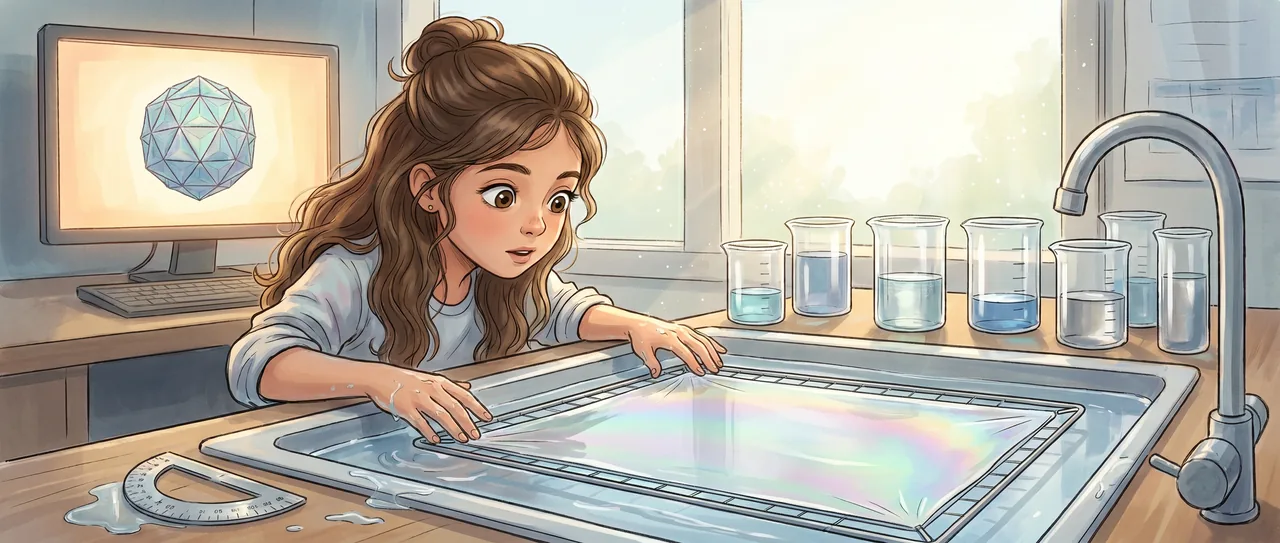
Not the dispenser. The soap itself. She had been scrubbing a beaker for her cousin Priya, who was somewhere down the hall arguing with her thesis advisor about chromatography columns, and Maya had squeezed too much dish soap into the rinse water and now the surface was doing something she could not stop watching.
The bubbles were organizing themselves.
Not just floating. Organizing. Where two bubbles touched, they shared a wall, perfectly flat between them. Where three met, the walls always joined at the same angle. She popped a cluster. It reformed. She popped it again. Different bubbles, same geometry. One hundred twenty degrees every time, like the bubbles had read the same instruction manual.
She had not told them to do that.
Maya set down the beaker. She pulled a stool to the sink and sat. She poured more soap. She watched.
The thing that bothered her was not that the bubbles made patterns. The thing that bothered her was that they made the same pattern. Every time. Without her.
Priya came back twenty minutes later, lab coat half off, looking like she had either won or lost the argument and could not tell which. She found Maya elbow-deep in suds with seven beakers lined up on the counter, each filled with a different concentration of soap and water.
"What are you doing to my glassware?"
"Why do they always pick one hundred twenty degrees?" Maya said.
"Who?"
"The bubbles. Where three walls meet. It is always one hundred twenty. I checked with your protractor."
Priya opened her mouth, then closed it. She looked at the beakers. She looked at her protractor, which was now wet. She pulled up a stool.
"That is actually a real thing," Priya said. "Plateau's laws. The soap film minimizes surface tension, so it finds the most efficient shape automatically."
"Automatically," Maya repeated. She said it the way she said words that were not yet answers.
"Yeah. No one tells it what to do. The physics of the molecules just makes that angle happen."
Maya looked at the sink. "What else does that?"
"Does what?"
"Builds itself."
Priya stared at her for a second, then stood up so fast her stool scraped the floor. "Come here."
She led Maya to a bench at the back of the lab where a monitor displayed something that looked like a dandelion made of triangles. Except each triangle was the same size, and they fit together into a sphere so precise it looked engineered.
"This is a virus capsid," Priya said. "The outer shell. It is made of proteins. Identical proteins. You put them in a solution and they snap together into this. Nobody folds them. Nobody builds it."
"How many proteins?" Maya asked.
"This one? Sixty. Same protein, sixty times, and they find each other and arrange themselves into an icosahedron. Twenty faces, all equilateral triangles."
Maya touched the screen. "Sixty copies, and they just know?"
"They do not know," Priya said. "They fit. Their shapes and charges only match one way. So they find it."
"Like the bubbles."
"Like the bubbles. Like everything." Priya was pulling up more images now, clicking fast, excited in a way that made her forget she was supposed to be supervising, not lecturing. "Look. Cell membranes. Phospholipids. Each one has a head that likes water and two tails that hate it. Dump them in water and they build a sheet, two molecules thick, curved into a sphere. A cell. No one draws the blueprint."
Maya was quiet for a long time. She was looking at the phospholipid diagram, the little circles with their two wavy tails, all lined up in a double layer, heads out, tails in, like they were hiding from the water together.
"Priya," she said. "Every cell in me is wrapped in that?"
"Every one."
"And no one built it."
"The molecules built it. The shape of each molecule is the instruction."
Maya picked up one of the beakers from the counter. She looked at the film of soap on its inner surface. She tilted it and watched the film slide and reform. It did not hesitate. It did not try different angles. It went straight to one hundred twenty degrees like a ball rolling downhill.
She thought about that. A ball rolling downhill does not decide to go down. It just goes. Gravity is the instruction. And for the soap film, the instruction was the shape of the molecule itself.
So the thing she was looking at, this wobbling soap film, it was doing the same thing her cells were doing. The same thing a virus did when it built a perfect geometric shell. The rules were in the pieces.
"Priya. If you could design a molecule that fit together a certain way, could you make it build anything?"
Priya smiled. "That is literally what DNA origami is."
"Wait."
"People design short DNA strands that fold themselves into three-dimensional shapes. Boxes. Smiley faces. Tiny machines. You design the sequence, mix it together, heat it, cool it, and it folds itself."
"You are making this up."
"Google it. I dare you."
Maya pulled out Priya's laptop without asking. She searched. She found electron microscope images of DNA folded into a map of the Western Hemisphere, into a box with a lid that opened, into a robot that walked. Each one assembled from a single long strand and hundreds of short staple strands that held it in shape. Mix them. Heat them. Cool them. Done.
She scrolled through image after image. Tiny structures no one had built with their hands. Structures that had built themselves because the pieces only fit one way.
She closed the laptop slowly.
The lab was quiet. Priya had wandered back to her chromatography argument. The soap in the sink had settled into a flat, still film, and Maya leaned over it, close enough to see the faint rainbow colors shifting across its surface.
One molecule thick. Arranging itself because it could not do otherwise. The same force that wrapped every living cell on Earth in a membrane was right here, in dish soap, in a university sink, on a Saturday.
She blew gently across the surface and watched the colors scatter and reorganize, finding their way back to the geometry they had never been taught.
Read the interactive version, listen to the narration, and earn a gold star →
A science-verified short story for curious kids · Curiosity Land