The Sugar Pill Experiment
The argument started over ice water.
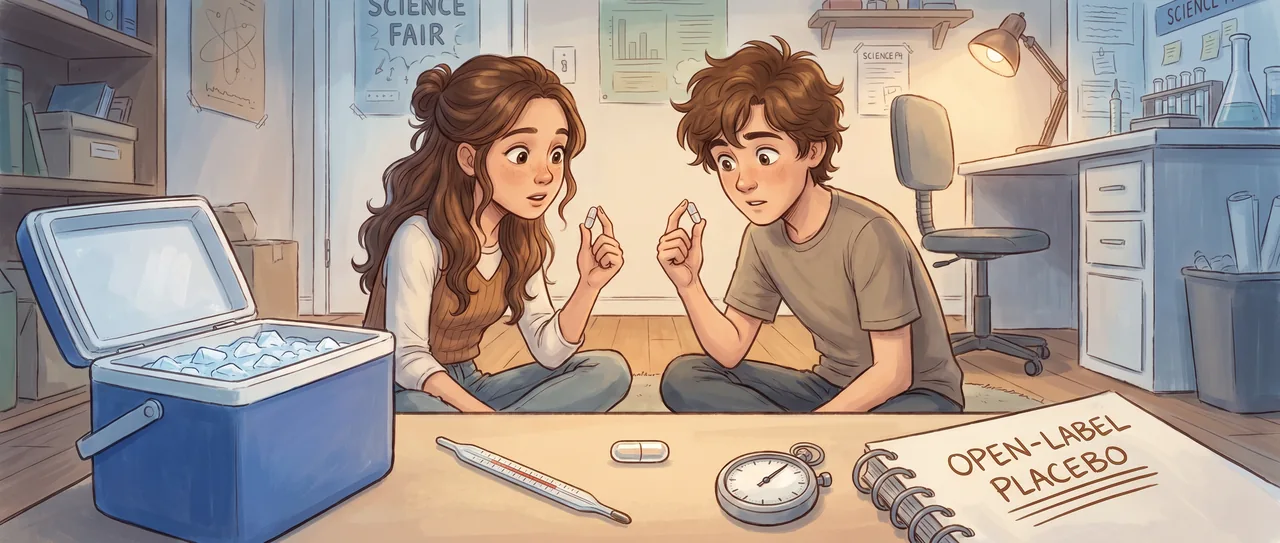
Maya wanted their science fair project to prove that the brain could change the body. Soren wanted their science fair project to prove something they could actually measure. They were both sitting on the floor of Soren's kitchen with a cooler full of ice, a thermometer, a stopwatch, and twenty-four volunteers who were actually just a sign-up sheet taped to Soren's locker.
"We give half of them sugar pills," Maya said. "We tell them the pills are sugar pills. We tell them there's no medicine in them at all. Then they hold their hands in ice water, and I bet the sugar pill group keeps their hands in longer."
"That's not how placebos work," Soren said. "The whole point of a placebo is that people think it's real medicine. If you tell them it's sugar, there's nothing to believe in. There's no trick."
"That's what I'm saying. There is no trick. That's the whole point."
Soren opened his notebook. He had written PLACEBO across the top of a fresh page and underlined it twice, which meant he was taking this seriously but didn't agree yet. "Show me."
Maya pulled up three studies on her phone. She turned the screen toward him and let him read. She didn't summarize. She waited.
Soren read for a long time.
The studies were from Harvard, from the University of Lisbon, from a pain clinic in Germany. In every one, researchers gave patients sugar pills and said, clearly, honestly: these contain no active ingredient. They are made of cellulose. There is no medicine here. But research shows that placebo pills can trigger your body's own healing responses if you take them.
Patients with irritable bowel syndrome improved. Patients with chronic back pain reported real reductions. Cancer survivors with crushing fatigue felt measurably better. Not all of them. Not completely. But measurably, repeatedly, even though they knew.
"They knew," Soren said.
"They knew."
"And it still worked."
"The researchers think the ritual matters. The act of taking something. The body has these pathways that respond to the expectation of treatment. And maybe you don't even have to expect it consciously. Maybe the pathways just fire."
Soren looked at the cooler of ice. Then at the thermometer. Then at his notebook. He crossed out PLACEBO and wrote OPEN-LABEL PLACEBO and underlined it three times.
"Okay," he said. "We need a protocol."
They spent two hours building it. The control group would hold their hand in one degree Celsius water for as long as they could stand it. The experimental group would take a sugar pill first, a clear capsule filled with ordinary white sugar, and be told exactly what it was. Both groups would be timed with the stopwatch.
Ms. Huang, their science teacher, had to approve the protocol. She read it in the hallway on Monday between classes, frowning, one earbud still in from whatever podcast she'd been half-listening to.
"You're going to tell them it's sugar," she said.
"Yes."
"And you think it will still affect their pain tolerance."
"The studies say it does," Soren said.
"Those studies used patients with real clinical conditions. You're using sixth graders with ice water."
"The cold pressor test is a standard pain measurement tool," Maya said. "They use it in labs."
Ms. Huang pulled out her other earbud. She looked at Maya the way adults looked at Maya when she had done more reading than they expected. Not annoyed, exactly. Recalibrating.
"Fine," she said. "No one holds their hand in longer than three minutes. I want a consent form for every volunteer, signed by a parent. And I want you to record not just time but self-reported pain on a one to ten scale."
She walked away still holding the protocol, then came back and handed it to them. "I'm curious too," she said. "Don't tell anyone I said that."
They ran the experiment on a Wednesday after school. Twelve volunteers in each group. The control group went first. Average time with hand submerged: forty-one seconds. Average self-reported pain: seven point two.
Then the sugar pill group.
Maya held up the capsule for each person. She said the same thing every time, reading from an index card so she wouldn't change the words: "This is a sugar pill. It contains no medicine. It is made of sugar and a gelatin capsule. However, research shows that placebo pills can activate your body's natural pain management systems even when you know they are placebos. Please swallow the pill with water, wait two minutes, then place your hand in the ice water."
She said it twelve times. Twelve kids swallowed a sugar pill knowing it was a sugar pill. Some of them laughed. One kid, Derek Hoffmann, said "this is so dumb" while swallowing it.
Average time with hand submerged: fifty-eight seconds.
Average self-reported pain: five point nine.
Soren stared at the numbers. He recalculated. He recalculated again.
"Seventeen seconds longer," he said. "And a full point three lower on pain. They knew, Maya."
"They knew."
"Derek Hoffmann said it was dumb. He kept his hand in for seventy-one seconds. The longest in either group."
They sat with that for a while.
"It's not about believing," Maya said slowly. "Not the way people mean when they say believing. It's not faith. It's not being tricked. It's something the body just does."
"The body hears 'this will help' and starts helping," Soren said. "Even when the brain knows better. Like the body has its own kind of listening."
Maya picked up one of the leftover sugar capsules from the table. She rolled it between her fingers. "People always say the placebo effect means something isn't real. Like if a sugar pill helps you, your pain was fake. But the pain reductions in those studies showed up on brain scans. Real changes in real brains. The effect isn't pretend. It's just coming from somewhere we didn't build."
Soren wrote that down, then stopped writing. He picked up a sugar capsule too.
"So every human being is walking around with this system inside them," he said. "This thing that can dial pain down, change brain chemistry, reduce inflammation. And we barely know how to turn it on. We just accidentally figured out that swallowing a pill in a certain context does it."
"What if that's the smallest door into it," Maya said. "What if there are bigger ones."
The kitchen was quiet. The ice in the cooler crackled as it settled. Maya placed the sugar capsule on the table between them, and they both looked at it, this tiny empty thing that somehow wasn't empty at all.
Read the interactive version, listen to the narration, and earn a gold star →
A science-verified short story for curious kids · Curiosity Land