The Smallest Hunger
The lab was supposed to be locked.
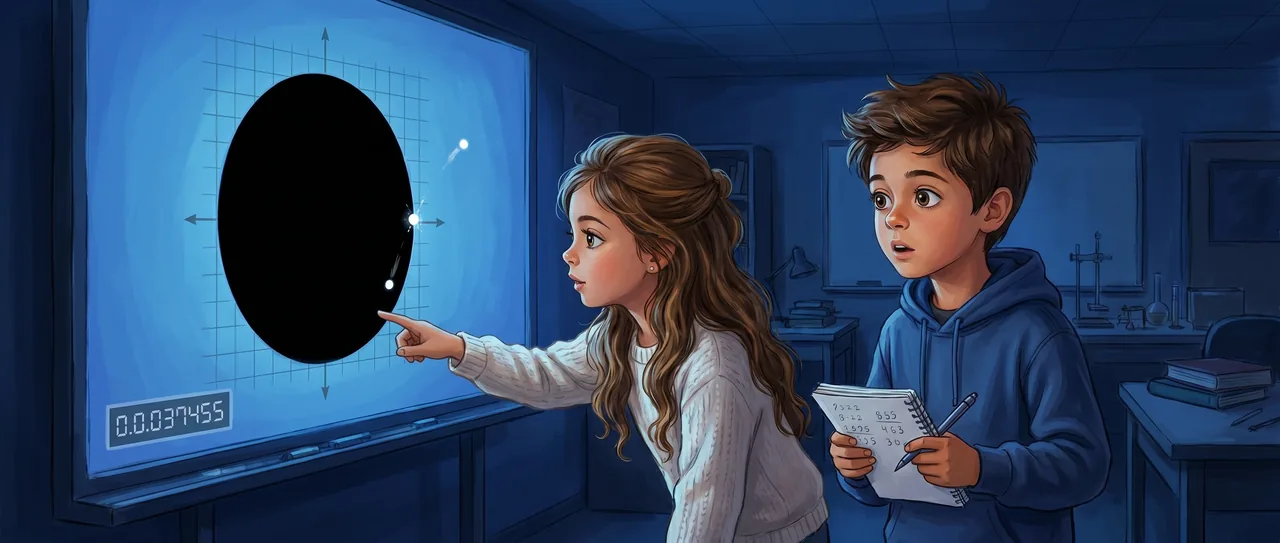
Maya found the door propped open with a copy of Physical Review D, rolled into a fat cylinder and jammed under the hinge. Inside, every light was off except the wall display, which filled the room with a deep blue glow. A simulation was running. Something had been left mid-calculation, and the screen showed a black circle, perfectly round, surrounded by a faint shimmer.
"That's not a screensaver," Soren said behind her.
He was right. The shimmer was moving. Tiny bright dots appeared at the edge of the black circle, flickered, and either fell inward or drifted away. A counter in the corner read mass values, ticking down by amounts so small they needed scientific notation.
"It's losing weight," Maya said.
Soren set his notebook on the nearest desk and leaned closer. "But nothing's coming out of it. Look. The dots that escape, they're appearing outside the circle. They're not crossing the boundary."
Maya had already noticed that. The bright dots never came from inside the black circle. They sparked into existence right at its edge, in pairs, and then one fell in while the other flew free. Every time the free one escaped, the counter dropped.
"How does it get smaller if nothing leaves it?" she said.
Soren traced the edge of the circle with his finger, not quite touching the screen. "The pairs. Watch. They always show up together. Two dots, same spot, same moment. Then they split."
They watched six more pairs appear. Seven. Eight. Each time, the pattern held. Two born together. One swallowed. One freed.
"It's paying for them," Maya said.
Soren looked at her.
"The one that escapes carries energy away. Real energy. So the black hole has to pay for it. It gets lighter." She pointed at the counter. "Every single time."
"But the particles came from outside," Soren said. "The black hole didn't make them. They just showed up."
"At its edge. Because of its edge."
Soren pulled his notebook open and started writing the numbers from the counter. He copied six values, then twelve, then calculated the difference between each. Maya let him work. She was watching something else.
The circle was smaller.
Not by much. But the grid behind it showed faint coordinate lines, and she could see that the boundary had pulled inward by a fraction of a pixel. She pressed her face closer, waiting, and watched another pair appear, split, escape, and the circle shrank again by an amount almost too small to see.
"Soren. How long would this take?"
He was already doing the math. He had the mass loss per event and the event rate and he was scribbling fast, his handwriting getting worse the way it always did when he was excited. He stopped. He underlined a number. He underlined it again.
"Longer than the universe has existed," he said. "For a big one. Way longer. Like, the number doesn't fit on this page longer."
Maya sat on the edge of the desk. "But it does happen."
"It has to. The math works. Every pair that splits costs it something. And nothing stops the pairs from forming. So eventually."
"Eventually it's gone."
They both looked at the screen. The black circle sat there, patient and enormous in simulation, shrinking at a rate that would take longer than anything either of them could imagine to matter. But it was shrinking. Right now. Dot by dot.
The door opened behind them and Dr. Kaur walked in carrying a paper cup of tea, already talking on her phone. She saw them and stopped mid-sentence.
"The outreach kids aren't supposed to be in here," she said, not unkindly, but not waiting for an answer either. She set her tea down and leaned past them to check the simulation. "I left this running to see if the pair-creation rate scaled correctly at lower masses. Has it crashed?"
"No," Maya said. "It's beautiful."
Dr. Kaur glanced at her, then at the screen, then back at her phone. "I need to call you back," she said, and hung up. She looked at the counter and frowned. "The rate is still too uniform. Real quantum fluctuations would be messier than this." She started typing on the keyboard, adjusting parameters, already somewhere else in her head.
"Dr. Kaur," Soren said. "Has anyone actually seen this happen? With a real black hole?"
"No," she said, still typing. "Not directly. The radiation would be incredibly faint for any black hole we can observe. We'd need a very small one, and we've never found one. Or we'd need to wait." She almost smiled. "A very long time."
"But you believe it happens," Maya said.
"The theory is consistent with everything we know about quantum mechanics and gravity. Both of which work. Both of which we've tested." She hit enter and the simulation restarted, the shimmer now uneven, irregular, more like static than breathing. "This version is better. Messier."
She picked up her tea and her phone and moved to a desk on the far side of the room, already dialing again.
Maya and Soren stood in the blue glow. The new simulation was harder to watch. The pairs appeared unpredictably now, clustering and then going quiet, sometimes three at once, sometimes none for long seconds. But the counter still ticked down.
"Nobody has ever seen it," Soren said quietly. "But it means that nothing lasts. Not even the thing that's supposed to be the end of everything."
Maya was quiet for a while.
"You know what gets me?" she finally said. "The universe just does this. All by itself. Empty space at the edge of something that swallows everything, and it keeps making these little pairs, over and over, like it can't help it. And one always gets away."
Soren wrote that down. Then he crossed it out and wrote something shorter.
On the screen, two dots appeared together at the edge of the dark circle, the way they had a hundred times before. One fell in. One drifted out into the blue, carrying with it a piece of something that was supposed to last forever.
The counter ticked down by one.
Read the interactive version, listen to the narration, and earn a gold star →
A science-verified short story for curious kids · Curiosity Land