The Slowest River
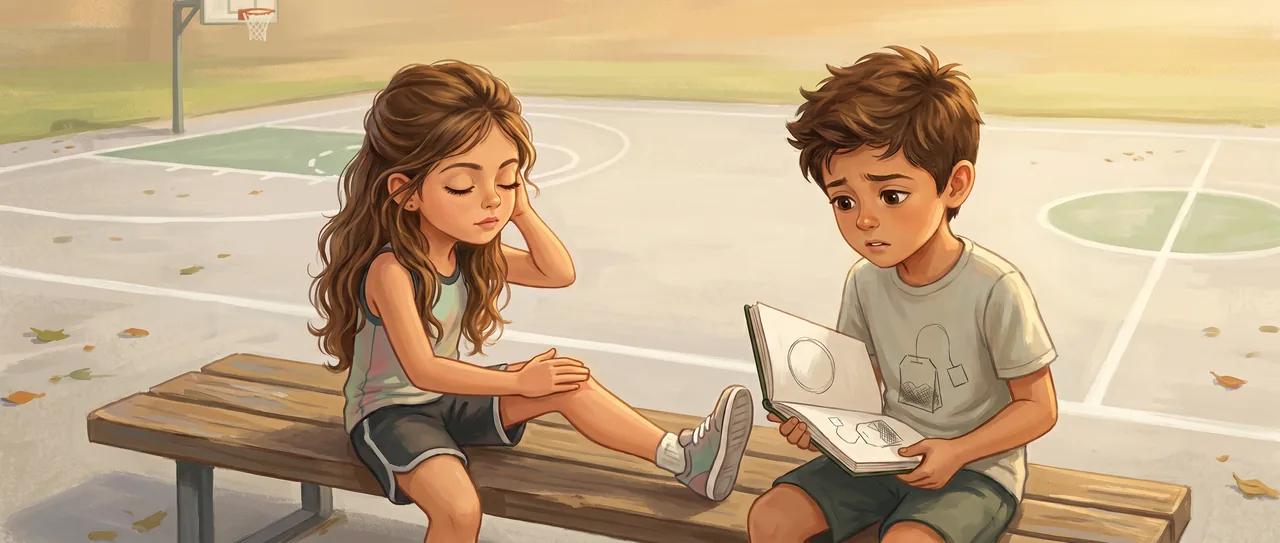
Maya sat on the bench with her leg stretched out and her hands flat on her kneecap like she was holding something in place.
"It popped," she said.
"I heard it," Soren said. He was standing near her but not hovering. He knew she didn't like hovering.
Her older sister Priya had jogged to the parking lot to bring the car closer. The court was emptying out. A few players lingered at the far end, shooting free throws in the late morning light.
"It's not that bad," Maya said. Then she tried to bend it and went very still.
Soren sat down next to her. "Priya said ten minutes."
"I've torn something," Maya said. Not dramatic. Certain. Like she was reading a gauge.
Soren looked at her knee. It wasn't swollen yet. "How do you know?"
"Because it felt like two things sliding past each other that shouldn't."
Soren pulled his notebook from his back pocket. Not to write. He just held it sometimes when he was thinking, the way some people hold a pen.
"My uncle had a cartilage thing," he said. "In his knee. He said it never really healed."
"What do you mean never really healed."
"I mean years. He said the doctor told him cartilage doesn't have blood vessels."
Maya looked at him. "Everything has blood vessels."
"Cartilage doesn't."
"That doesn't make sense. How does it eat?"
That was how Maya talked about cells. How does it eat. Like they were small animals with habits.
Soren opened his notebook to a blank page and drew a circle. "So blood vessels deliver stuff, right? Oxygen, nutrients, whatever. But he said cartilage just sits in fluid. And the nutrients kind of soak in."
"Soak in," Maya repeated.
"Diffusion. Like how a tea bag works. The stuff moves from where there's a lot to where there's less. Slowly."
Maya stared at her kneecap. "So there's tissue in there right now that has no blood supply at all."
"Right."
"And when it gets damaged, there's no blood rushing to fix it. No delivery system."
"Just the fluid around it. Just soaking."
Maya moved her hands slightly, feeling the shape of the joint beneath her skin. "How slowly."
"My uncle had surgery seven years ago. He still can't run."
The court was almost empty now. A ball bounced somewhere and stopped. The concrete radiated heat.
Maya said, "That's why old people have bad knees."
Soren looked at her.
"Not because they're old," Maya said. "Because they were young. Because they hurt something when they were young and it never came back all the way. And then twenty years of walking on it."
"Thirty years," Soren said.
"Forty."
They sat with that.
"So right now," Maya said, "whatever I did in there is just sitting in fluid. Waiting for molecules to find it."
"No ambulance coming," Soren said. "No fire trucks. Just diffusion."
Maya almost laughed but her knee hurt. "That's the worst healing strategy I've ever heard."
"Except it works for most of your life. The cartilage in your ears, your nose, your ribs, between every vertebra in your spine. All of it. No blood. Just fluid."
Maya touched her ear. Squeezed it gently between two fingers.
"That's cartilage," Soren said.
"I know it's cartilage."
"And it's alive. Right now. Fed by nothing but what drifts into it."
Maya held her ear for a long time. Then she pressed her fingers to the bridge of her nose. Then she reached behind her neck and pressed the knobs of her spine.
"I'm full of things with no blood supply," she said.
"We all are."
"Living on the slowest river in the world."
Soren wrote that down. He couldn't help it. The slowest river in the world.
"So why," Maya said, and Soren could hear the list in her head adding an entry, "why doesn't cartilage have blood vessels? Everything else does. Muscles do. Bones do. Bones. Bones have blood supply and they're basically rocks."
"They're not basically rocks."
"They're the most rock-like thing in your body, and they have blood vessels, and the smooth flexible stuff that lets your knee bend doesn't. Why."
Soren had been thinking about this. "Maybe because it can't. Maybe blood vessels would get crushed. Think about what cartilage does. It gets compressed a thousand times a day. Every step. If you ran blood vessels through it, they'd be squeezed shut every time you moved."
Maya went quiet. She was seeing it.
"So it trades healing for function," she said.
"It has to be smooth and slippery and compressible. Blood vessels would wreck that. So it feeds the slow way. And the slow way means it barely heals."
"The thing that makes it good," Maya said, "is the same thing that makes it fragile."
She pressed her palm to her kneecap again. Under her hand was a layer of tissue maybe four millimeters thick. No blood. No vessels. Just cells sitting in quiet fluid, receiving whatever drifted their way. Patient in a way that almost nothing in the body is patient. Alive the way things are alive at the bottom of the ocean, slowly, in the dark, with whatever arrives.
And right now part of that layer was torn or cracked or compressed wrong, and there was no cavalry. There was no alarm system flooding the area with platelets and white blood cells and everything the body throws at a wound. There was just fluid. Just concentration gradients. Just molecules bumping from high to low, the way a tea bag colors water, the way fog enters a room.
"Soren," Maya said.
"Yeah."
"If it heals so slowly, that means what I did today matters for a really long time."
"Yeah."
"Like. Decades."
"Maybe."
She looked at her outstretched leg, at the ordinary shape of her knee, which looked exactly the same as it had an hour ago when she'd jumped for a rebound and come down wrong. Nothing visible had changed.
A car door opened in the parking lot. Priya's voice carried across the court.
Maya didn't move yet. She pressed both palms flat over her knee and held them there, like she was listening to something underneath that had no voice and no blood and no way to call for help, something that would spend the next ten thousand hours trying to fix itself one molecule at a time.
Soren closed his notebook and offered her his arm.
She took it, and stood on one leg, and they walked together across the warm concrete, slowly.
Read the interactive version, listen to the narration, and earn a gold star →
A science-verified short story for curious kids · Curiosity Land