The Slow Wave
The argument started because of the container ship.
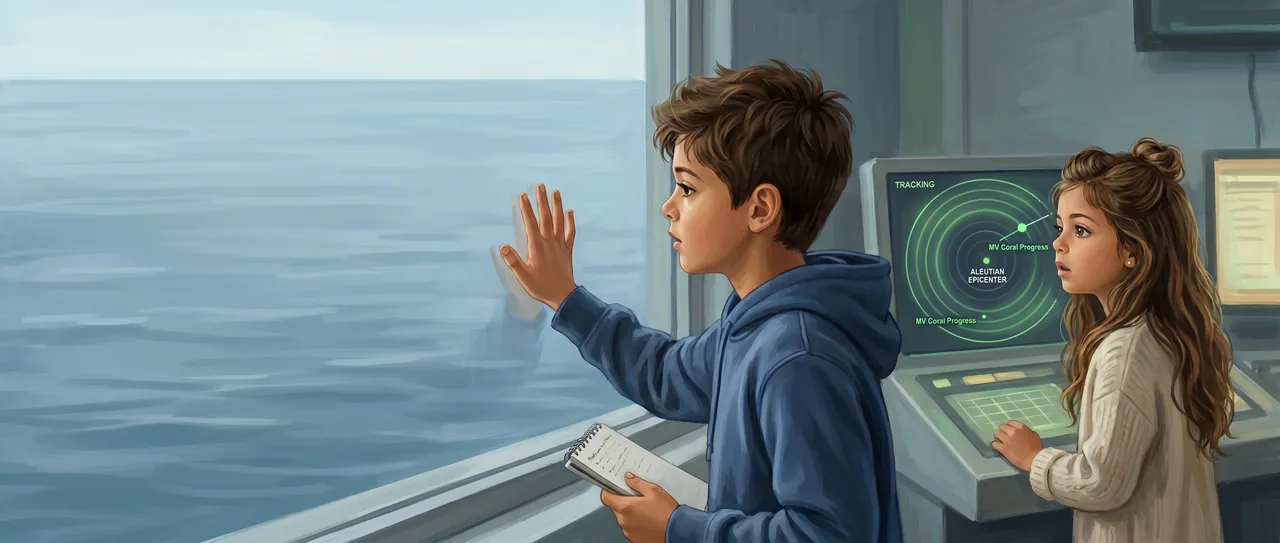
Maya was pointing at the tracking screen in the observation room, where a green dot labeled MV Coral Progress crawled across the Pacific between them and the earthquake that had just happened near the Aleutian Islands. The camp counselors were in the hallway talking in low, serious voices. The other kids had gone to the cafeteria for an early lunch because nobody knew what else to do with them.
But Maya and Soren had stayed, because the screens were still on.
"That ship is right in the path," Maya said. "Look. The wave has already passed it."
Soren leaned closer. The concentric rings on the display showed the tsunami's estimated position expanding outward from the epicenter like ripples in a pond. The outermost ring had already swept past the green dot of the Coral Progress.
"Then the ship is gone," he said. Not dramatically. Just factually.
Maya shook her head. "No. That's what's wrong."
"What do you mean, wrong?"
"The ship is still transmitting. Still moving. Same speed, same course. It didn't even change direction." She tapped the dot. "The wave already hit it and nothing happened."
Soren pulled out his notebook and wrote down the ship's coordinates and the time. Then he wrote: wave passed ship. Ship fine. Question mark.
"Maybe the model is wrong," he said. "Maybe the wave hasn't reached it yet."
"The model says eight hundred kilometers per hour," Maya said. "That's jet speed. The earthquake was three hours ago. Do the math."
Soren did the math. He did it twice. The wave had definitely passed the ship.
"So a wave traveling the speed of a seven forty seven went right under a container ship and the container ship didn't notice."
"Yes."
"That's impossible."
"That's what I'm saying. Something is wrong, or something is really, really interesting."
They stared at the screen. The concentric rings kept expanding. The green dot kept crawling. The numbers on the sidebar updated: estimated wave height in open ocean, zero point four meters.
Soren wrote that down. Then he stopped writing.
"Point four meters," he said. "That's less than half a meter. That's like, knee height."
"In the open ocean," Maya said. She was reading the sidebar too, but a different part of it. "Estimated arrival Honolulu, five hours twelve minutes. Estimated coastal wave height." She paused. "It says twelve to eighteen meters."
Soren looked at her. "How does knee height become eighteen meters?"
"I don't know yet."
"Those are completely different things. Half a meter and eighteen meters. That's not the same wave."
"It is though. It has to be. There's only one wave."
They stood there, both of them stuck, and that was when Dr. Nakata came back in. She was the center's deputy director and she was not a camp counselor. She was short and moved fast and she had clearly forgotten they were still in the room because she said a word that adults usually don't say in front of eleven-year-olds before she noticed them.
"You two. Cafeteria. Now."
"The wave already passed the Coral Progress and the ship didn't notice," Maya said.
"Of course it didn't." Dr. Nakata was already at her workstation, pulling up data. "Ships never notice."
"But the coastal estimate says eighteen meters," Soren said.
Dr. Nakata did not look up. "Correct."
"How," Maya said. Not a question. A demand.
Dr. Nakata was typing. She was clearly not in a teaching mood. She was in the middle of an actual tsunami event, coordinating with stations across the Pacific, and she answered the way people answer when they're working on something else. Impatiently. Incompletely.
"Speed and depth. It's all about the depth. Go to the cafeteria."
She picked up a phone and started talking to someone in Japanese.
Maya and Soren did not go to the cafeteria.
They went to the reference terminal in the hallway, which was basically a computer with a bunch of NOAA bookmarks, and they started pulling up bathymetric charts. Ocean depth maps.
"Speed and depth," Soren repeated. "She said the speed depends on the depth."
"The Pacific is what, four thousand meters deep in the middle?" Maya was scrolling. "And it gets shallow near shore. Obviously."
"So when it's deep, it goes fast."
"Eight hundred kilometers per hour fast. Jet fast."
"And when it's shallow, it slows down."
Maya stopped scrolling. Soren could see it happening, the thing she did where the answer arrived before the explanation. Her eyes went wide.
"Soren. Where does the energy go?"
"What?"
"If it slows down. If four thousand meters of water are pushing this wave along at jet speed and then the water gets shallow and the wave slows down, the energy doesn't just disappear. It has to go somewhere."
Soren's pencil hovered over his notebook. He thought about a car on a highway suddenly hitting a narrow road. He thought about water in a hose when you put your thumb over the end.
"It goes up," he said.
"It goes up."
"The wave gets taller because it can't go fast anymore."
They looked at each other. Soren wrote it down, but slowly, because the shape of it was still assembling itself in his head. A wave you couldn't see, couldn't feel, that a massive cargo ship sailed right over without noticing. Crossing an entire ocean in hours, as fast as the planes overhead. Invisible. Patient. Carrying all of that energy in its body like a held breath.
And then the ocean floor rises to meet it. And the breath becomes a scream.
Soren looked at the tracking screen visible through the doorway. The concentric rings were still expanding, calm and geometric and precise, and every point on every ring was a knee-high ripple moving at the speed of flight, and the entire coastline of the Pacific was the place where the floor would rise and the wave would remember what it was carrying.
Dr. Nakata was still on the phone. The sirens had not started yet. They would soon. The warning would go out and people would move to high ground and the system would work the way it was designed to work.
But right now, out there, the wave was invisible.
Soren pressed his hand flat against the window that faced the ocean, feeling the glass vibrate faintly with the sound of Dr. Nakata's urgent voice, and the sea outside was perfectly, perfectly calm.
Read the interactive version, listen to the narration, and earn a gold star →
A science-verified short story for curious kids · Curiosity Land